
Parking Across Two Bays: When Councils Can Fine You
Can you get a PCN for parking across two bays? We explain Carmarthenshire Council guidance, bay markings, enforcement rules and how to challenge a ticket.

The Parking Ticket Pal Editorial Team
27 November 202610 min read
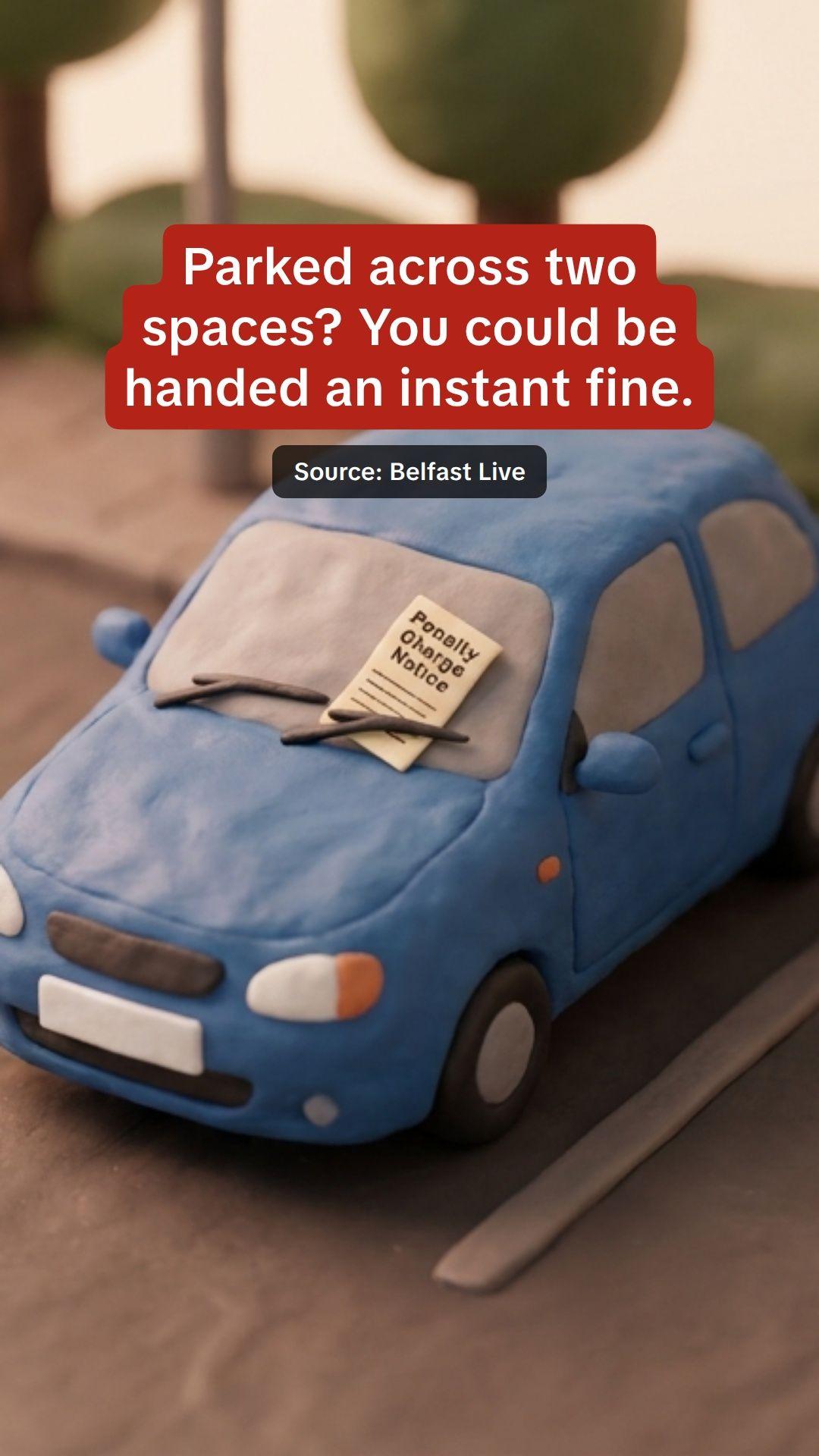
Most of us have seen it. A car straddling the white line, nose in one bay and tail in the next, with a smug sort of confidence that says "I'm only here five minutes." Many drivers assume the worst outcome is a few dirty looks. A council guidance story reported by Belfast Live suggests otherwise.
According to the report, Carmarthenshire Council's guidance says parking beyond the marked bay lines may be a contravention, and councils can issue a penalty immediately when a vehicle takes up more than one space. That is a very different prospect from a grumpy note under the wiper.
Here is what the story says, why it matters, and what drivers should know.
What Happened: The Story in Detail
The report centres on a long-running argument that plays out in car park forums, on social media and in the street. If you pay for a space but your vehicle sits over the line, are you actually breaking any rule?
Going by the summary of the article, the guidance from Carmarthenshire Council indicates that:
- Parking beyond the marked bay lines may amount to a parking contravention.
- A penalty charge notice (PCN) may be issued straight away, without a warning first.
- This can apply when a vehicle takes up more than one space.
I am working from that summary, not a full copy of the guidance, so the exact wording and any exceptions are for the council and the original report to confirm. The broader principle is not unique to one Welsh local authority, though. Councils across the UK enforce bay markings in a similar way, and the "settling" of the debate is really a reminder that bay lines are not decorative.
Why It Matters: The Context Behind the Headline
Bays are legal boundaries, not suggestions
On-street and council-run car park bays are created through traffic orders. The markings define where a vehicle must be to be parked lawfully in that bay. Cross those markings and you may be treated as not parked correctly, regardless of whether you have paid.
That explains why paying for one space does not necessarily protect you if the car takes up two. Your payment buys the use of one bay, parked properly within it.
Why councils care
Councils typically point to a few reasons for enforcing this:
- Capacity. Every space lost to a badly parked car is a space someone else cannot use, which matters in busy town centres and seaside car parks.
- Access. Cars that spill over lines can block neighbouring drivers from opening doors, which particularly affects wheelchair users, parents with children and older drivers.
- Safety. Vehicles that overhang a bay can narrow the carriageway or obstruct sightlines.
Cars are getting bigger, bays are not
Vehicles have grown over the decades, while many older car parks still have bays designed for much smaller cars. That tension is behind a lot of disputes, and our piece on how bigger SUVs are reshaping UK streets explores it further. If your vehicle is large, a tight bay can leave you with a genuine problem, but it does not remove the rule.
The Legal Angle: How These Penalties Work
Council PCNs
In Wales, and in England outside London, councils with civil parking enforcement powers issue PCNs under the framework of the Traffic Management Act 2004 and its associated regulations. Contraventions are categorised by code, and the one that usually applies here is:
- Code 24 (on-street): not parked correctly within the markings of the bay or space.
- Code 86 (off-street): the equivalent in council car parks.
We have detailed explainers on both: PCN code 24: not parked within markings and PCN code 86: not parked in bay markings off-street.
Why "instant" is possible
A civil enforcement officer generally needs to see that a contravention is happening. For some contraventions, such as a pay and display car left beyond its paid time, officers will sometimes allow a period before issuing. For others, including a vehicle clearly outside a bay's markings, there is no general legal requirement to wait. The contravention is occurring at the moment the officer observes it.
That is the practical meaning of "instant fine." There is typically no statutory grace period for this type of contravention, though individual councils may have their own policies on discretion.
How much could it cost?
Penalty levels are set by statute and vary by area and by contravention type. In general, a PCN is reduced by 50 per cent if paid within 14 days, and rises if it goes unpaid. The exact figures printed on the notice are what count, so check the PCN itself or your council's website for current rates.
Your rights to challenge
A PCN is an accusation, not a final verdict. The usual council process runs in stages:
- Informal challenge, usually within the discount period.
- Notice to Owner, if the council rejects that challenge and you have not paid.
- Formal representations to the council on the statutory grounds.
- Appeal to an independent tribunal if those are rejected. In Wales and much of England, this is the Traffic Penalty Tribunal.
Statutory grounds include that the alleged contravention did not occur, or that there was a procedural impropriety by the council. Our guides to crafting an informal PCN appeal, formal representations and the Traffic Penalty Tribunal process walk through each step.
What about private car parks?
Supermarket, retail park and other private car parks work differently. Private operators do not issue PCNs under the Traffic Management Act. They issue "parking charges" under contract law, and, where they pursue the registered keeper, under Schedule 4 of the Protection of Freedoms Act 2012. Terms on the signage define what counts as a breach, and parking outside the marked bay is often one of them. The Supreme Court in ParkingEye v Beavis [2015] UKSC 67 upheld a parking charge as enforceable where it was clearly signed and served a legitimate interest, which is why signage and contract terms matter so much in those disputes. Our guide to private parking charges covers that world in more detail.
What Drivers Should Know: Practical Takeaways
This is general information, not advice on any particular case. With that said, here are some sensible habits.
Before you leave the car
- Check your wheels and bumpers against the lines. It sounds obvious, but a quick glance at both ends of the car can save a penalty.
- Look at the whole bay, not just the front. Reversing in or angling slightly can leave the rear sticking out.
- Remember payment is not permission. A valid ticket or app payment does not automatically cover you for being outside the markings.
- Do not rely on "I was only a minute." There is generally no built-in grace for this contravention.
If the bay is genuinely a problem
Sometimes the fault is not yours, or not entirely. Examples include:
- Worn or faded lines that are hard to see.
- Bays that are clearly too small for a normal vehicle.
- Another driver parked so badly that it forced you out of position.
- Obstructions such as a bollard, a pile of snow or road works that made it impossible to park squarely.
If you choose to challenge a PCN in such circumstances, the strongest cases tend to be backed by evidence. Note that "I couldn't fit" is not automatically a defence, so avoid assuming it will succeed.
If you get a PCN
- Photograph everything. Take pictures of the bay markings, your vehicle's position, the surrounding cars, signage and the condition of the lines. Do it from several angles, ideally before you move.
- Check the PCN itself. Errors in the contravention code, location, date or time, or vehicle details can matter, so read it closely.
- Mind the 14-day window. If you intend to pay, doing so within the discount period halves the cost. If you plan to challenge, check how that interacts with the discount on the notice itself.
- Keep your tone factual. Councils respond best to clear evidence and a concise explanation, not outrage.
- Know the stages. If an informal challenge is rejected, you may have further options, so do not give up automatically if you believe you have a good case.
Disabled drivers and others with access needs
Blue Badge holders sometimes need extra space to get in and out of a vehicle. Badge holders should not assume the badge permits parking outside markings, as bay rules can still apply. Where a bay is genuinely unusable, it is worth raising the design with the council, as well as keeping evidence if challenged. Our guide on Blue Badge holder rights has more.
Looking Ahead: What This Could Mean
The most useful takeaway from this story is not that one council has a hard line. It is that the old assumption, "as long as I've paid, I'm fine," is shaky.
Several trends are worth watching:
- More technology. Enforcement is moving towards cameras and automated systems in many areas. The more evidence there is of exactly where a car sat, the harder it is to argue about it later.
- Pressure on bay sizes. As vehicles grow, there may be growing calls for councils to review the dimensions of bays, especially in older car parks. Whether that translates into action will vary from place to place.
- Local discretion. Because guidance differs between councils, practice can vary. What one authority tolerates, another may treat as an instant contravention.
- Consistency in private parking. With reforms to private parking in the pipeline, the line between council and private enforcement may become clearer for drivers, though the markings issue will still sit in the signage and contract terms.
For now, the sensible approach is simple. Treat the white lines as the legal edge of your space, take a few seconds to check your position, and if you do end up with a notice you believe is unfair, gather your evidence and use the proper process. A few seconds of care on arrival costs far less than a PCN, and the rules are easy to follow once you know they apply.
This article is general information about UK parking and motoring rules, not legal advice. For the specifics of your own PCN, check the notice, your council's guidance, and if the stakes are high, seek independent professional advice. Source: Belfast Live.
Written by
The Parking Ticket Pal Editorial Team
Source-checked parking guidance