
Five ULEZ Charges Without Visiting London: Your Rights
A driver received five £12.50 ULEZ charges despite never entering London. Learn how wrong TfL charges arise, what evidence to keep and how to challenge them.

The Parking Ticket Pal Editorial Team
22 October 2026
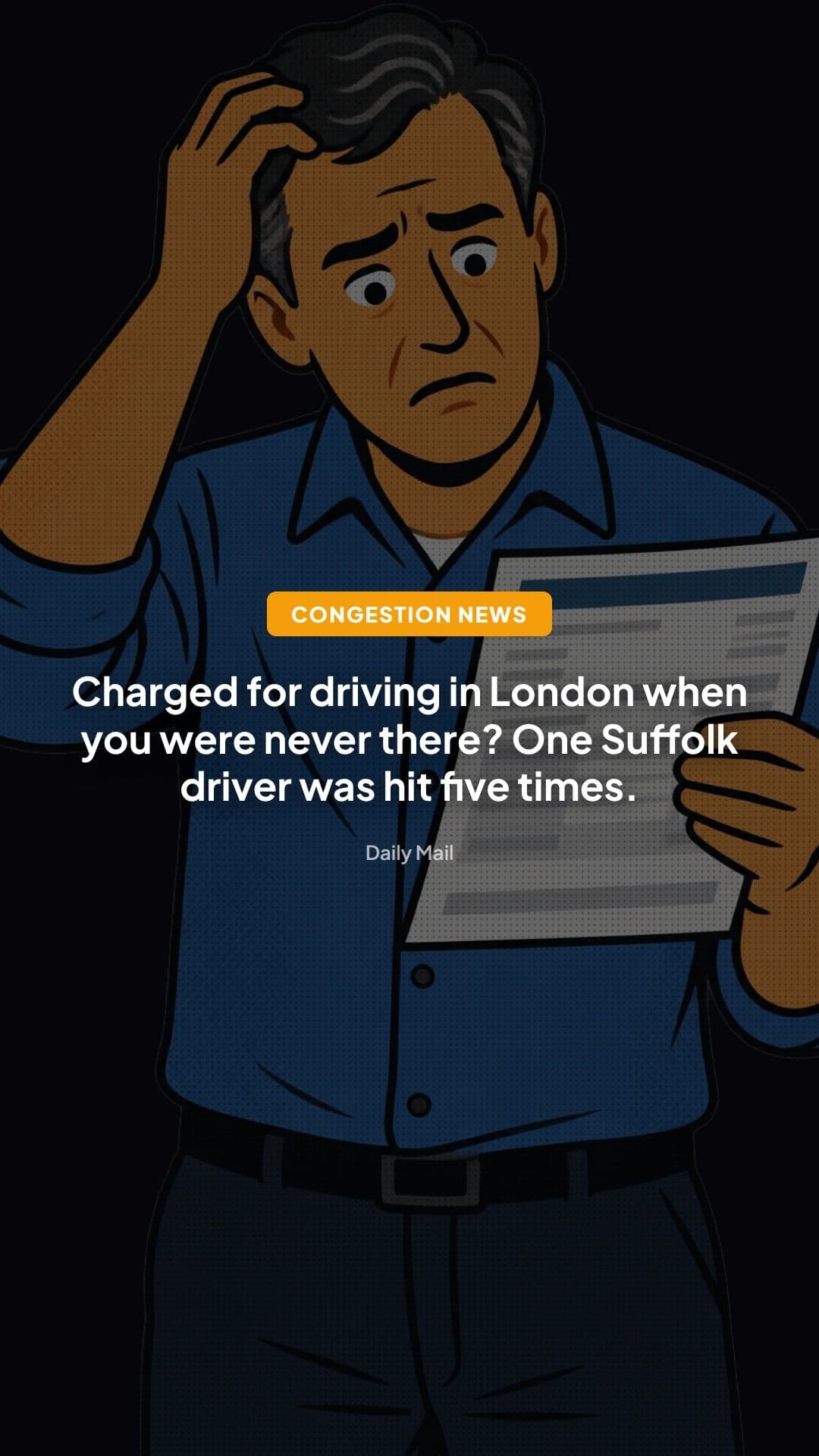
Five ULEZ Charges and No Trip to London: How Can That Happen?
Imagine opening your post or email and finding a demand from Transport for London (TfL) for a charge in a city you haven't visited. Now imagine it happens again. And again. By the fifth, you would be forgiven for wondering whether you had slipped into a parallel universe where your car commutes without you.
That is broadly what a motorist reported to the Daily Mail, which described them receiving five £12.50 ULEZ charges despite saying they had not travelled to London. The details of any individual case are best read in the original article, but the story touches something many drivers worry about: being held responsible for a journey they never made.
What was reported
According to the Daily Mail piece, the motorist was hit with five separate ULEZ charges, each at the standard £12.50 daily rate, even though they say they had not been anywhere near the capital. The article frames it as an example of disputed or wrongly attributed enforcement charges.
The summary does not tell us exactly how the charges arose, and it would be unfair to guess for this particular driver. It is also unclear whether the £12.50 figures were daily charge demands or penalty charge notices (PCNs). The distinction matters. The daily charge is £12.50, whereas the penalty for failing to pay it is considerably higher. TfL's ULEZ PCN has been £180, reduced to £90 if paid within 14 days, so figures can escalate quickly if letters are ignored.
Rather than speculate about one person's experience, it is more useful to look at how this sort of problem can arise in general, what the law says, and how drivers can protect themselves.
How ULEZ enforcement works, and where the cracks can appear
ULEZ now covers all London boroughs. It operates 24 hours a day, every day of the year except Christmas Day. If your vehicle does not meet the emissions standards, you pay £12.50 for each midnight-to-midnight period in which it is driven within the zone. Compliant vehicles pay nothing.
Enforcement relies on automatic number plate recognition (ANPR) cameras. These read the plate, send it to a database, and check it against the DVLA vehicle record and TfL's payment and exemption data. If the plate is flagged as non-compliant and unpaid, a PCN is issued to the registered keeper.
That chain has several links, and an error at any one can produce a charge for someone who was never there:
- Misread plates. A camera can confuse characters such as 8 and B, or 0 and O, particularly in poor light, with dirty plates or at speed. The wrong vehicle can then be matched.
- Cloned or "ringed" plates. Someone copies a legitimate registration onto another vehicle, often one that would be non-compliant. The camera sees a valid plate and TfL pursues the genuine keeper.
- Keeper data problems. If vehicle ownership has recently changed, or records are out of date, the notice can end up with the wrong person.
- Paid but not matched. Sometimes a charge has been paid but linked to the wrong plate or date.
A run of identical charges, as in the reported case, is a pattern that can point towards a persistent cause. A single mistaken camera read tends to be a one-off. Repeated charges for the same registration might suggest something ongoing, such as a cloned plate, though that is only a possibility. Only TfL's evidence can show what actually happened.
The legal angle
ULEZ is not enforced under the same rules as ordinary council parking. It is a road user charging scheme, created under the Greater London Authority Act 1999 and the associated charging orders, with enforcement and adjudication governed by the Road User Charging (Enforcement and Adjudication) (London) Regulations 2001. This is why the appeals route is different from a council parking ticket.
In outline, the process looks like this:
- A PCN is served on the registered keeper. Liability usually rests with the person recorded by the DVLA as the keeper, not necessarily whoever was driving.
- Representations can be made to TfL. These must generally be made within 28 days of the notice being served. The notice itself sets out the grounds and deadlines, and you should read it carefully.
- TfL responds. It can cancel the PCN or issue a notice of rejection.
- An appeal to an independent adjudicator. If representations are rejected, a driver can appeal to London Tribunals, which hears road user charging cases. This is again subject to strict time limits stated in the paperwork.
The permitted grounds are set out in the regulations and on TfL's notices. They typically include situations such as the vehicle not having been in the zone, the charge having been paid, the vehicle having been used without the keeper's consent (for example, stolen), or the person not having been the keeper at the time. "I wasn't there" can therefore be a legitimate ground, but it is one you generally need to support with evidence.
The 28-day windows matter. Ignoring letters because you know you did nothing wrong is a risk. An unchallenged PCN can progress to a charge certificate with an increased penalty, and potentially to debt registration and enforcement agents. If you receive a notice you believe is wrong, the safest general approach is to respond within the stated time and keep copies of everything. For complex or high-stakes situations, independent advice from a solicitor or a consumer advice body is sensible.
What drivers should know
This is general information, not advice on any individual case, but there are some practical points worth understanding.
Check the notice carefully
Look at the date and time of the alleged contravention, the location, the vehicle make and colour, and the registration. Mismatches in these details are often the first clue. Notices should also set out how to challenge them and the deadlines.
Ask to see the evidence
TfL's PCNs usually allow you to view camera images online using the reference number. Compare the vehicle photographed with yours: make, model, colour, distinguishing features, even the style of the plate lettering. If the car in the image is clearly not yours, that can be powerful evidence.
Gather proof of where you were
If you were nowhere near London, think about what records could show it. Examples might include:
- fuel or shopping receipts with date stamps
- work rotas, timesheets or office access records
- phone location history or fitness app data
- dashcam footage
- toll, parking or train ticket records elsewhere in the country
- MOT or servicing records showing the car was in a garage
You do not need every item, but a coherent set of evidence is more convincing than a bare statement.
Consider whether the plate has been cloned
If images suggest a different vehicle carrying your registration, that is a serious matter. Drivers in this position often report it to the police and obtain a crime reference number to include in their challenge. Our existing guides on proving a cloned number plate PCN and how to fight bogus fines from plate cloning go into that scenario in detail.
Check your DVLA record
Make sure your keeper details are accurate, particularly if you have recently bought, sold or moved. An outdated record can send notices to the wrong address, or leave you unaware of letters addressed to you.
Look into ANPR reliability more broadly
Camera errors are a recurring theme in enforcement disputes. Our article on ANPR camera accuracy and how errors are proved explains what evidence tends to matter.
Don't ignore escalating letters
If you believe you have already been wrongly charged and the demands keep arriving, treat each as time-sensitive. Our guide on what to do if you have paid ULEZ but TfL is still chasing you covers the mismatch scenario, and innocent motorists chased by bailiffs looks at what can happen if notices go unanswered.
Keep a paper trail
Keep copies of every letter, email and web submission, with dates. If a dispute drags on, a clear record of what you sent and when can be decisive. Use methods that give proof of delivery where possible.
Know when to seek help
If the sums involved are large, if you are facing enforcement agents, or if you suspect identity-related fraud, independent advice is worth seeking. Consumer advice charities and solicitors can look at your specific circumstances in a way a general article cannot. Official guidance from TfL and London Tribunals explains the formal process.
Why cases like this matter
Automated enforcement is efficient and scalable, but it shifts the burden. Once a PCN lands on your doormat, the practical onus is often on you to show that the system got it wrong. That is workable if you have records and the time to dig them out. It is far harder for someone who is elderly, unwell, or simply overwhelmed by paperwork.
There is also a trust dimension. Clean air schemes depend on public confidence that charges are fair and accurate. Every reported case of an incorrectly attributed charge, whether it ends in a cancellation or not, feeds scepticism about the technology and the process. That does not mean the system is unreliable in general. We do not have verified figures on error rates in this article, and it would be wrong to suggest otherwise. But it does underline why clear evidence disclosure, quick responses to credible challenges and straightforward routes to resolution are important.
Looking ahead
Several trends are likely to shape how such disputes develop.
First, enforcement technology continues to expand, and with it the volume of automated decisions. More cameras and more data matching mean more opportunities for the system to work smoothly, and more for it to get things wrong.
Second, number plate cloning remains a problem for enforcement authorities generally, not just in London. As long as there is a financial incentive to evade charges, innocent keepers risk being swept up. Better plate security, improved data cross-checks and faster police-authority cooperation would help, but progress depends on resources and priorities.
Third, expect continued pressure for transparency. Drivers and campaigners want clearer information on how errors are identified, how quickly they are corrected, and what happens to those who have already paid disputed charges.
For motorists, the message is practical rather than alarmist. Most drivers will never face a wrongly issued ULEZ notice. But if you do, remember that being sure you were not there is a starting point, not a defence in itself. The strongest challenges combine prompt action, careful reading of the notice, evidence of where you actually were, and persistence through the formal process.
If five £12.50 charges can arrive for journeys never made, as the Daily Mail reported, the lesson is simple: open your post, check the details, respond on time, and keep your receipts.
This article provides general information about UK motoring rules and is not legal advice. For guidance on a specific penalty charge, consult TfL's official information, London Tribunals, or a qualified adviser.
Written by
The Parking Ticket Pal Editorial Team
Source-checked parking guidance
Ready to Challenge Your Ticket?
Let our AI analyse your PCN and generate a professional appeal letter in minutes.
Start Free Appeal