
ULEZ Bailiffs Chase Innocent Motorist: Know Your Rights
A driver was chased for unpaid ULEZ fines on a car they never owned. Learn how liability, bailiffs and enforcement errors can be challenged in England.

The Parking Ticket Pal Editorial Team
28 September 2026
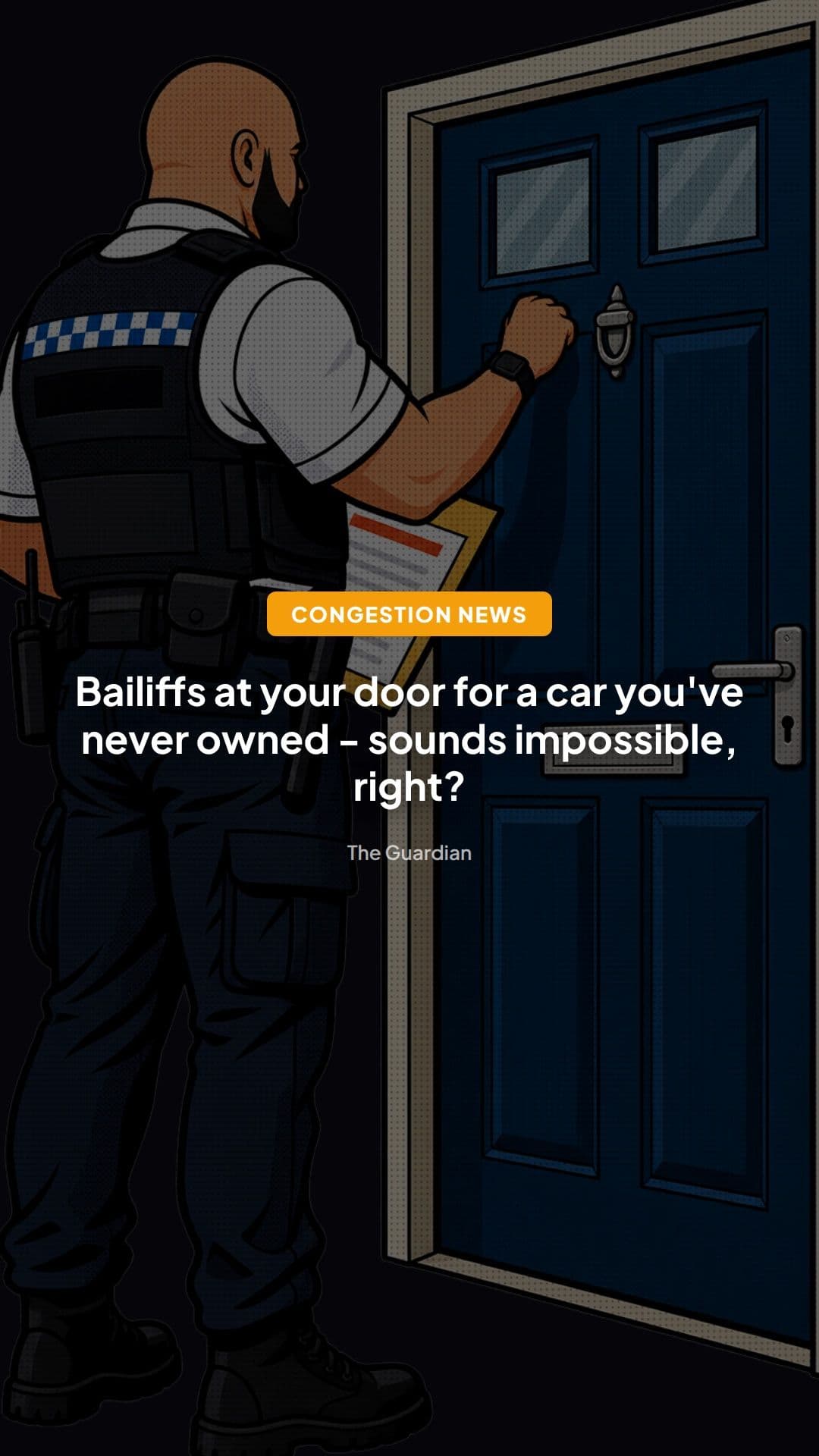
TfL's bailiffs are chasing me for a stranger's unpaid Ulez fines
Imagine opening your front door to find a bailiff on your doorstep, demanding payment for parking penalties on a car you have never owned, driven, or even seen. That is precisely the nightmare recently reported by The Guardian, where a motorist found themselves pursued for four unpaid Ulez penalty charges tied to a vehicle with no connection to them whatsoever. It sounds like the plot of a Kafka novel, but for the person on the receiving end, it is very real, very stressful, and potentially very expensive.
What happened
According to the Guardian's report, the case centres on Transport for London's Ultra Low Emission Zone enforcement system. TfL issues automatic penalty charge notices when a vehicle without a compliant engine, or without having paid the daily charge, is detected by an ANPR camera driving within the zone. When those penalties go unpaid and unchallenged, they escalate through the enforcement process, eventually landing with an enforcement agent, commonly known as a bailiff, who has the legal power to recover the debt, sometimes by seizing goods or clamping vehicles.
In this instance, the motorist says the four penalties relate to a vehicle they have never owned. Somewhere along the chain, from the DVLA's vehicle keeper records through to TfL's enforcement database and onward to the bailiff firm instructed to collect, the wrong person's name and address ended up attached to somebody else's unpaid debt. The result: a stranger's Ulez fines becoming this driver's problem, enforced with all the seriousness that bailiff action implies.
Why it matters
This story matters far beyond one unlucky individual, because it exposes a structural weakness that sits at the heart of London's automated enforcement machinery. Ulez, like the congestion charge and most borough parking enforcement, relies heavily on data matching. A camera reads a number plate, that plate is checked against a database of registered keepers held by the DVLA, and a penalty notice is generated and posted to whoever's name appears against that registration at that moment in time.
The system works well most of the time, but it is only as reliable as the records feeding it. Vehicles get sold and the paperwork lags behind. Number plates get cloned and used on unrelated cars. Data entry errors creep in when registration numbers are transcribed. Multiple similar-sounding names or addresses can occasionally get muddled during the transfer between agencies. Any one of these failure points can send an enforcement letter, and eventually a bailiff, to entirely the wrong door.
We have covered similar territory before when looking at what happens when drivers are chased for penalties on cars they sold, and separately when examining how cloned number plates can generate bogus fines for innocent owners. This case fits the same pattern, but with an added layer of anxiety: it is not just a letter demanding payment, it is a bailiff, someone with statutory powers to remove goods from a person's home to satisfy a debt.
The wider implication is one of trust. If TfL's systems can misattribute penalties so badly that a stranger's debt reaches enforcement stage, how confident can any driver be that the PCNs landing on their own doormat genuinely belong to them? For a city that increasingly polices its roads through cameras and automated systems rather than human traffic wardens, this story is a pointed reminder that automation without robust human checks and balances can go seriously wrong, and the person left picking up the pieces is rarely the one who made the mistake.
The legal angle
Understanding why this matters legally requires a quick look at how Ulez penalties are enforced. TfL issues a PCN under the London Local Authorities and Transport for London Act, and if it is not paid or successfully challenged within the statutory timeframe, it can be registered with the Traffic Enforcement Centre as an unpaid debt. Once registered, TfL can apply for a warrant of control, which allows enforcement agents, bailiffs, to take control of goods belonging to the debtor to recover the sum owed, plus their own fees.
Crucially, the person named as the debtor should be the registered keeper of the vehicle at the time of the alleged contravention, as recorded with the DVLA. If that record is wrong, outdated, or has been incorrectly matched, the wrong person can be pursued through no fault of their own.
There are established legal remedies for exactly this scenario. A driver who genuinely was not the keeper of the vehicle in question, and who was never properly served with the original penalty notice, can apply to the court using a statutory declaration, commonly known as the TE7 and TE9 forms, to have the case reopened and the warrant set aside. We have written previously about how these statutory declarations work and the deadlines involved, and this remains one of the most important tools available to anyone wrongly pursued for a debt that is not theirs.
It is also worth knowing that once a warrant of control has been issued, bailiffs have specific legal obligations under the Taking Control of Goods Regulations 2013. They must issue a compliance notice, allow a reasonable period before enforcement action, and follow strict rules about what can and cannot be taken. If a bailiff has acted outside these rules, or has continued enforcement action after being told clearly that the debt does not belong to the person being pursued, there are formal complaint routes available, including through the bailiff's trade body and, in serious cases, the courts.
There is also the underlying question of data protection. Under the UK GDPR and Data Protection Act 2018, both the DVLA and TfL have obligations to ensure personal data used for enforcement purposes is accurate. A driver who can demonstrate they have been wrongly linked to a vehicle and its associated debts may have grounds to challenge the accuracy of the records held about them, separate from disputing the penalty itself.
What drivers should know
If you ever find yourself contacted by bailiffs over a penalty that has nothing to do with you, the instinct to panic is understandable, but a clear head and a paper trail matter far more than urgency.
Do not ignore correspondence, even if you believe it is a mistake. Silence can allow enforcement to escalate. Respond promptly, in writing, setting out clearly why you dispute liability.
Gather your evidence early. This might include proof you never owned the vehicle, such as your own vehicle's V5C logbook, insurance documents, or a DVLA vehicle enquiry showing a different keeper. If you did once own the car but sold it, retain the sale receipt or notification of transfer sent to the DVLA.
Check who the debt is actually registered against. You can request a full breakdown of the case from TfL or the enforcement agency, including the original PCN, the vehicle registration, and the name and address used for enforcement purposes.
Use the statutory declaration route where appropriate. If you were never the keeper and never received the original notice, the TE7 and TE9 process allows you to ask the court to set aside the warrant and reopen the case for a proper challenge.
Complain formally if a bailiff continues after being told of the error. There is a structured process for raising concerns about bailiff conduct, and it is worth pursuing if enforcement continues despite clear evidence being provided.
Consider contacting the DVLA directly if you suspect your details have been wrongly linked to a vehicle, since incorrect keeper records are often the root cause of these mix-ups.
Anyone facing an active bailiff visit or clamping threat over a disputed debt should treat it seriously and, where the sums or stress involved are significant, seek advice from a solicitor, Citizens Advice, or a specialist parking appeals service rather than trying to resolve it alone under pressure.
Looking ahead
Cases like this one raise uncomfortable questions for TfL about the reliability of its data matching processes, particularly as London's Ulez and congestion charge enforcement becomes ever more automated and camera dependent. As enforcement volumes grow, so too does the risk of these errors multiplying, and each one erodes public confidence in a system that already attracts plenty of scrutiny and criticism.
For ordinary drivers, the lesson is a sobering one. Even those who have never driven into central London, never owned a polluting vehicle, and never received so much as a parking ticket cannot assume they are safe from being caught up in someone else's enforcement nightmare. Keeping vehicle records up to date, responding promptly to any unexpected correspondence, and knowing the statutory declaration process exists could be the difference between a quickly resolved administrative error and a genuinely distressing brush with the bailiffs.
Written by
The Parking Ticket Pal Editorial Team
Source-checked parking guidance
Ready to Challenge Your Ticket?
Let our AI analyse your PCN and generate a professional appeal letter in minutes.
Start Free Appeal