
AA Calls for Urgent Reform of Blanket 20mph Speed Limits
AA president Edmund King urges councils to target 20mph speed limits where needed, as speeding tickets rise and Birmingham plans wider restrictions.

The Parking Ticket Pal Editorial Team
30 October 2026
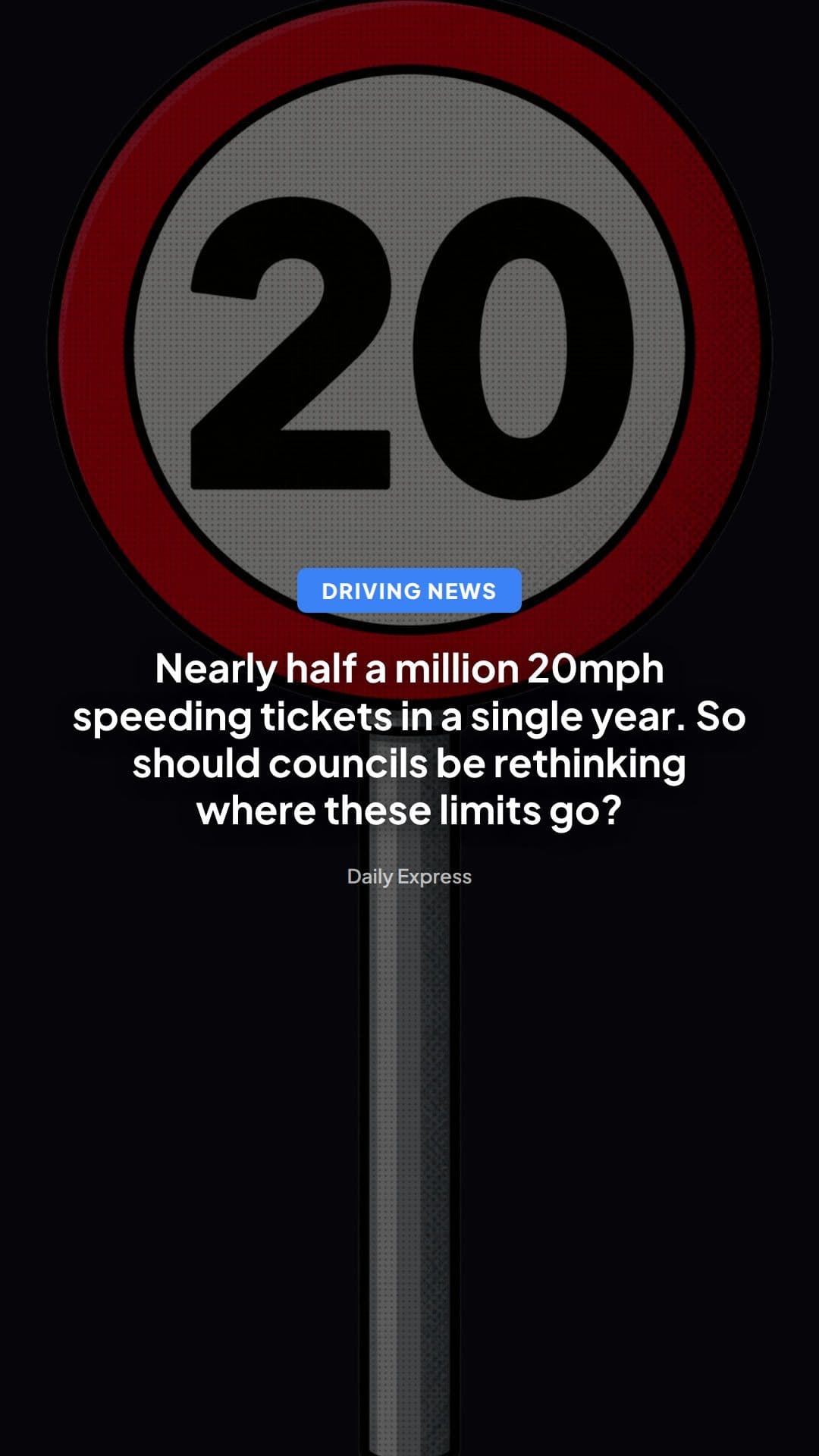
AA Chief Wants 20mph Limits Used Selectively: What the Row Means for Drivers
Few road signs divide opinion like the little red circle with a "20" in it. For some, it means quieter streets and children who can walk to school. For others, it means crawling along an empty road with one eye on the speedometer and the other on the nearest lamppost, wondering whether it hides a camera.
That tension has returned to the headlines. AA president Edmund King has called for councils to use 20mph limits selectively rather than applying them broadly across whole areas. The Daily Express report puts the issue in sharp relief, noting nearly half a million 20mph speeding tickets in the previous year, and highlighting plans to extend restrictions in Birmingham.
This post looks at what is being argued, why the numbers matter, how the law works, and what drivers can do to stay on the right side of it.
What the story says
The core of the AA's position, as reported, is not that 20mph limits are wrong. It is that they should be targeted. The argument is that councils should put them where they make the most sense, such as outside schools, in busy shopping streets and in residential areas with lots of pedestrians and cyclists, rather than switching whole networks of roads to 20mph at once.
The article pairs that call with two headline facts:
- Nearly half a million 20mph speeding tickets were reported in the previous year.
- Birmingham plans to extend its 20mph restrictions, which adds to a trend of towns and cities lowering limits.
We should be careful about what the ticket figure proves. A big number can mean many things. It could mean lots of drivers are doing something dangerous. It could mean limits are being set where drivers do not find them credible. It could mean enforcement technology is catching more people. Or it could be some mix of all three. The figure alone does not settle the argument, but it does show how many ordinary motorists are now facing penalties in 20mph areas.
Why the "selective" argument matters
The policy debate here is really about credibility. Speed limits work best when drivers understand why they exist. A 20mph limit outside a primary school at 8.30am is intuitive. A 20mph limit on a wide, straight road with few houses and no obvious hazard can feel arbitrary, and drivers tend to drift above limits they do not respect.
That is the heart of the selective approach: if 20mph appears where the risk is obvious, compliance should be easier and the limit more defensible. If it appears everywhere, there is a risk that drivers treat it as background noise, and those who slip over by a few miles per hour are drawn into the enforcement net.
The other side of the argument deserves a fair hearing too. Supporters of wide-area 20mph limits point to simplicity. If a whole neighbourhood is 20mph, there is no guessing about where the limit changes, and no pedestrian has to judge whether this street is a "20 street". The Highway Code figures also illustrate why speed matters so much in built-up areas: typical overall stopping distance is about 12 metres at 20mph, compared with about 23 metres at 30mph. That gap is the basis of the safety case, and it is one reason many councils have taken the broad approach.
So the debate is less "20mph good or bad" and more "where, how consistently, and how enforced". Wales, for instance, moved its default limit on restricted roads from 30mph to 20mph in September 2023, then saw a political and practical debate about which roads should be exceptions. That experience shows how hard it is to get a blanket rule to feel right on every road. We cover the wider English picture in our post on why 20mph limits are spreading across UK towns and cities.
The legal angle: who sets limits, and who enforces them
Councils set the limits
In Great Britain, local traffic authorities have the power to set speed limits on their roads through Traffic Regulation Orders under the Road Traffic Regulation Act 1984. Roads with street lighting (lamps no more than 200 yards apart) are generally treated as restricted roads with a 30mph limit unless signs say otherwise. A council that wants a 20mph limit must make an order and put up the appropriate signs, either 20mph roundels, or a "20 zone" with entry signs and repeaters or traffic calming.
National guidance expects limits to be evidence-led and, ideally, self-explaining to drivers. That is where the AA's call for more selectivity fits in. It is an argument about how councils exercise a power they already have, rather than a call to change the underlying law.
The police enforce them
This surprises many people: councils generally cannot issue speeding penalties in England. Speeding is a criminal offence, so enforcement is by the police, using cameras, patrols and mobile units. Council parking tickets (PCNs) are civil penalties and work very differently, which is why this issue sits in a different bucket from the parking rules we usually cover.
For a typical speeding offence, the consequences are:
- A fixed penalty of £100 and three penalty points, in most cases.
- A speed awareness course may be offered instead, at the discretion of the police, usually for lower-level offences and generally to those without a recent course or a poor record.
- Court proceedings for higher speeds or where a fixed penalty is not offered, with fines linked to income and a maximum of £1,000 for most roads (£2,500 on motorways).
- Disqualification is possible for a serious offence, or if you reach 12 points within three years under the "totting up" rules.
New drivers face an extra danger. Under the Road Traffic (New Drivers) Act 1995, six or more points within two years of passing your test leads to your licence being revoked.
The "tolerance" myth
Police forces follow National Police Chiefs' Council guidance, which commonly leaves a margin of 10 per cent plus 2mph before enforcement action is normally considered. In a 20mph limit, that works out at around 24mph. Crucially, that is guidance and discretion, not a legal right. The limit is 20mph, and a driver at 22mph is technically committing an offence even if a ticket is unlikely. Individual forces and individual cases can vary. We debunk more of these in our guide to UK speeding rules and the myths that could cost drivers dearly.
The paperwork rules
If a camera catches you, you will usually receive a Notice of Intended Prosecution within 14 days of the offence (Road Traffic Offenders Act 1988). The registered keeper is legally required to tell the police who was driving when asked, normally within 28 days, under section 172 of the Road Traffic Act 1988. Failing to respond can bring its own penalty, so it is important not to ignore the letter.
What drivers should know in practice
None of this is legal advice, and what applies to you depends on your circumstances. But some general points help anyone who drives through 20mph areas.
1. Know what kind of 20mph area you are in. Look out for the red-ringed roundel and repeater signs on lamp posts. A "20 zone" may have signs only at the entrance, and the limit applies to every road inside until you pass a sign ending it. A lot of confusion comes from drivers assuming a limit has ended when it has not.
2. Do not rely on your speedometer alone. Speedometers are permitted to over-read but must not under-read, so yours may show a little higher than your true speed. At 20mph, though, a couple of miles per hour is a large proportion. A satnav or phone navigation app can offer a useful cross-check, though neither is a legal measure. Many newer cars also have speed limit warning or assistance systems, but these can misread signs or hold outdated map data, so they are an aid, not a defence. See our piece on speed limit warning tech getting it wrong.
3. Pay particular attention on roads where the limit has recently changed. Roads that were 30mph last year may now be 20mph, and habit is powerful. Check local council announcements if you regularly drive in a city that is rolling out changes. If you drive in Birmingham, our guide to Birmingham's 20mph plans explains what is proposed.
4. Use the tools you have. Cruise control or a manual speed limiter set to 20mph removes much of the guesswork on suitable roads, though it is no substitute for paying attention to pedestrians, parked cars and junctions.
5. If you receive a Notice of Intended Prosecution, read it carefully. Check the date, time, location and vehicle details, and note the response deadline. If you are unsure of your options, such as whether a speed awareness course is offered, seek independent advice from a solicitor or a motoring organisation. The official guidance on gov.uk explains the process for responding. Remember that any dispute about the limit itself, for example whether signs were missing or inadequate, is a legal question that should be considered carefully before you rely on it. Technical sign challenges can succeed in some cases, but they depend heavily on the specific facts and evidence.
Wider implications
The AA's intervention may not change the law, but it adds weight to a growing debate about how limits should be set. Here is what to watch.
Pressure on councils to justify their approach. If critics argue that blanket limits drive up non-compliance and enforcement, councils may face calls to show their reasoning, road by road. Some may adjust their plans, especially where limits have proved unpopular locally. We have already seen some reversals elsewhere, covered in our post on 20mph limits being reversed.
Possible national policy shifts. There is ongoing discussion about whether a national default of 20mph in built-up areas might be introduced in England. Our summary of what MPs are proposing on a 20mph default sets out where that stands.
Enforcement technology. As automated cameras and AI-based detection become more common, the likelihood of being caught for small excesses may grow, and the debate over proportionality will go with it.
A rising number of drivers affected. If towns like Birmingham extend limits further, more motorists will be driving at 20mph on roads that used to be 30mph. Driver behaviour, rather than policy statements, will determine whether the figure of nearly half a million tickets rises or falls.
The bottom line
Whether you love or loathe 20mph limits, the practical position is the same: the limit is the limit, and the penalty for breaching it is a criminal one, with points that can build up quickly. The AA's call for a more selective approach is a fair challenge to how councils use their powers, and it may shape how limits are designed over the coming years. But for now, the safest course for drivers is to know exactly which limit applies on the road in front of them, check their speed, and keep a close eye on local changes.
This article is general information about UK motoring rules and is not legal advice. For guidance on a specific notice or offence, consult the official gov.uk guidance or a qualified professional.
Written by
The Parking Ticket Pal Editorial Team
Source-checked parking guidance
Ready to Challenge Your Ticket?
Let our AI analyse your PCN and generate a professional appeal letter in minutes.
Start Free Appeal