
Why 20mph Limits Are Spreading Across UK Towns and Cities
More UK councils are introducing 20mph limits. Explore the safety evidence, local authority powers and what lower speed limits mean for drivers on local roads.

The Parking Ticket Pal Editorial Team
29 September 2026
Why are more towns and cities moving to 20mph?
Slow down, save a life? The debate dividing British streets
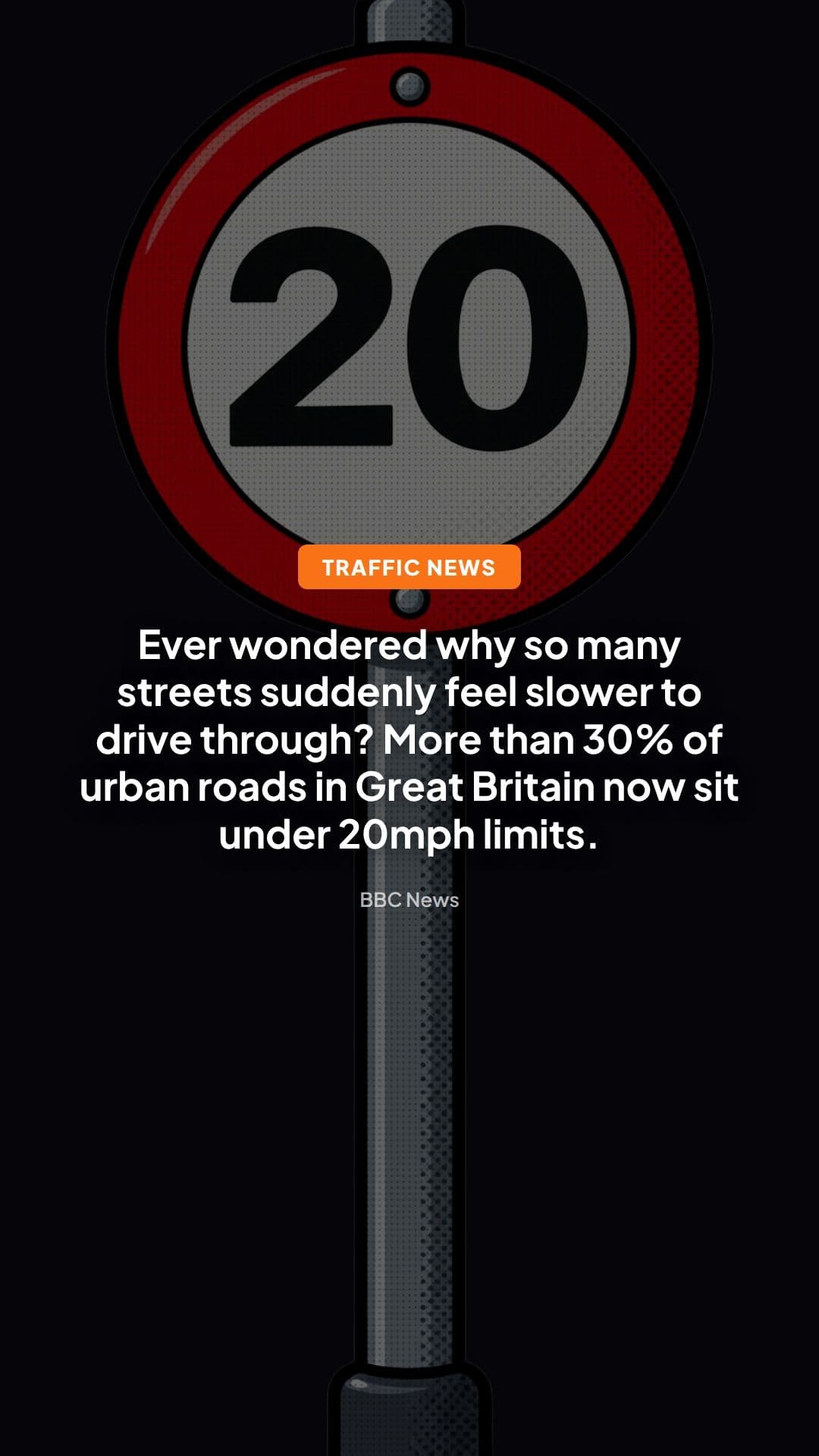
Drive through almost any residential area in the UK these days and you'll likely spot the same circular white sign with "20" emblazoned across it. What was once a rarity outside schools has become the default speed limit on countless streets from Cardiff to Edinburgh, and the trend shows no sign of slowing (pun very much intended). But behind those simple signs lies a genuinely contentious debate about road safety, personal freedom, and whether blanket speed restrictions actually work as intended.
The BBC's recent examination of this shift highlights a story that's been unfolding gradually across the country for years, and one that touches nearly every driver in Britain in some way.
What's actually happening on our streets
The core story is straightforward: more local authorities are introducing 20mph limits on residential roads, replacing the traditional 30mph default that has governed built-up areas for decades. According to the BBC's reporting, supporters argue that lower speeds improve safety and save lives, and councils are increasingly adopting these restrictions as standard practice rather than exception.
This isn't a single national policy but a patchwork of local decisions. Wales made headlines in 2023 by becoming the first UK nation to set 20mph as the default limit on restricted roads (essentially, roads with street lighting) rather than 30mph. England and Scotland have taken a different approach, allowing individual councils to decide whether to introduce 20mph zones, often street by street or neighbourhood by neighbourhood.
The result is a genuinely mixed picture. Some cities, such as Bristol, were early adopters of widespread 20mph limits. Others have moved more cautiously, introducing them near schools, parks, or in specific residential zones while leaving arterial roads at 30mph. This piecemeal approach means drivers travelling between different areas can encounter frequent changes in speed limit, sometimes within the same short journey.
Why this matters more than you might think
The push towards 20mph limits isn't happening in a vacuum. It reflects a broader shift in how councils and central government think about urban road design, one that prioritises vulnerable road users (pedestrians, cyclists, children) over the convenience of motor traffic.
The safety argument centres on physics as much as policy. A pedestrian struck by a vehicle travelling at 20mph is statistically far more likely to survive than one hit at 30mph, largely due to reduced stopping distances and lower impact forces. This is the foundation supporters point to when justifying the switch, and it's difficult to argue against the basic principle that slower speeds reduce the severity of collisions.
But the debate isn't purely about safety statistics. There's a cultural and practical dimension too. Critics argue that blanket 20mph limits on roads that were never particularly dangerous simply frustrate drivers without meaningful safety benefit, potentially breeding resentment and non-compliance. There's also a persistent concern about enforcement: a speed limit without meaningful enforcement is, in the eyes of many motorists, little more than a suggestion.
This tension between "safer streets" and "unnecessary restriction" isn't going away. As more councils weigh up local 20mph schemes, expect continued disagreement about where the limits should apply, how they should be enforced, and whether resources would be better spent on infrastructure changes such as road narrowing, speed bumps, or better crossings rather than simply changing the number on a sign.
The legal angle: what the law actually says
For drivers, understanding the legal framework around 20mph zones is essential, not least because getting it wrong can result in points on your licence and a fine.
How 20mph limits are created
Under the Road Traffic Regulation Act 1984, local authorities have the power to set speed limits on roads within their jurisdiction, subject to Department for Transport guidance. This means a 20mph limit isn't simply decorative. Once properly signed and implemented through a Traffic Regulation Order (TRO), it carries the same legal weight as any other speed limit.
There's an important distinction between a "20mph zone" and a "20mph limit". A 20mph zone typically includes traffic-calming measures such as speed humps or chicanes and, crucially, doesn't always require repeater signs throughout because the physical measures reinforce the limit. A 20mph limit, by contrast, is usually signed without physical calming measures and does require repeater signage at regular intervals under the Traffic Signs Regulations and General Directions.
This matters for drivers because it affects enforceability. If a council fails to sign a 20mph limit correctly, in theory this could form the basis of a legal challenge to any resulting penalty, though such cases can be complex and fact-specific.
Penalties for breaching a 20mph limit
Speeding in a 20mph zone is treated the same as speeding anywhere else. You could face a Fixed Penalty Notice with three penalty points and a fine, or in more serious cases, a court summons. The actual fine is calculated as a percentage of weekly income, with minimum and maximum thresholds set out in sentencing guidelines. Persistent or excessive speeding can lead to disqualification.
Wales's default 20mph law, introduced under the Restricted Roads (20mph Speed Limit) (Wales) Order 2022, technically reversed the presumption: roads with street lighting are now 20mph unless specifically signed otherwise as 30mph. This is a meaningfully different legal structure to England, where 30mph remains the default and 20mph must be actively introduced and signed.
What drivers should know
Navigating this evolving landscape doesn't need to be stressful, but a bit of awareness goes a long way.
Pay attention to signage, especially in unfamiliar areas. Because 20mph adoption varies so much by council, you can't assume a residential street will be 30mph just because it looks similar to one you know elsewhere. Watch for the circular signs and repeater markings, particularly near schools, parks, and high pedestrian footfall areas.
Understand the difference between zones and limits. If you're driving through an area with obvious traffic calming (speed bumps, narrowed carriageways), that's a strong hint you're in a 20mph zone even if you momentarily miss a sign.
Be aware that enforcement is increasingly automated. Many councils are investing in average speed cameras and mobile enforcement units specifically for 20mph zones, particularly around schools. Don't assume a lack of visible police presence means a lack of enforcement.
If you receive a speeding penalty in a 20mph zone, check the basics first. Was the limit properly signed? Was there a valid Traffic Regulation Order in place? These questions matter, though genuinely successful challenges usually depend on specific procedural failures rather than simply disagreeing with the limit itself. If you believe there's a real problem with signage or the underlying order, it's worth seeking a solicitor's advice or consulting official DVLA and DVSA guidance before assuming a fine can be easily overturned.
Consider practical driving adjustments. In areas with widespread 20mph limits, journey times may increase marginally, but the safety trade-off, particularly near schools and residential areas with children, is generally considered worthwhile by road safety bodies including Brake and RoSPA.
Looking ahead
The direction of travel, quite literally, seems clear. More councils are likely to introduce 20mph limits in coming years, particularly in residential areas and around schools, as part of broader "Vision Zero" style road safety strategies aimed at eliminating serious injuries and deaths on the roads.
Whether this becomes a truly national standard, as it effectively has in Wales, or remains a patchwork of local decisions in England and Scotland, is likely to depend on political appetite and how contentious individual schemes prove to be. Wales's experience has been closely watched, and how public opinion there evolves may well influence whether other UK governments consider similar blanket approaches.
For drivers, the practical takeaway is simple: pay attention to your surroundings, don't assume speed limits based on habit or the type of road, and expect the trend towards lower urban speed limits to continue rather than reverse. As always with UK motoring law, ignorance of a properly signed limit is rarely an accepted defence, so a moment's extra attention behind the wheel is a small price for avoiding penalty points, and potentially, for avoiding a much more serious outcome altogether.
Written by
The Parking Ticket Pal Editorial Team
Source-checked parking guidance
Ready to Challenge Your Ticket?
Let our AI analyse your PCN and generate a professional appeal letter in minutes.
Start Free Appeal