
£42m 20mph Limits Reversed: What Drivers Need to Know
Councils have spent £42m rolling out 20mph speed limits in three years, yet some roads are returning to higher limits. See the cost and impact for UK drivers.

The Parking Ticket Pal Editorial Team
23 October 2026
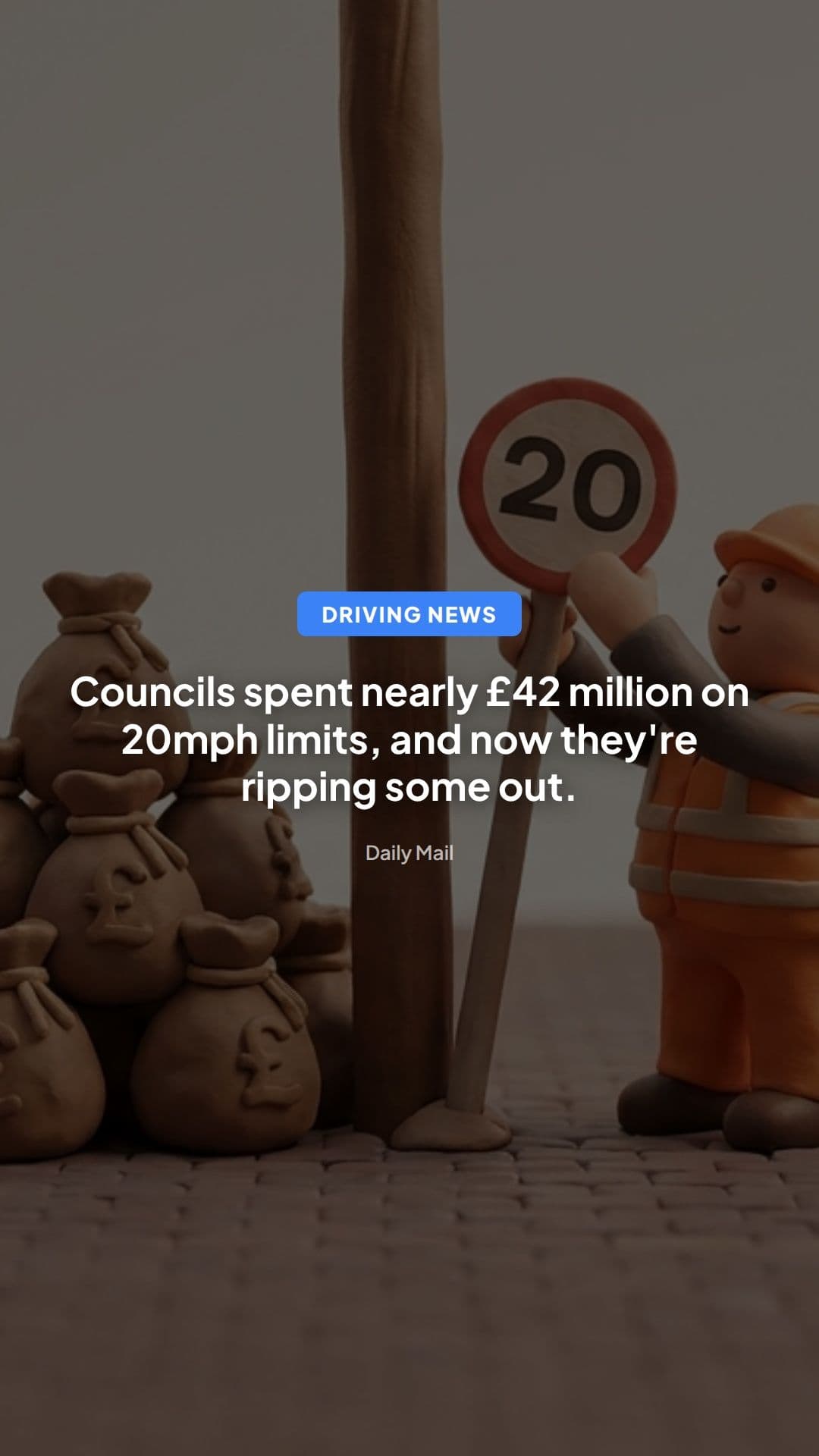
£42m on 20mph Limits, Then Some Are Reversed: What Drivers Need to Know
Few things in motoring stir up stronger feelings than a speed limit sign. Drop one from 30mph to 20mph and you can expect petitions, angry social media threads and, increasingly, a stack of cash spent on the change. Now a Daily Mail report has put a price tag on the trend, and it makes uncomfortable reading for councils.
According to the report, councils have spent £42 million introducing 20mph limits over three years, with some roads now reverting to their previous, higher limits. It is a striking figure, and the reversals raise a bigger question: what happens when a policy that cost millions to install is partly undone?
This post looks at what the story suggests, how speed limits are actually changed in law, and what it means for your licence.
What the report says
The Daily Mail's piece centres on two points:
- Councils spent around £42 million over three years introducing 20mph limits.
- Some of those roads are now going back to higher limits, meaning further spending to undo the change.
The headline figure should be read with some care. The report does not, as far as the summary tells us, suggest that every scheme has failed or that most have been reversed. It says some roads are reverting. Nor does a spending total tell you whether the schemes delivered safety benefits. Cost and outcome are separate questions.
Still, the reversals matter. Changing a speed limit is not as simple as swapping a sign. Every change involves legal paperwork, consultation, new or altered signage and sometimes road markings. If a limit goes down and then back up, much of that work is repeated.
Why would a council reverse a 20mph limit?
The report's summary does not break down the reasons, so I will not guess at individual councils. But there are some well-established reasons why limits get reviewed, and the wider debate gives useful context.
Political and public pressure. A 20mph limit applied broadly, rather than road by road, can catch routes where drivers and residents feel 30mph, or higher, is sensible. Complaints build, and councillors respond.
Changes to national or devolved guidance. Wales introduced a default 20mph limit on restricted roads in September 2023. Following a backlash, the Welsh Government revised its guidance to give councils more flexibility over which roads should revert to 30mph. That was a clear example of a policy being refined after launch, though the details are for the Welsh Government's own guidance rather than this English-focused story.
Local reviews. Councils may find that compliance is poor on certain roads, that a bus route or main road was caught by a blanket approach, or that traffic has simply moved elsewhere.
None of this means 20mph limits are failing. Supporters argue they make residential streets safer and calmer, and many councils are keeping them. If you want the broader debate, we have covered it in our posts on why 20mph limits are spreading across UK towns and cities and 20mph limits: safer streets or tougher enforcement.
Why the cost matters to drivers
You might think a council's spending on signs is not your concern. But local authority budgets are finite, and money spent on speed limit schemes is money not spent elsewhere. Highways teams juggle pothole repairs, resurfacing, crossings and road safety schemes from the same overall pot.
There is also a transparency point. When a policy is rolled out at scale and then partly reversed, drivers reasonably ask whether the evidence base was solid, whether consultation was meaningful and whether the reversal costs were considered at the outset. Those are fair questions to put to your local council, and councillors are accountable to residents for how this money is spent.
How speed limits are changed in law
Understanding the legal mechanics helps explain why this is not cheap and why it is not quick.
Traffic Regulation Orders. Most local speed limits on roads are set through a legal process under the Road Traffic Regulation Act 1984. For a new or altered limit, the council typically makes a Traffic Regulation Order (TRO), which usually involves publishing notices and allowing objections. Councils can also use other procedures, but the point is that a limit is a formal legal measure, not an informal decision.
Signage rules. The Traffic Signs Regulations and General Directions 2016 set out how limits must be signed. Roads with street lighting are presumed to be 30mph unless signs show otherwise, so a 20mph limit on a lit road needs appropriate signing to be enforceable. A reversal needs the same care: old signs need to come down or be altered, and drivers must be clearly informed of the change.
Government guidance. The Department for Transport publishes guidance for councils on setting local speed limits. It is guidance rather than law, but councils are expected to have regard to it, and it has historically encouraged limits that suit the road's function and the way people actually use it. Check the DfT's current published guidance, as policy in this area has been changing.
What does this mean for speeding enforcement?
This is where the story becomes personal. If a 20mph limit is validly in force, exceeding it is a speeding offence, just as on any other road.
- A fixed penalty for speeding is typically £100 and three penalty points.
- Drivers may be offered a speed awareness course at the discretion of the police, depending on factors such as how fast you were going and whether you have recently attended one.
- More serious cases can go to court, where fines are linked to income and a disqualification is possible.
- Police forces generally follow national guidance on enforcement thresholds, often described as 10% plus 2mph. That is guidance on discretion, not a legal allowance. Do not treat 24mph in a 20 as "safe". The limit is the limit.
Two points often catch people out during a period of changing limits.
1. A reversal does not wipe out earlier offences. If you were caught breaking a valid 20mph limit before it was changed, the limit's later removal does not automatically erase that offence. The position depends on the limit in force at the time of the alleged offence.
2. Being unhappy with a limit is not a defence. You cannot successfully challenge a speeding notice simply because you think the limit was daft, expensive or unpopular. Challenges tend to rest on technical or evidential grounds, such as whether the limit was lawfully made, whether it was properly signed, or whether the speed evidence is reliable. These are specialist issues, and if you are facing a prosecution it is worth speaking to a qualified motoring solicitor or checking official guidance.
Do not ignore a Notice of Intended Prosecution. You are legally required to identify the driver when asked, and failing to respond can create its own offence.
Practical tips for drivers
Check the signs, not your memory. Where limits are being reviewed, the speed on your usual route may change without much fanfare. Treat every road as new. Look for the roundel signs and repeaters, and do not assume last year's limit still applies.
Watch for in-between periods. While a council is implementing a change, you may see covered signs, temporary signs or mismatches between old and new markings. If it is unclear what the limit is, slow down and, if you wish, take photos. Dated photos are useful evidence if something later goes wrong.
Use satnav and apps with caution. Digital maps can lag behind real-world changes, particularly when limits are being altered. The sign on the roadside is what counts legally.
Know the 30mph presumption on lit roads. If you see street lights and no signs indicating a different limit, the default is generally 30mph. A 20mph limit on such a road should be signed clearly.
Raise concerns with your council. If you think a limit is poorly signed, inconsistent or wrongly applied, you can contact your local highways department, or your councillor, with specifics: the road name, what the problem is and, ideally, photos.
Be careful with speeding myths. Plenty of what drivers believe about thresholds and tolerances is wrong. Our guide to UK speeding rules and the myths that could cost drivers dearly covers the common ones.
Looking ahead
This story lands at a time when 20mph policy is under heavy scrutiny. There has been political debate about default limits, and our post on what MPs are proposing for a 20mph default limit in England explores one strand of that. The £42m figure will likely be used by both sides: critics will point to it as evidence of wasteful policy, while supporters will argue that the true test is the safety record, which a spending total says nothing about.
A few things to watch:
- More local reviews. Councils face pressure to revisit limits, and some will keep them, some will tweak them and some will reverse them. Expect a patchwork rather than a single national pattern.
- Calls for clearer evidence. Residents increasingly want councils to publish before and after data on speeds and collisions, so decisions can be judged on outcomes.
- Guidance changes. National and devolved governments may continue adjusting what they expect from councils, which can change what is lawful or advisable at local level.
- Enforcement attention. Whatever the limit on a given road, cameras, mobile units and police checks are all part of the picture, and technology is making enforcement more consistent.
The bottom line
The report's headline number is eye-catching, but the most useful lesson for drivers is a practical one. Speed limits are legal measures that can and do change, sometimes in both directions on the same road. Your obligation is to know the limit that applies at the moment you are driving, and the only reliable way to do that is to read the signs in front of you.
If you are unsure about a limit on a particular road, or you have received a notice you do not understand, check the Department for Transport's published guidance, contact your local council's highways team, or take advice from a qualified professional before deciding how to respond. This article is general information, not legal advice.
Source: Daily Mail, "Councils have spent £42m on 20mph speed limits in three years, only for many to be reversed".
Written by
The Parking Ticket Pal Editorial Team
Source-checked parking guidance
Ready to Challenge Your Ticket?
Let our AI analyse your PCN and generate a professional appeal letter in minutes.
Start Free Appeal