
M4 Wiltshire Roadworks: 18 Months of 50mph Limits
M4 drivers in Wiltshire face 18 months of 50mph limits, contraflows and overnight closures between junctions 16 and 17. See what to expect.

The Parking Ticket Pal Editorial Team
23 October 2026
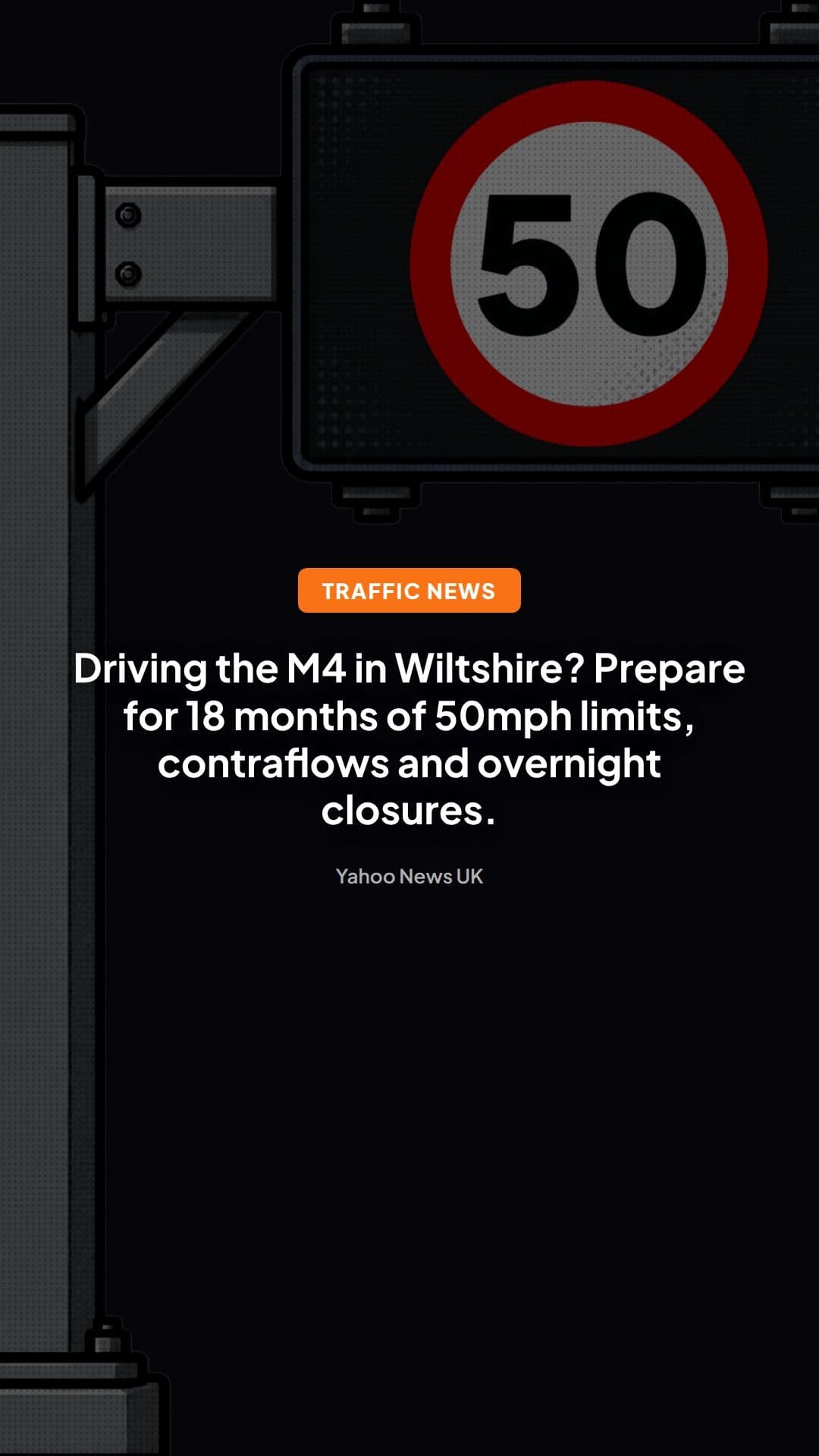
M4 Wiltshire Roadworks: 18 Months of Contraflow, 50mph Limits and Overnight Closures
If you drive the M4 west of Swindon, it is worth putting a reminder in your diary. For roughly 18 months, one of the busiest stretches of the route between London and South Wales will become a very different driving experience. According to Yahoo News UK, maintenance between junctions 16 and 17 will bring a 50mph limit, contraflow arrangements and overnight closures from 30 October through to October 2027.
That is a long time to live with disruption. Here is what we know, what it could mean for different types of driver, and how the law treats roadworks speed limits and lane restrictions.
What has been announced
The reported details are fairly simple, though the implications are not:
- Location: the M4 in Wiltshire between junction 16 (Swindon and Wootton Bassett) and junction 17 (Chippenham).
- Start date: 30 October.
- Duration: around 18 months, running to October 2027.
- Measures: a 50mph limit, contraflow arrangements and overnight closures.
The source describes the work as maintenance, and the summary does not break down exactly what will happen when. Drivers should be cautious about assuming the whole 18 months will look the same. Large maintenance schemes are often delivered in phases, with different restrictions in different places at different times. The most reliable information will come from National Highways, which runs the strategic road network, so check its published scheme details and live traffic updates before longer journeys.
Why this stretch matters
The M4 is a major artery for commuters, freight, holidaymakers and business travellers heading between London, the South West and South Wales. A sustained slowdown anywhere on it has knock-on effects well beyond the roadworks themselves.
A 50mph limit. Cutting a 70mph motorway to 50mph through a works zone may sound modest, but over a busy corridor it can reduce capacity and make queues form faster at peak times. Sustained lower speeds tend to mean tighter gaps and more stop-start driving, which is tiring and can raise the risk of rear-end shunts.
Contraflow. In a contraflow, traffic in both directions shares one carriageway while the other is worked on. Lanes are usually narrower, there is little or no margin for error, and the central reservation may be replaced by temporary barriers. These layouts demand more concentration, particularly for drivers towing or in wider vehicles.
Overnight closures. These are the least visible but potentially the most disruptive for people who work shifts, deliver goods or travel late. Closures push traffic onto local roads and signed diversions, which are rarely designed for lorries and heavy motorway flows. Towns and villages on the likely alternatives, which for this area includes routes around Swindon, Wootton Bassett and Chippenham, can see noticeably heavier traffic at night.
If you want a sense of how a motorway diversion can play out for local roads, our explainer on the A50 closure and its 43 mile diversion route shows how a long detour changes a journey.
The legal angle: how roadworks restrictions work
A temporary 50mph limit is not just advisory. It is a legal limit, and breaking it carries the same consequences as breaking any other speed limit.
Temporary speed limits are enforceable
Temporary restrictions for roadworks are put in place under the Road Traffic Regulation Act 1984 framework. Once the signs are up and the limit is in force, exceeding it is a speeding offence. The usual penalty for a speeding offence dealt with by fixed penalty is a £100 fine and three penalty points, and more serious cases can go to court, where fines are linked to income and a disqualification is possible. Drivers who have built up points can find a short burst of roadworks speeding is enough to push them towards a totting up ban, which is normally triggered at 12 points within three years.
Police forces and National Highways partners use enforcement thresholds set out in national guidance, but those are not a promise of leniency. It is risky to treat the number on the sign as something you can exceed safely. Our piece on UK speeding rules and the myths that could cost drivers dearly covers the common misunderstandings.
Cameras in works zones
Roadworks zones are a common location for enforcement. Depending on the layout, this can include fixed, mobile or average speed cameras. The announcement does not say which will be used here, so it is sensible to assume speed will be monitored. We have looked at the wider picture in speed camera networks and smart motorway fines.
An average speed system, where used, records how long you take between two points rather than catching a single moment. That makes the old habit of braking for the camera and then speeding up ineffective. The only reliable approach is to hold a steady speed throughout.
Red X and closed lanes
Within works zones, overhead or temporary signals can show a red X above a lane. Driving in a lane under a red X is an offence, and National Highways has said for years that it takes this seriously. The typical outcome is a fixed penalty of £100 and three points. It is very easy to drift into a closed lane in slow, dense traffic, so keep an eye on signals above, not just the road in front.
Merging, tailgating and careless driving
The Highway Code advises drivers to use both lanes up to the point where a lane closes and then merge in turn. Many drivers see early merging as the polite approach, but it can cause queues to lengthen. Whatever your view, aggressive behaviour such as blocking the lane, tailgating or last-second swerves can lead to a careless or inconsiderate driving charge. For more on this, see our article on why drivers risk lives to skip roadwork queues.
Practical advice for drivers
This is general information rather than legal advice, but a few steps are sensible for anyone using the corridor.
Plan before you go
- Check the scheme. National Highways publishes closure dates and diversion routes. Look at them before you set off, not when you are already in the queue.
- Use live traffic tools. Navigation apps will help with real-time delays, but they do not always know about planned overnight closures, so check official sources for those.
- Think about timing. If you have a choice, avoiding peak commuting hours, Friday afternoons and summer weekends is likely to reduce your delay. Many drivers heading to and from the South West use this route on holiday weekends.
Build in time and patience
Being late is the main reason people speed or make risky merges. If you regularly use this stretch, add a buffer to your timings and accept the new baseline for the next 18 months.
Driving the contraflow safely
- Keep a generous gap to the vehicle ahead, as there is less room to take evasive action.
- Stay in your lane position, especially in narrower lanes.
- If you are towing or driving a wide vehicle, check the lane width signage and plan your route accordingly.
- Avoid using your phone or adjusting devices. Slow traffic does not make handheld use any less of an offence.
If you break down
Breaking down in a contraflow or roadworks zone is more hazardous than usual, because there may be no hard shoulder. The Highway Code advises, where possible, to move to a place of safety, leave the vehicle by the left-hand door, and call National Highways or the emergency services rather than trying to fix the problem on the carriageway. Make sure your vehicle is serviced and your tyres and fuel are in good condition before a long journey through the zone.
Overnight and diversion traffic
If you travel at night for work, check closure times and diversion routes in advance. Diverted routes may include local roads with different speed limits, width restrictions, or parking controls. Unfamiliar roads are where drivers most often pick up a penalty, such as a speeding ticket in a village limit, or a parking charge when stopping to regroup. If you need to pull over to check directions, choose somewhere safe and legal, and be aware that private land such as pub and shop car parks often has its own terms. Our guide to parking on private land and your rights explains how that works.
Think about your fuel use
Stop-start traffic and constant speed changes can push up fuel use. Smooth, steady driving at the limit can help, and our post on the 60mph rule and how drivers can cut fuel costs has some practical tips.
What about compensation for the inconvenience?
Drivers sometimes ask whether they can claim for delays caused by roadworks. In general, there is no automatic compensation for time lost in planned maintenance. If your vehicle is actually damaged by something connected to the works, such as debris or a defective road surface, there are separate claim routes through the relevant highway authority, and it is worth keeping photographs and receipts. For anything more significant, official guidance or professional advice is the right starting point.
Looking ahead
Eighteen months is a long time, and the long-term picture matters as much as the first few weeks. Some of the likely effects:
- Habits will change. Regular commuters and hauliers often find alternative routes or schedules. That can shift traffic to other roads, so local councils and residents may see changes in congestion that outlast the works.
- Enforcement will be a constant. With a long scheme comes a long period in which cameras and patrols can monitor compliance. Drivers who get used to the limit early will have fewer problems.
- Details may change. Schemes of this scale often adjust their phasing, so what is announced now may be updated. Treat the headline details as a guide and expect updates.
- The payoff is a better road. The intention of maintenance is to keep the carriageway safe and reliable. It is little comfort in a queue, but it is the reason for the pain.
Key takeaways
- The M4 between junctions 16 and 17 faces a 50mph limit, contraflow and overnight closures from 30 October to October 2027, according to Yahoo News UK.
- Temporary speed limits are legally enforceable, usually with a £100 fine and three points for a fixed penalty, with harsher outcomes possible for more serious cases.
- Do not enter a lane under a red X, and expect cameras in the works zone.
- Check National Highways for phase details, closures and diversions before you travel, especially at night.
- Leave extra time, keep your distance in the contraflow, and know what to do if you break down.
Eighteen months of roadworks is an irritation, but it does not need to become an expensive one. A little planning and a steady speed will go a long way.
Written by
The Parking Ticket Pal Editorial Team
Source-checked parking guidance
Ready to Challenge Your Ticket?
Let our AI analyse your PCN and generate a professional appeal letter in minutes.
Start Free Appeal