
Labour Budget Car Tax Rumours: Will Heavy Cars Pay More?
Could a Labour Budget bring a weight-based car tax supplement? We examine the Tory claim, the facts so far and what it could mean for UK drivers today.

The Parking Ticket Pal Editorial Team
22 October 2026
Weight-Based Car Tax: What the Tory Warning Could Mean for Your Wallet
Every Budget season brings a familiar ritual. Rumours swirl, opposition parties warn of doom, and drivers brace for the worst. This time the focus is weight. If you own a large SUV, a heavy electric car or a family-sized people carrier, you may be wondering whether the Chancellor is about to tax you by the kilo.
The honest answer is that nobody outside the Treasury knows yet. But the rumour is worth unpicking, because it touches on some of the biggest tensions in UK motoring policy.
What actually happened
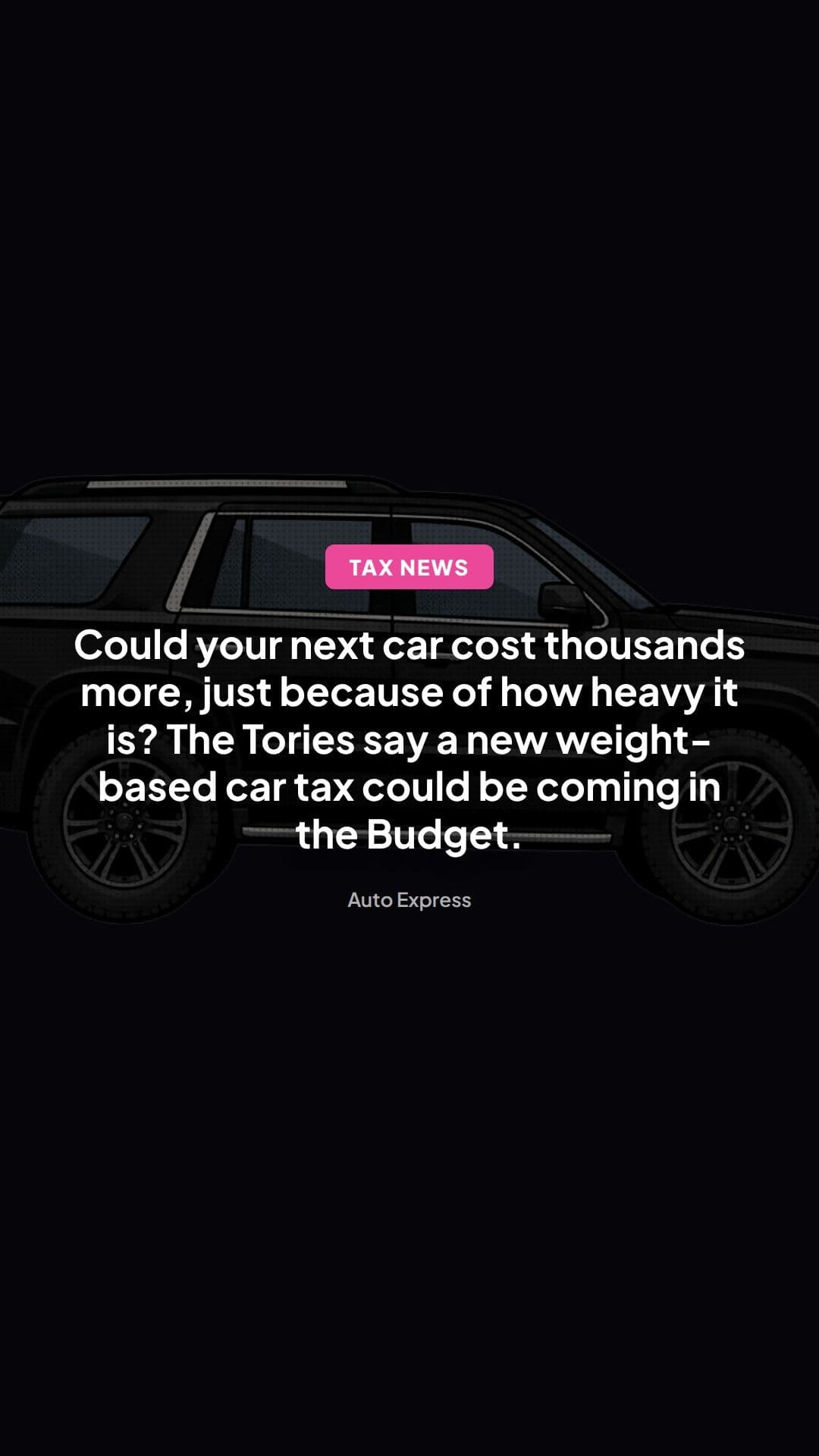
According to Auto Express, the Conservative Party claimed that the Chancellor could introduce a weight-based supplement to car tax in the forthcoming Budget. The key word is claimed. No such measure has been confirmed, and the story is political speculation, not a policy announcement.
That distinction matters. Opposition parties have every incentive to portray the government as hungry for motorists' cash, and governments rarely confirm or deny Budget contents in advance. So the sensible reading is this: a weight-based charge is being floated as a possibility, but it should not yet be treated as fact.
Even so, the idea does not come from nowhere. Weight is already a factor in UK vehicle taxation for some vehicle types, and the debate about heavier cars has been growing for years.
Why the idea has legs
Weight is already part of the tax system
Heavy goods vehicles pay vehicle tax based partly on their weight and axle configuration. Vans have their own rate structure. So the principle that heavier vehicles cost more to tax is not alien to the system. What would be new is applying it to ordinary cars.
Cars are getting bigger and heavier
SUVs now make up a large share of new car sales, and electric cars carry heavy battery packs. Heavier vehicles generally cause more road wear, take more energy to move, and can be more dangerous to pedestrians and cyclists in a collision. Campaigners and some councils have argued that size should carry a price. We have covered this wider trend in our pieces on carspreading and how bigger SUVs are reshaping UK streets and on bigger cars and the case for charging them more.
The tax base is shifting
Here is the part that makes the Treasury's interest plausible. Fuel duty and emissions-based vehicle tax bring in money partly because most cars burn petrol or diesel. As more drivers switch to electric, that income erodes. The government has already moved to bring electric cars into the vehicle tax system and has set out plans for pay-per-mile charging for EVs. Our electric vehicle tax changes guide walks through that in detail.
A weight-based charge could, in theory, be another lever. It would capture heavy electric cars that currently pay little, while also hitting large petrol and diesel SUVs. That is analysis, not a leak, but it shows why the idea is not far-fetched.
The awkward part: weight and EVs pull in different directions
If a weight supplement did arrive, it would collide with another government goal, which is getting people into electric cars. Many EVs are significantly heavier than petrol equivalents because of their batteries. A tax on weight could therefore penalise the very vehicles that ministers want drivers to buy.
Policymakers could try to resolve this in several ways, such as exempting zero-emission vehicles, setting weight thresholds that only catch the largest cars, or tying any charge to list price or emissions as well. The design would decide who actually pays. A blunt weight charge would be politically messy. A narrow one aimed at the heaviest vehicles would be easier to defend.
This is why the headline "heavy car tax" tells you very little. The detail, including thresholds, exemptions and start date, would be everything.
The legal angle: how a change like this would actually happen
Vehicle tax in Great Britain is governed by the Vehicle Excise and Registration Act 1994. Rates are set in the Act and amended through later legislation, usually the annual Finance Act. In practice, that means:
- A Budget announcement is not law. The Chancellor sets out proposals, and they normally need to be enacted through a Finance Bill that Parliament votes on. Some measures take effect from a stated date and are legislated for afterwards, but the formal process still applies.
- The start date is crucial. Past reforms to vehicle tax have often applied only to cars registered after a certain date. The 2017 overhaul of the system, for example, applied to newly registered cars rather than existing ones. A weight-based supplement could follow a similar pattern, but we cannot assume it would.
- Existing supplements give a clue to design. The current "expensive car supplement" applies to cars with a list price above a set threshold and is charged for a limited number of years after the first. A weight-based supplement could be bolted on in a similar way, but again, that is speculation.
- Rates and thresholds change. Figures for vehicle tax, including the expensive car threshold and how electric cars are treated, have been adjusted in recent years, so always check the current numbers on GOV.UK rather than relying on older articles.
If a measure is confirmed, the Budget documents and the GOV.UK announcements will set out who is affected and from when. Those, not headlines, are the sources to trust.
What drivers should do now
You cannot plan around a tax that has not been announced. But you can avoid panic decisions and get your records in order.
1. Don't change your car plans on a rumour
If you are weighing up a new vehicle, resist the urge to rush into or out of a purchase because of a political claim. If anything is confirmed, transitional arrangements often matter more than the headline. Wait for the actual announcement and read the detail.
2. Know your car's weight and how it is described
Weight can be defined in several ways, such as kerb weight, gross vehicle weight and mass in running order. Manufacturers' figures can differ from one source to another. If a weight-based charge ever becomes real, the definition used would determine your bracket. It is worth knowing where to find the figure for your car in the handbook, manufacturer specifications and your V5C logbook, and being aware that these may not all match.
3. Check what you already pay
Many drivers do not know how their current vehicle tax is calculated. Look at your car's registration date, CO2 band if relevant, and whether the expensive car supplement applies. Our guide to 2026 vehicle tax changes is a good starting point. Knowing your baseline lets you judge any new proposal quickly.
4. Keep your vehicle tax in order
Whatever happens in the Budget, existing enforcement rules continue. Vehicle tax is not transferable when you sell a car, and unpaid tax can lead to penalties. If you are off the road, a SORN declaration matters. Our article on DVLA enforcement and what happens if you don't pay explains the risks.
5. Beware of opportunistic scams
Budget speculation and tax changes are catnip for fraudsters. Emails or texts claiming you owe a "new weight tax" or must "update your vehicle tax details" are a red flag. Vehicle tax is handled through GOV.UK and the DVLA. If in doubt, type the address into your browser yourself rather than clicking a link.
6. Watch the local level too
National tax is not the only way size can cost you more. Some councils have explored or introduced parking charges that vary by vehicle size or emissions. If you drive a large car, it is worth checking your local authority's charging rules, as we explored in Bath's plans for larger cars and Cardiff's SUV parking charges. A national weight charge and local size-based parking fees would be separate costs, and they could stack up.
Looking ahead
Whether or not this particular rumour proves true, the direction of travel is clear. Motoring taxation is being reshaped. Fuel duty revenue is under pressure as electric cars spread, and ministers need to replace it. At the same time, concern about ever-larger vehicles on narrow streets is pushing size, weight and emissions up the political agenda.
There are a few things worth watching:
- Whether the Budget actually mentions weight. If it does not, the claim will likely fade. If it does, look for thresholds and exemptions straight away.
- How EVs are treated. The relationship between weight and electric cars will be the real test of whether the policy is coherent.
- Whether it applies to new or existing cars. This is often the biggest practical question for current owners.
- Interaction with other charges. Vehicle tax, pay-per-mile plans, congestion and clean air charges, and parking fees may all be pointed at the same drivers. The cumulative effect matters more than any single measure.
For now, the story remains a warning, not a policy. Treat it as a prompt to understand what you already pay and where your car sits in the system, not as a reason to act. When the Chancellor stands up, the small print will tell you far more than the pre-Budget noise ever can.
This article is general information about UK motoring and vehicle tax rules, not legal or financial advice. For the current rates and rules that apply to your vehicle, check GOV.UK or contact the DVLA, and consider professional advice if you are making a significant financial decision.
Written by
The Parking Ticket Pal Editorial Team
Source-checked parking guidance
Ready to Challenge Your Ticket?
Let our AI analyse your PCN and generate a professional appeal letter in minutes.
Start Free Appeal