Carspreading: bigger cars could mean 400 more UK deaths
Carspreading is making cars longer, taller and wider. New research warns visibility and impact risks could mean 400 extra road deaths a year by 2040.

Isabella Romano
25 June 2026
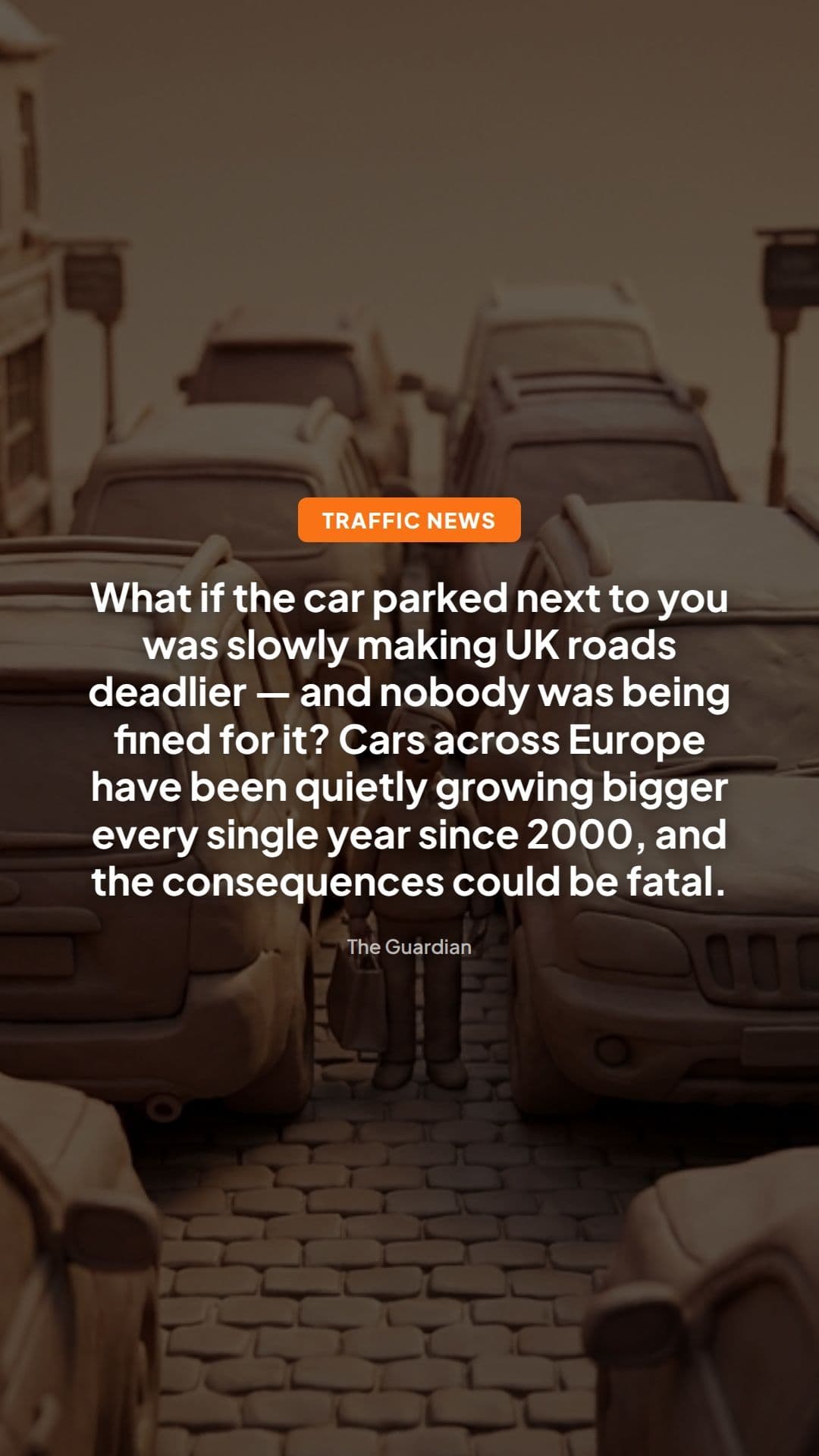
Carspreading: Why Britain's Obsession With Bigger Cars Could Be Killing Us — And What the Law Says
Picture this: you're reversing out of a supermarket car park, visibility clear in both directions. Now imagine the same manoeuvre flanked on either side by a pair of hulking SUVs, their bonnets rising well above your roofline, their bulk swallowing the sight lines you'd normally rely on. That's not a hypothetical — it's Tuesday morning in virtually every retail car park across Britain. And according to a significant new study, it may be quietly contributing to a death toll we've barely begun to reckon with.
What the Study Found
Research published in June 2026, and reported by The Guardian, has put hard numbers on a trend that many road safety campaigners have long suspected but struggled to quantify. The phenomenon — dubbed "carspreading" — refers to the steady, relentless growth in vehicle dimensions across Europe. Cars are getting longer, wider, and taller with each successive model generation, and the cumulative effect on road safety is now being projected in stark terms.
The study's headline figure is alarming: without meaningful policy intervention, carspreading could contribute to approximately 400 additional road deaths per year across Europe by 2040. The mechanisms are twofold. First, larger vehicles reduce visibility — both for the drivers of those vehicles and, critically, for everyone around them. Pedestrians, cyclists, and occupants of smaller cars are increasingly obscured by the physical mass of the vehicles surrounding them. Second, when collisions do occur, greater vehicle mass and height translates directly into greater injury severity, particularly for vulnerable road users.
This isn't a study about reckless driving or distracted motorists. It's about the structural, systemic impact of a shift in vehicle design that has happened gradually, almost imperceptibly, over the past two decades — but which is now reaching a tipping point.
The Background: How We Got Here
The numbers tell their own story. The original Ford Fiesta, launched in 1976, was 3.57 metres long. The final generation, discontinued in 2023, had grown to 4.07 metres. The Ford Puma SUV that effectively replaced it in the lineup is taller still, with a raised ride height that places its bonnet significantly higher than the average pedestrian's centre of gravity.
Across the industry, the pattern repeats. SUVs and crossovers now account for roughly 60% of new car sales in the UK, up from negligible figures at the turn of the millennium. Manufacturers have followed consumer demand — and consumer demand has been shaped, in part, by aggressive marketing of size as a proxy for safety, status, and practicality.
The irony is cutting. Buyers often choose larger vehicles because they feel safer. And for the occupants of those vehicles, the data does broadly support that intuition — modern SUVs perform exceptionally well in Euro NCAP crash tests. But those tests measure what happens to the people inside the car. They say relatively little about what happens to the pedestrian, the cyclist, or the driver of a smaller vehicle that the SUV strikes.
Research from the European Transport Safety Council has previously shown that SUV fronts are more likely to strike pedestrians in the head or chest rather than the legs — a significantly more lethal impact geometry. The new carspreading study adds a further dimension: it's not just about what happens during a collision, but about the visibility degradation that makes collisions more likely in the first place.
The Legal Angle: What UK Law Actually Says
Here's where things get genuinely interesting — and, frankly, rather uncomfortable for policymakers.
UK law does not restrict the sale or use of passenger vehicles based on their dimensions, beyond certain practical limits relating to road infrastructure. The Road Vehicles (Construction and Use) Regulations 1986 set maximum width limits for vehicles (2.5 metres for most motor vehicles), but these thresholds are designed to ensure vehicles can physically use the road network, not to protect third parties from the visibility or collision-severity effects of large cars.
The Highway Code requires all drivers to have a full and unobstructed view of the road ahead (Rule 229 addresses obscured windscreens and windows), but there is no corresponding duty on a driver to ensure that their vehicle's external dimensions do not degrade the visibility of other road users. A driver sitting in a Range Rover Sport cannot be penalised simply because their vehicle makes it harder for a child on a bicycle to be seen by oncoming traffic.
Planning law offers a partial parallel. Local authorities can — and increasingly do — restrict access to certain roads or zones by vehicle height or width, using traffic regulation orders under the Road Traffic Regulation Act 1984. Width restriction signs (the familiar red-bordered circles with a measurement in metres) are a common sight on narrow country lanes and low bridges. But these are infrastructure-protection measures, not road safety interventions targeting carspreading specifically.
There is also the question of type approval. All new vehicles sold in the UK must comply with UK-retained EU type approval standards (now administered under the Road Vehicles (Approval) Regulations 2020), which include requirements around pedestrian impact protection. Euro NCAP's pedestrian testing protocols have become progressively more demanding, and from 2023 onwards, the assessment of "vulnerable road user" protection has been significantly expanded. However, these standards address crashworthiness — they do not cap vehicle dimensions.
The Corporate Manslaughter and Corporate Homicide Act 2007 is theoretically relevant in the most extreme scenarios — if, for instance, a manufacturer knowingly designed a vehicle whose dimensions created a foreseeable and unreasonable risk to road users. In practice, no such case has been brought, and the legal threshold would be extraordinarily difficult to meet given the diffuse nature of the harm.
What this means, in practical terms, is that the law as it currently stands provides almost no mechanism to address carspreading directly. Liability for individual collisions rests on the usual principles of negligence and the Road Traffic Act 1988. The systemic risk identified by the study falls into a legal vacuum.
What Drivers Should Know Right Now
While legislators catch up — if they ever do — there are practical steps every driver can take to navigate a road environment increasingly shaped by oversized vehicles.
If you drive a larger vehicle:
- Be acutely aware of your blind spots. Modern SUVs and large crossovers have significant front-end blind zones. A child standing directly in front of many large SUVs is invisible to the driver. Before moving off, physically check around the vehicle.
- Use your parking sensors and cameras actively, not passively. These systems are aids, not substitutes for observation.
- Give cyclists and pedestrians significantly more space than you think necessary. Your vehicle's mass and height mean a collision that might be minor in a smaller car could be fatal.
- Consider whether your vehicle is proportionate to your actual needs. This isn't a moral lecture — it's a risk management point.
If you drive a smaller vehicle:
- Assume you are invisible at junctions when surrounded by larger vehicles. Edge out slowly, use your mirrors aggressively, and never rely on a sight line that runs through or past an SUV.
- At pedestrian crossings and school zones, be especially cautious. Visibility degradation is worst in precisely these environments.
For all drivers:
- Maintain greater following distances behind large vehicles. Their braking profiles differ from smaller cars, and your forward visibility is compromised.
- Report near-misses via the Road Safety GB near-miss reporting tools where available. Building the evidence base matters.
Looking Ahead: What Needs to Change
The study's authors are clear that this is a policy problem, not merely a consumer behaviour problem. The 400 deaths figure is explicitly framed as preventable — but only with intervention.
Several European cities are already moving. Paris has introduced higher parking charges for heavy SUVs. Some Swiss cantons have experimented with access restrictions. In the UK, Transport for London has explored vehicle size considerations within its streets design frameworks, and the Active Travel England agenda implicitly favours smaller, lighter vehicles through its emphasis on pedestrian and cycling infrastructure.
The more substantive question is whether the UK Government will incorporate vehicle dimension considerations into future type approval reform, emissions policy, or road safety strategy. The Road Safety Action Plan — currently under review — could in principle be extended to address carspreading, but there is no indication this is currently on the table.
What seems increasingly clear is that the current approach — treating road safety as primarily a matter of driver behaviour and road design, while allowing vehicle dimensions to grow unchecked — is no longer sufficient. The evidence is accumulating. The deaths are, on current trajectories, coming.
The cars are getting bigger. The question is whether our laws, our infrastructure, and our collective awareness will grow fast enough to keep pace.
Written by
Isabella Romano
Civil Enforcement Officer
Ready to Challenge Your Ticket?
Let our AI analyse your PCN and generate a professional appeal letter in minutes.
Start Free Appeal