
Supermarket Parking: How to Avoid £100 Private Charges
Could you face a £100 supermarket parking charge? Learn why Tesco, Sainsbury's and Asda car parks can issue private PCNs after hours.

The Parking Ticket Pal Editorial Team
6 November 2026
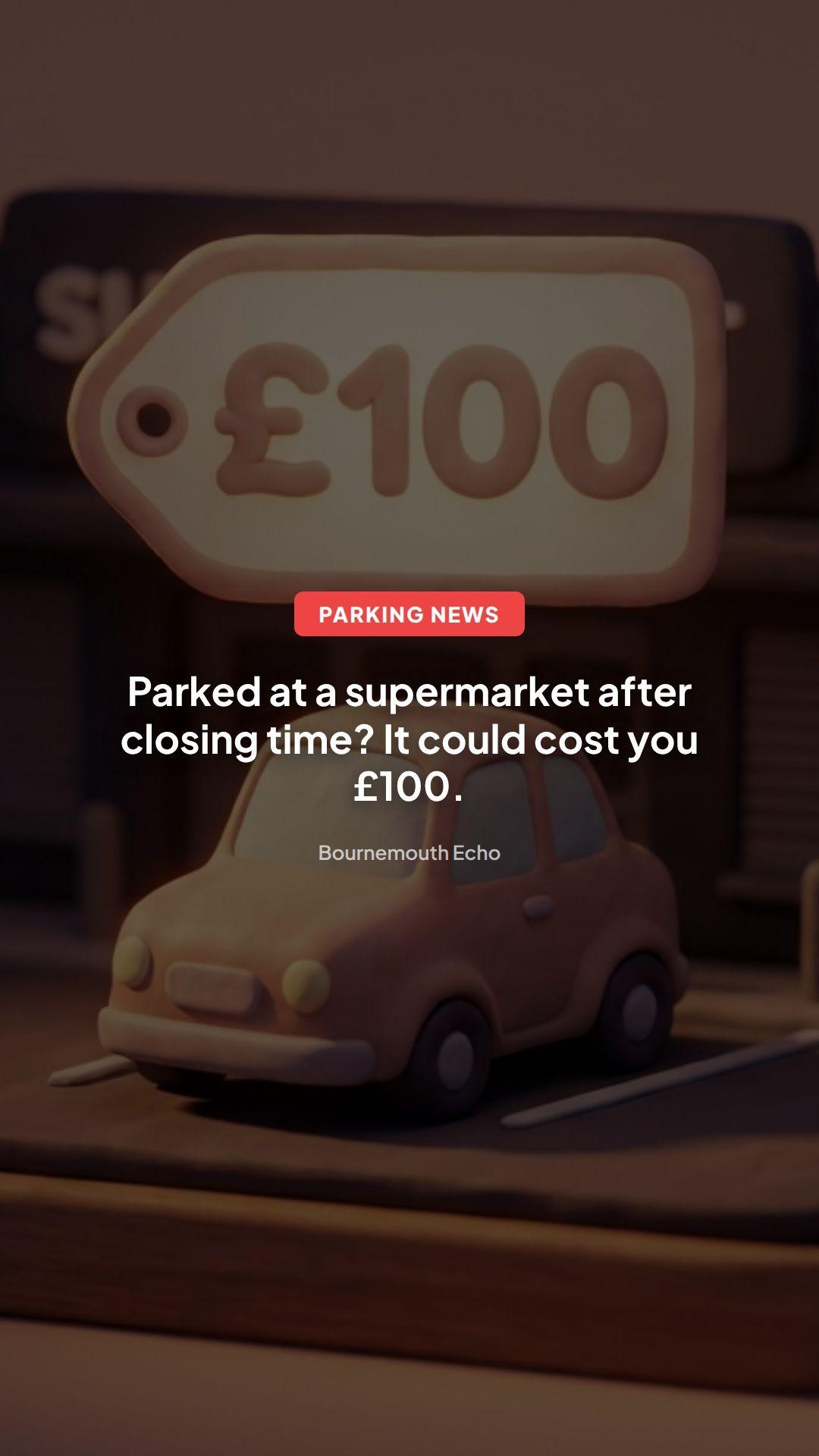
Supermarket Car Parks After Hours: Why Parking Overnight Could Cost You £100
You finish a late shift, pull into the supermarket car park to meet a friend, and leave the car there overnight because it is free and it is right there. A few weeks later, a letter lands on your doormat demanding £100.
That is the scenario behind a recent Bournemouth Echo report, which warns that drivers can face private parking charges at supermarket car parks outside opening hours. The headline names Tesco, Sainsbury's and Asda "and more", but the underlying issue is much wider than any single retailer. It is about what a supermarket car park actually is in law, and why the rules that apply to it differ so sharply from those on the high street.
What the story is saying
The core warning is simple. Supermarket car parks are generally private land, and operators can set conditions on who may park there and when. If a store is closed, the car park may be closed to customers too, or restricted to certain hours or a maximum stay. Park outside those terms and you may receive a parking charge from a private company, with £100 the figure highlighted in the headline.
The report also draws a distinction that many motorists miss. A charge from a private operator is not the same thing as a council penalty. Both land on the doormat in similar envelopes and both use the language of "notices" and "charges", but they come from entirely different legal footings, and the route to challenging them is different.
Why this catches so many drivers out
Supermarket car parks feel public. They are open to anyone, often have no barrier, and sit beside a road. Many drivers assume that if there are no yellow lines, there are no rules.
Several things make out-of-hours parking a particular trap:
- Opening hours are not car park hours. A store might close at 10pm while the car park is monitored round the clock. Equally, a 24-hour store may still have restrictions at certain times.
- Customer-only conditions often apply. Once the shop shuts, nobody can be a "customer", so any parking could technically breach the terms.
- ANPR does the watching. Cameras log your arrival and departure automatically. There is no warden to speak to and no ticket on the windscreen, so you may not realise anything is wrong until weeks later.
- Local habits clash with the signs. Town-centre supermarkets near bars, stations and beaches attract people who treat them as free parking. Operators know this and enforce accordingly.
Private charge versus council penalty
This is the distinction the Echo highlights, and it matters because your rights hang on it. I have covered this in more depth in our guide to council PCNs versus private charges, but here is the short version.
Council Penalty Charge Notices (PCNs) are issued under statute for contraventions of traffic or parking regulations, on the public highway or in council-run car parks. There is a formal process: informal challenge, formal representations, then an independent adjudicator, such as the Traffic Penalty Tribunal outside London. Penalty levels are set by law and councils must follow prescribed procedures.
Private parking charges are different. They are not fines. A private operator is alleging that you breached the terms of a contract, and the charge is either the price of that breach or, depending on the wording of the signs, a form of contractual damages. They have no statutory force on their own. The operator has to persuade you to pay, or take you to court.
That is why a private charge cannot, by itself, lead to bailiffs, points on your licence or a criminal record. Those consequences belong to other systems. A private charge only escalates to enforcement if the operator wins a county court claim and you then fail to pay a judgment.
The legal angle
How the contract arises
When you enter private land and park, the operator's case is that you accepted its terms by conduct, having seen the signs. That is why signage matters so much. For a contract to bind you, the terms need to be prominent, clear and visible at the point you could reasonably have decided to enter or leave.
The Beavis case
The leading authority is ParkingEye Ltd v Beavis [2015] UKSC 67. The Supreme Court upheld a £85 charge at a retail park car park, finding that it was not an unenforceable penalty because the operator had a legitimate interest beyond simply recovering a loss, namely managing the car park for the benefit of the shops and customers, and the charge was not extravagant. The judgment did not give operators a blank cheque. The court stressed the prominence of the signage and the modest amount involved, and later cases have turned on whether the specific terms were clear and the charge proportionate. Out-of-hours enforcement relies on the same principle: the operator argues that keeping the car park available for customers is a legitimate interest.
Keeper liability
If an operator does not know who was driving, it can try to pursue the registered keeper using Schedule 4 of the Protection of Freedoms Act 2012 (POFA). This only works if the operator follows strict rules about the wording of its notices and the timings of when they are sent. Where it has not met those conditions, it may be unable to hold the keeper liable, though it can still pursue the driver if it can identify them. These technicalities are among the most common grounds on which private charges fail.
Codes of practice
Most larger operators belong to an accredited trade association, either the British Parking Association (BPA) or the International Parking Community (IPC). Each has its own code of practice covering signage, charge levels and appeals. Our explainer on BPA versus IPC membership sets out why the difference matters in practice.
Meanwhile, the government has been working on a single statutory code under the Parking (Code of Practice) Act 2019, covering issues such as charge caps and grace periods. The timetable has moved more than once, so it is worth checking the current position on GOV.UK. Our recent posts on the proposed £100 cap and 10-minute grace period cover what has been proposed.
What drivers should know
This is general information rather than advice on any particular charge, but these are the points that tend to matter most.
Before you park
- Read the entrance signs, not just the ones by the bays. Hours of operation, customer-only conditions and maximum stays are often set out at the entrance.
- Check whether the car park has a closing time. Some close with a barrier, some do not and rely on cameras instead. A missing barrier is not permission.
- Do not assume a 24-hour store means 24-hour parking. Terms can still limit stay lengths overnight.
- If you must leave a car overnight, ask. Store management or the operator named on the signs can sometimes confirm whether overnight parking is allowed, and in some cases register your vehicle.
- Keep your own records. Dated photos of the signage, the bay and your car can be valuable later, particularly if the signs were unclear or hidden.
If a charge arrives
- Do not ignore it. Silence does not make a charge disappear, and a claim can follow if it goes unanswered. Equally, do not panic.
- Check who it is from and what it alleges. Look for the date, time and location, and whether it names the driver or the keeper.
- Check the deadlines. If the operator is relying on keeper liability, the dates on the notice and when it was posted matter.
- Consider whether the signs were adequate. Was the key term, such as the opening hours or the customer-only rule, visible and legible?
- Look at whether the data is right. ANPR can misread plates or log a visit incorrectly. Our piece on ANPR errors and how to challenge them goes into this.
- Use the appeals route. If you appeal to the operator and are rejected, a BPA member must give you a code to take your case to POPLA, the independent appeals service. Our step-by-step POPLA guide explains how it works. IPC members use a different service, the Independent Appeals Service.
- Be careful about what you say. If you are not the keeper and have no obligation to name the driver, think before volunteering information that the operator could use against you.
Debt collectors and "solicitors' letters" that follow can look alarming, but they are not court orders. If a genuine court claim arrives, though, it has strict deadlines. That is the point to seek independent advice from a source such as Citizens Advice or a qualified solicitor.
Genuine reasons for being there
Emergencies, breakdowns, medical situations and genuine mistakes are sometimes accepted by operators or by POPLA, though outcomes vary and there is no guarantee. If something genuinely unavoidable happened, gather evidence such as a breakdown report, a hospital record or a receipt, and explain it plainly.
Looking ahead
The Echo's warning reflects a tension that is unlikely to go away. Operators argue that without enforcement, supermarket car parks would be filled with commuters, shoppers going elsewhere and people avoiding other charges, leaving customers with nowhere to park. Drivers argue that a £100 demand for sitting in an empty car park overnight looks disproportionate.
Regulation is moving towards a middle ground. The long-promised single code of practice is intended to make signage, charge levels and appeals more consistent, and ministers have indicated an interest in tackling the worst practices. How quickly that is implemented, and how many of the current proposals survive, remains to be seen, so it is worth keeping an eye on official announcements.
In the meantime, the safest approach for drivers is the old one: treat every supermarket car park as private land with rules of its own, and check the signs before you walk away from the car. If a charge does arrive, you have rights and routes of challenge, and the first step is knowing which system you are dealing with. A private charge is a contractual claim, a council PCN is a statutory penalty, and mixing the two up is often the costliest mistake of all.
This article is general information about UK parking rules and is not legal advice. For official guidance, see GOV.UK, the BPA, the IPC, POPLA and Citizens Advice, or consult a qualified adviser if you are facing a court claim.
Written by
The Parking Ticket Pal Editorial Team
Source-checked parking guidance
Ready to Challenge Your Ticket?
Let our AI analyse your PCN and generate a professional appeal letter in minutes.
Start Free Appeal