
Smart Motorway Speed Cameras Offline: What Drivers Face
Speed cameras on hundreds of miles of English smart motorways have reportedly been offline since December 2025. What this means for drivers and safety.

The Parking Ticket Pal Editorial Team
19 October 2026
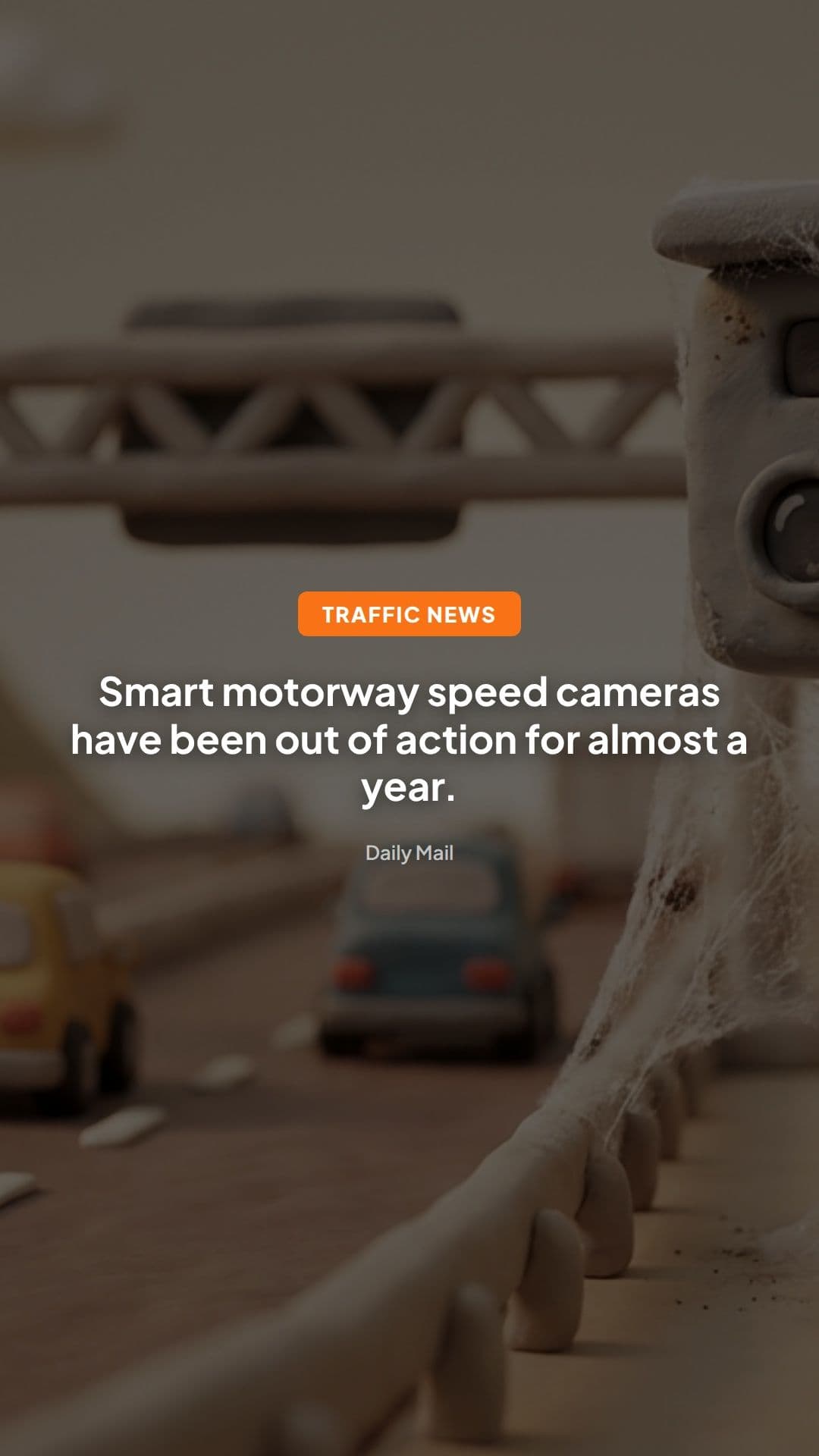
Smart motorway cameras reportedly dark for months: what drivers need to know
Picture the scene. You are cruising along a smart motorway at 50mph because the overhead gantry says so, while a motorbike streaks past at 80. You assume the cameras will catch them. According to a Daily Mail report, there is a fair chance they would not have.
The paper says ministers have reportedly admitted that speed cameras enforcing limits across about 440 miles of major English roads have been out of action since December 2025. The headline puts that at a third of the cameras and "almost a year", and claims smart roads are now "more deadly". Those are big claims, so it is worth separating what is reported from what is established, and then asking what it means for the rest of us.
What has been reported
The core allegation is that a large part of the enforcement network on England's smart motorways stopped working and stayed that way. The Daily Mail says ministers have admitted this, and that it raises concerns about both safety and enforcement.
A few caveats are worth stating plainly:
- The timeline needs checking. The summary dates the outage from December 2025, while the headline refers to almost a year. Read the original article and any official parliamentary answer for the exact dates and figures.
- "More deadly" is a claim, not a proven finding. The source does not give us a verified before-and-after casualty comparison, and I am not going to invent one. Whether the outage has affected casualties is a question for official data.
- "Out of action" may not mean the same thing everywhere. Cameras can fail in different ways, and some may have been working partially. Official figures matter here.
What we can say is that if the report is accurate, the deterrent effect of mandatory variable speed limits has been weakened over a substantial stretch of the network.
Why smart motorway cameras matter so much
Smart motorways were designed around a simple idea: manage traffic flow with variable speed limits and lane controls rather than building more tarmac. That only works if drivers obey the signs. Two main types of enforcement are relevant:
- Speed cameras tied to variable mandatory limits. When the gantry shows 40, 50 or 60mph in a red circle, that is a legal limit, not advice.
- Red X lane closures. A red X above a lane means do not use it. It might be closed because of a breakdown, an incident or roadworks, and ignoring it can put a stranded driver or a recovery worker at serious risk.
The cameras are only one part of this system, but they are the part that makes the signs credible. If drivers come to believe nobody is watching, compliance tends to fray. That is the real worry behind the story: not that any individual camera is switched off, but that the whole system becomes optional in drivers' minds.
This also sits against a long-running public debate about smart motorway safety, particularly all-lane-running schemes where the permanent hard shoulder has been removed. The government cancelled planned new smart motorway schemes in 2023, but the existing network remains. If you want the wider picture of driver sentiment, our post on why drivers feel unsafe on smart motorways covers it.
The legal angle: the limit is still the limit
This is the most important point for ordinary drivers. A switched-off camera does not suspend the law.
The speed limit remains enforceable
Speeding is an offence under section 89 of the Road Traffic Regulation Act 1984. Variable mandatory limits on smart motorways are set through legal orders and displayed on signals. If the signal shows a limit and you exceed it, you are committing an offence whether or not a camera is working.
Enforcement can still happen through other routes:
- Roads policing officers with handheld or vehicle-mounted devices
- Average speed or other camera systems that are working
- Dashcam or witness evidence in serious cases, such as dangerous or careless driving
The typical outcome for a speeding offence is a fixed penalty of £100 and 3 penalty points, a speed awareness course if you are offered one, or a court prosecution for higher speeds. Newly qualified drivers face the added risk of having their licence revoked if they reach six points within two years of passing their test under the Road Traffic (New Drivers) Act 1995.
Red X offences
Driving in a lane closed by a red X is a separate matter. Failing to comply with a traffic sign is an offence under section 36 of the Road Traffic Act 1988, and a red X violation typically attracts a £100 fine and 3 points. Cameras on some smart motorway sections are used to detect this. If those cameras are also affected, the risk is that more drivers ignore closed lanes. The real danger is not the fine, it is hitting a stationary vehicle.
What about notices of intended prosecution?
If you are caught by a working camera, the procedure is set by the Road Traffic Offenders Act 1988. In general, a notice of intended prosecution must reach the registered keeper within 14 days of the alleged offence. Separately, section 172 of the Road Traffic Act 1988 requires the keeper to say who was driving when asked, usually within 28 days. Ignoring a section 172 request is its own offence, typically carrying 6 points, so it should never be ignored.
Evidence and type approval
For speed evidence from a camera to be used, the device generally has to be of a type approved by the Home Office, under section 20 of the Road Traffic Offenders Act 1988. Calibration, signing and the legal validity of the speed limit order can all become points of dispute in a contested case. We covered what happens when equipment goes wrong in our posts on 36,000 speeding fines cancelled after a smart motorway camera fault and speed camera faults that let thousands avoid penalties. The principle is that faults can cut both ways, either wiping out penalties or, as in the case of wrongly issued ones, creating grounds to challenge.
Does the outage help anyone previously fined?
Not automatically. If a camera was working when you were caught, a different camera being down elsewhere is irrelevant to your case. If you believe a particular fine rests on faulty or uncalibrated equipment, that is a fact-specific question, and one where official guidance or a motoring solicitor is the right route rather than a blog post.
What drivers should know in practice
1. Treat variable limits as live
The sensible default is to assume the signs are enforced. Police can and do enforce motorway speed limits, and a camera being out of action on one stretch tells you nothing about whether a patrol car is behind you. Our explainer on why speeding myths can cost drivers dearly is a useful companion here.
2. Do not rely on other drivers to follow the rules
If enforcement has weakened, the practical risk is behavioural. Expect:
- More vehicles running well above the displayed limit
- More drivers in lanes closed by a red X
- Bigger speed differences between lanes
Leave extra space, scan ahead for gantry changes, and be wary of anyone approaching fast from behind in a slowed section.
3. Know the breakdown drill
Concerns about enforcement are bound up with concerns about stopped vehicles. Official guidance for smart motorways is broadly:
- If your vehicle has a problem, try to leave at the next exit or services, or pull into an emergency area if you can.
- If you cannot, put your hazard lights on and stay in the vehicle if it is safe to do so, with seat belts on, unless it is unsafe.
- If you must get out, use the left-hand side, get behind a barrier if there is one, and call National Highways or 999 as appropriate.
- Where fitted, emergency areas have a phone that connects to a control room.
Check the current Highway Code and National Highways guidance for the details, as they have been updated over the years.
4. Keep a record if you are caught or witness something serious
If you receive a notice of intended prosecution, note the date, time, location and what the gantry displayed. If you witness dangerous driving, a dashcam clip and a report to the police are far more useful than a social media post. For something you believe is a safety defect, such as a faulty gantry or missing signal, report it to National Highways.
5. If you get a penalty, respond properly
Do not ignore a section 172 request or a court summons. If the stakes are high, such as a possible ban or a dangerous driving allegation, speak to a qualified solicitor. For ordinary notices, official government guidance on gov.uk explains your options, including speed awareness courses where you are eligible.
Looking ahead
If the Daily Mail's account holds up, several questions follow.
Who is accountable for maintenance? Smart motorways rely on dense networks of sensors, cameras and gantries, run by National Highways, with the police responsible for enforcement. When the equipment fails, responsibility can become diffuse, so expect parliamentary questions and pressure on the Department for Transport for a clear repair timetable.
What does it mean for public trust? Confidence in smart motorways has been fragile for years. A prolonged enforcement gap, even if technical rather than deliberate, feeds the perception that the system is running on goodwill rather than oversight.
Could there be knock-on legal arguments? Possibly, though these would depend on the specific equipment and facts. Where the validity of evidence is contested, fault logs, calibration records and maintenance schedules can become central. That is something to watch, not something to assume.
Will cameras be restored quickly? The report gives no timeline beyond the outage date, so that is the thing to look for in any follow-up official response. Technology is also moving: AI-enabled cameras are being trialled across the UK, a theme we explored in what drivers need to know about AI speed cameras, and new systems may eventually replace ageing kit.
The bottom line
The story is a useful reminder that enforcement technology is only as good as its maintenance, and that the law does not depend on whether a camera is watching. A red X is still a red X, and 50mph is still 50mph.
The sensible approach for drivers is simple: obey the signs because the risks are real, not because of the cameras, and drive on the assumption that others may not. For the full detail of the reported outage, read the original Daily Mail article and any official responses as they emerge.
This article is general information about UK motoring rules, not legal advice. If you are facing a penalty or prosecution, check official guidance on gov.uk or speak to a qualified professional.
Written by
The Parking Ticket Pal Editorial Team
Source-checked parking guidance
Ready to Challenge Your Ticket?
Let our AI analyse your PCN and generate a professional appeal letter in minutes.
Start Free Appeal