Private parking tickets hit 13.1m—are you at risk?
Private parking firms issued 13.1m tickets in 2025 so far—up 19%. Learn why drivers are caught out, £100 charges, and the push for a new Code of Practice.

Raj Patel
3 May 2026
Private Parking Fines Are Spiralling Out of Control — Here's What Every Driver Needs to Know
Imagine pulling into a retail car park, popping into a shop for twenty minutes, and returning to find a £100 demand on your windscreen. No warden in sight, no obvious signage you recall reading, and no clear explanation of what you did wrong. For tens of thousands of British drivers every single day, this is not a hypothetical — it is Tuesday.
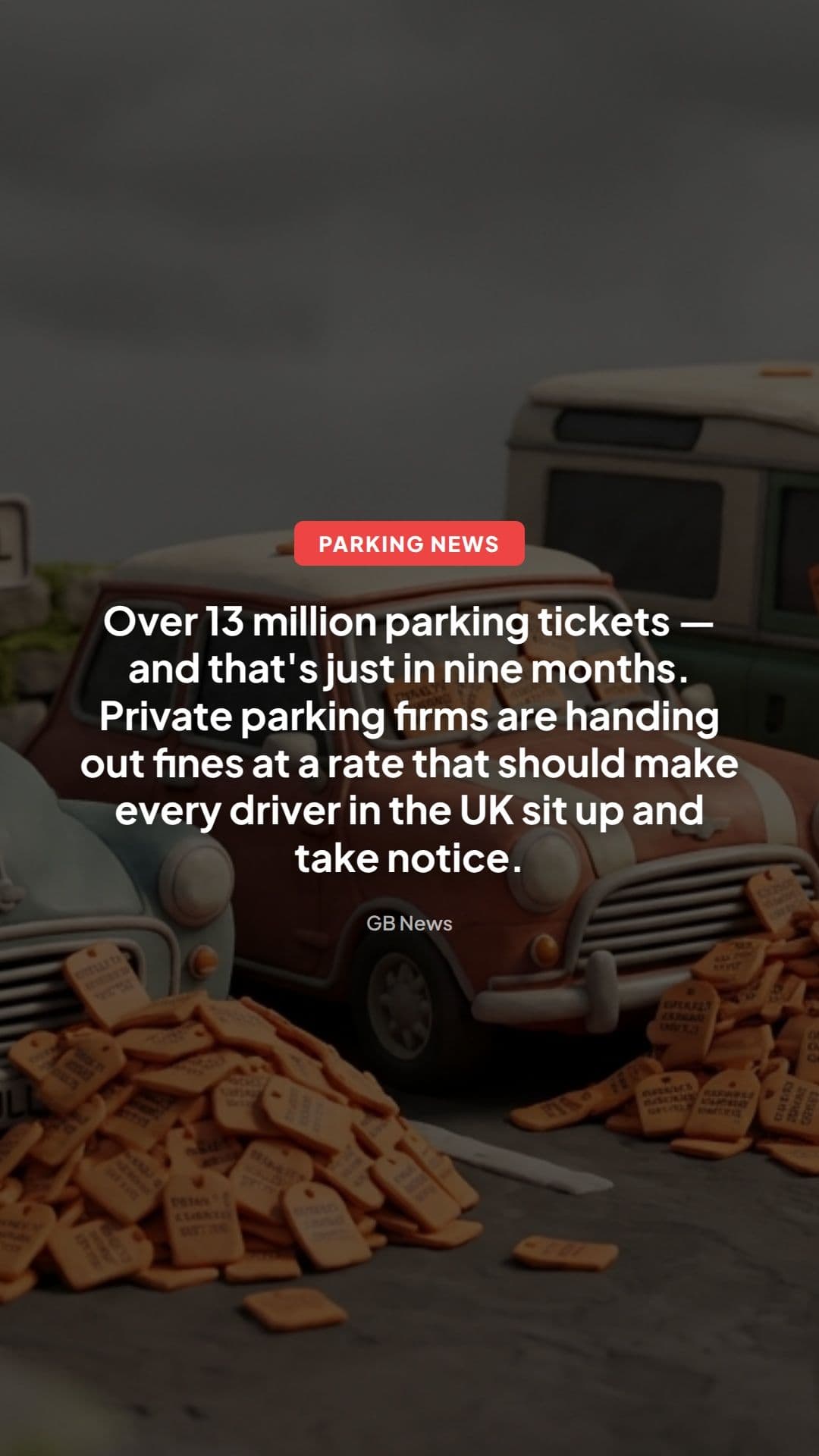
New figures reveal that private parking operators issued an estimated 13.1 million parking charge notices (PCNs) between April and December 2025 — roughly 48,000 every day. That represents a staggering 19% rise on previous comparable figures, and it raises an urgent question that drivers, consumer groups, and MPs have been asking for years: who is actually keeping these companies in check?
What's Actually Happening on the Ground
The numbers alone are alarming, but the human stories behind them are what really bring the scale of this problem into focus. Take the case of a Wiltshire driver who reportedly accumulated fines totalling over £3,000 after a series of unpaid private parking tickets escalated through debt collection. That kind of figure — which can spiral due to administrative fees, debt recovery costs, and interest — illustrates just how quickly a minor parking dispute can become a financial catastrophe.
At up to £100 per ticket (the current maximum charge permitted under the British Parking Association and International Parking Community codes of practice), the revenue potential is eye-watering. Even at a conservative average of £70 per notice, 13.1 million tickets represents a theoretical income stream approaching £900 million in a single nine-month period. Not all of those will be paid, of course — many are challenged, cancelled, or simply ignored — but the sheer volume underscores just how lucrative private parking enforcement has become.
The 19% increase in ticket volumes is particularly striking given that the sector was already under intense scrutiny. It suggests that far from pulling back in anticipation of regulatory reform, operators have been pressing harder on the accelerator.
Why This Matters: A Sector With a Long History of Controversy
Private parking enforcement in the UK operates in a fundamentally different legal environment from council-issued PCNs. When a local authority issues a penalty charge notice, it is backed by statute — specifically the Traffic Management Act 2004 — and subject to formal appeal routes through independent adjudicators. Private operators, by contrast, issue what are technically civil invoices, not fines, even if the language used on the notices is designed to make them feel indistinguishable from official penalties.
This distinction matters enormously. A private parking charge is essentially a contractual claim — the operator argues that by entering their land, you accepted their terms (usually displayed on signs), and by breaching those terms (overstaying, failing to pay, parking in a restricted area), you owe them money. The landmark Supreme Court case ParkingEye Ltd v Beavis [2015] established that such charges can be enforceable even when they exceed the operator's actual losses, provided they represent a genuine commercial justification — in that case, deterring overstaying in a retail car park.
That ruling gave private operators significant legal confidence, and the industry has grown substantially since. But it also left many drivers confused about their rights, and it placed enormous weight on the quality and clarity of signage — a requirement that operators do not always meet.
The Code of Practice: Promised, Delayed, and Still Absent
Here is where the story becomes genuinely frustrating. Back in 2019, the government announced the development of a statutory Code of Practice for private parking, following a super-complaint by the consumer group Which?. The Parking (Code of Practice) Act 2019 was passed, creating the framework for a single, legally binding code that would replace the separate — and critics argued, self-serving — codes operated by the BPA and the IPC.
A draft code was published in 2022, and it contained some genuinely meaningful protections: a standardised ten-minute grace period after a parking session ends, a cap on charges, requirements for clearer signage, and a single independent appeals service. Drivers and consumer groups broadly welcomed it.
Then the government shelved it.
The official reason was that a Competition and Markets Authority (CMA) review had raised concerns that certain provisions — particularly around data sharing between operators — could facilitate anti-competitive behaviour. The code has been in limbo ever since, leaving drivers in a regulatory grey zone while the industry continues to issue tens of thousands of tickets every day.
The renewed calls for a new Code of Practice in the wake of these latest figures are therefore not new — they are a continuation of a campaign that has been running for the better part of a decade. The question is whether the current government will finally act, or whether drivers will continue to be caught in the gap between what was promised and what has been delivered.
The Legal Angle: What Protections Currently Exist?
In the absence of a statutory code, drivers are not entirely without recourse — but the protections are patchwork and inconsistent.
Industry self-regulation remains the primary framework. Operators must be members of either the BPA or the IPC to access DVLA data (which they need to identify the registered keeper of a vehicle). Both accreditation bodies have their own codes, which include requirements around signage, grace periods, and appeals processes. The BPA's code, for instance, requires a minimum ten-minute observation period before a ticket can be issued for certain contraventions.
The Protection of Freedoms Act 2012 introduced a critical protection: the concept of keeper liability. Before this legislation, operators could only pursue the driver of a vehicle. Now, provided they follow strict procedural rules — including sending a Notice to Keeper within 14 days of the alleged contravention and a further notice within 28 days if the driver is not identified — they can hold the registered keeper liable even if they were not the one driving. Crucially, if operators fail to follow these timelines precisely, their ability to pursue the keeper collapses entirely.
Drivers also have access to POPLA (Parking on Private Land Appeals) — the independent appeals service used by BPA members — and the IAS (Independent Appeals Service) for IPC members. Both offer a free appeals route, and success rates at appeal are meaningful: challenging a ticket is always worth considering.
What Drivers Should Know: Practical Steps to Protect Yourself
Whether you have just received a ticket or want to avoid one in future, here is what the current landscape means in practice:
When you park on private land:
- Read the signs carefully before you park, not after. Signage must be prominent, legible, and clearly state the terms — including charges for breach. If signs are obscured, damaged, or ambiguous, that is a legitimate ground of appeal.
- Take photographs of signage, your vehicle's position, and any payment receipts or permits displayed. Do this every time on unfamiliar private land.
- Note the time you arrive and depart. Operators use ANPR (automatic number plate recognition) cameras, and disputes about timing are common.
- Keep payment evidence — receipts, app confirmations, bank transaction records. Technical failures with payment machines are a recognised appeal ground.
If you receive a ticket:
- Do not ignore it. Unlike council PCNs, private tickets do not carry the same automatic escalation mechanisms, but persistent non-payment can result in county court proceedings, a CCJ, and genuine damage to your credit rating.
- Check the paperwork meticulously. Errors in the vehicle registration, date, time, or location can invalidate a notice. Verify that the operator is a BPA or IPC member.
- Appeal at the informal stage first. Most operators offer an initial appeal before the charge is formally contested. Set out your grounds clearly and factually.
- Escalate to POPLA or IAS if your informal appeal is rejected. These are free, independent, and operators are bound by their decisions.
- Check the timeline. If you are being pursued as the registered keeper rather than the driver, verify that all notices were issued within the statutory windows under the Protection of Freedoms Act 2012.
Looking Ahead: Reform or More of the Same?
The trajectory here is deeply uncomfortable. Ticket volumes are rising sharply, charges are at their legal maximum, and the statutory Code of Practice that was supposed to clean up the industry remains unimplemented years after it was legislated for. Meanwhile, drivers face an increasingly aggressive enforcement landscape with protections that are inconsistent, difficult to navigate, and largely unknown to the average motorist.
There are grounds for cautious optimism. The CMA has shown renewed appetite for scrutinising the sector — its recent enforcement actions against individual operators signal that the regulator is watching. Parliamentary pressure for the code's reinstatement has not gone away. And the sheer scale of the latest figures — 48,000 tickets a day — makes it politically difficult for ministers to continue treating this as a low-priority issue.
But the fundamental problem is structural. Private parking enforcement is a profitable industry with a financial incentive to issue more tickets, not fewer. Without a robust, statutory, and genuinely independent framework — with real teeth — the current situation is unlikely to improve on its own.
For now, the best protection a driver has is knowledge. Know your rights, document everything, and never assume a private parking ticket is final. In many cases, it is simply the opening move in a negotiation — and an informed driver is a much harder opponent than the operators are counting on.
Written by
Raj Patel
Transport Policy Analyst
Ready to Challenge Your Ticket?
Let our AI analyse your PCN and generate a professional appeal letter in minutes.
Start Free Appeal