Council paints disabled bay around car then issues PCN
A Newport amputee says he got a PCN minutes after the council painted a disabled bay around his car. What the rules are and how to challenge the ticket.

Oliver Johansson
16 April 2026
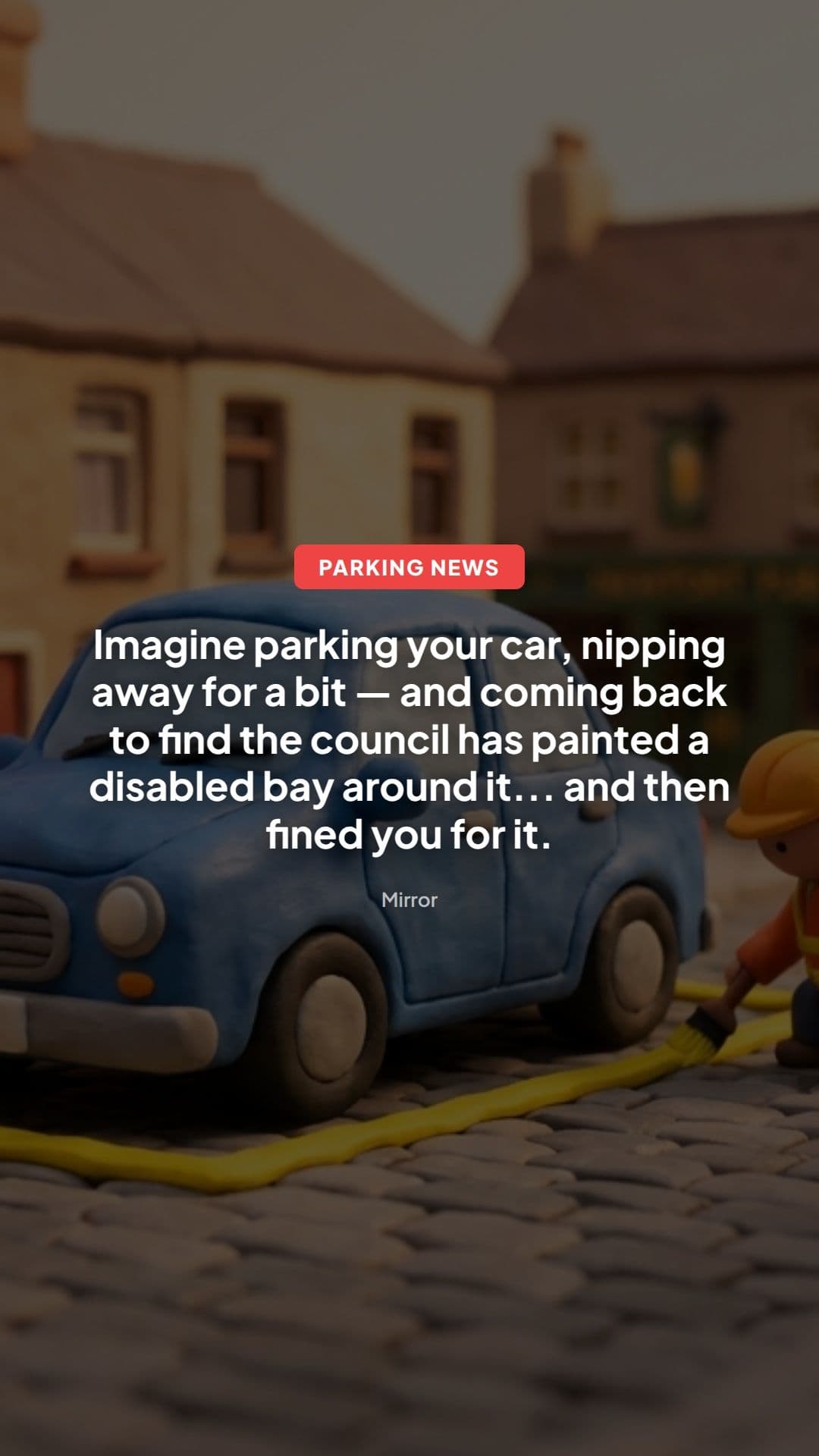
Fined While the Council Painted Around His Car: The Shocking Story That Exposes a Broken System
Imagine returning to your legally parked car to find a fresh coat of yellow paint surrounding it — and a parking fine tucked under your windscreen wiper. It sounds like something from a dark comedy sketch. But for one 66-year-old amputee in Newport, this was his real-life experience, and it raises serious questions about how councils handle parking enforcement, road marking procedures, and the rights of disabled drivers across the UK.
What Happened in Newport
According to a report in the Mirror, the man — a 66-year-old amputee — had parked his vehicle in what was, at the time, a perfectly ordinary parking space in Newport, Wales. While his car sat there, council workers arrived and painted a disabled bay around it. Shortly afterwards, a civil enforcement officer (CEO) issued him a Penalty Charge Notice (PCN) for parking in a disabled bay without displaying a valid Blue Badge.
Let that sink in for a moment. The bay didn't exist when he parked. The council created it around his stationary vehicle. And then, within minutes, he was fined for being in it.
Newport City Council has not disputed the basic sequence of events. The driver, understandably furious, has contested the fine. At the time of reporting, the outcome of that appeal had not been confirmed.
Why This Story Matters Far Beyond Newport
This isn't just a quirky local story. It's a vivid illustration of several systemic problems that affect drivers up and down the country.
First, it highlights the disconnect between highways teams and parking enforcement teams within the same council. Road marking crews and civil enforcement officers are often managed by entirely separate departments — sometimes even outsourced to different contractors. The left hand, quite literally, doesn't know what the right hand is doing.
Second, it raises urgent questions about the proper procedure for creating new parking restrictions. Under the Road Traffic Regulation Act 1984 and associated Traffic Management Orders, councils are required to follow a specific legal process before a new parking restriction becomes enforceable. This typically involves making a Traffic Regulation Order (TRO), publishing a notice, and allowing a period for public consultation or objection. You cannot simply paint lines on the road one afternoon and start issuing fines the same day.
Third, this case touches on the treatment of disabled people in the parking enforcement system — a subject that deserves far more scrutiny than it usually receives.
The Legal Angle: Can a Fine Like This Ever Be Valid?
In short: almost certainly not, and here's why.
Traffic Regulation Orders and Lawful Enforcement
For a parking restriction to be legally enforceable, it must be backed by a valid Traffic Regulation Order (TRO). The physical road markings — the yellow lines, the bay markings, the associated signs — are the visible expression of that TRO, not the TRO itself. Painting a disabled bay does not, by itself, create a lawful restriction. If the TRO was already in place but the bay had simply not yet been marked, there may be a grey area. But if the bay was marked on the same day enforcement began, without adequate signage and without the driver having any reasonable means of knowing the restriction existed when he parked, the PCN is almost certainly invalid.
Under the Traffic Management Act 2004, which governs civil parking enforcement in England and Wales, a PCN can only be issued for a contravention that was actually taking place at the time of issue. If the bay did not exist — or was not yet enforceable — when the vehicle was parked, there is no contravention.
The Reasonable Person Test
There's also a basic principle of fairness embedded in UK administrative law: a person cannot be penalised for failing to comply with a restriction they had no reasonable way of knowing about. Courts and adjudicators at the Traffic Penalty Tribunal (TPT) — which handles appeals in Wales and much of England outside London — have repeatedly upheld this principle. If a driver parked lawfully, and the restriction was created around their vehicle while they were absent, any resulting PCN should be cancelled at the formal representation stage, if not before.
Disability Discrimination Considerations
There is also a dimension here involving the Equality Act 2010. Disabled bay enforcement that disproportionately impacts disabled people — particularly in circumstances as absurd as this one — could, in extreme cases, be argued to constitute indirect discrimination. While this would be a high bar to clear in an appeal, it is worth noting that councils have a public sector equality duty that requires them to consider the impact of their decisions on people with protected characteristics, including disability.
What Drivers Should Know: Practical Takeaways
If you ever find yourself in a similar situation — or simply want to understand your rights better — here's what you need to know:
- Document everything immediately. If you return to your car and find new road markings that weren't there when you parked, photograph them from multiple angles. Include timestamps. Photograph any signs (or the absence of signs). This evidence is critical for any appeal.
- Check whether the TRO is in force. You can request a copy of the relevant Traffic Regulation Order from the council under the Freedom of Information Act 2000. If the TRO wasn't in place — or wasn't yet in effect — when you parked, the PCN has no legal foundation.
- Appeal at the informal stage first. Always challenge a PCN at the informal representation stage before paying. Paying a PCN, even at the discounted rate, is treated as an admission of the contravention. In a case like this Newport one, a clear written explanation of the timeline — supported by photographs — should be enough to get the fine cancelled without going to tribunal.
- Request the CEO's evidence pack. When you make a formal representation, the council must provide all the evidence an enforcement officer used to issue the PCN. In this case, that would include photographs taken at the time of issue — which should clearly show the freshly painted bay markings, potentially undermining the council's own case.
- Know your appeal route. In Wales, parking appeals are handled by the Traffic Penalty Tribunal. In London, it's the London Tribunals. Both are independent of the issuing council, and both have a track record of cancelling fines where enforcement has been procedurally flawed or manifestly unfair.
- Don't be intimidated by escalation letters. If you've submitted a valid appeal and are waiting for a response, debt collection letters and escalating notices can feel alarming. But a PCN cannot lawfully be pursued while a formal representation or appeal is pending.
Looking Ahead: A System That Needs to Change
The Newport case is an extreme example, but it points to a broader problem: parking enforcement in the UK has become increasingly automated, increasingly aggressive, and increasingly disconnected from common sense.
Councils are under significant financial pressure. Parking income — both from charges and from PCN revenue — contributes meaningfully to local authority budgets. That creates an incentive structure that isn't always aligned with fair enforcement. When highways teams and enforcement teams operate in silos, incidents like this one become almost inevitable.
What's needed is better internal coordination within councils, clearer rules about when newly created restrictions become enforceable, and a stronger presumption in favour of cancellation when a driver can demonstrate they parked lawfully before a restriction came into existence.
For disabled drivers, the stakes are even higher. The Blue Badge scheme exists to give greater independence to people with mobility impairments. Using disabled bay enforcement as a revenue tool — even inadvertently, even through administrative chaos — undermines that purpose entirely.
The man at the centre of this story is an amputee who parked his car legally, went about his day, and returned to find a fine waiting for him thanks to his own council's actions. If his appeal is handled properly, it should be cancelled without question. But the fact that he had to appeal at all — that the fine was issued in the first place — says everything about a system that is badly in need of reform.
Story originally reported by the Mirror. This analysis is based on publicly available information and general UK parking law.
Written by
Oliver Johansson
Traffic Management Consultant
Ready to Challenge Your Ticket?
Let our AI analyse your PCN and generate a professional appeal letter in minutes.
Start Free Appeal