
London Three-Ring Road Charge: What ULEZ Expansion Means
London could introduce a three-ring road-pricing scheme. Discover how it may reshape the Congestion Charge, ULEZ rules and costs for drivers across the capital.

The Parking Ticket Pal Editorial Team
8 October 2026
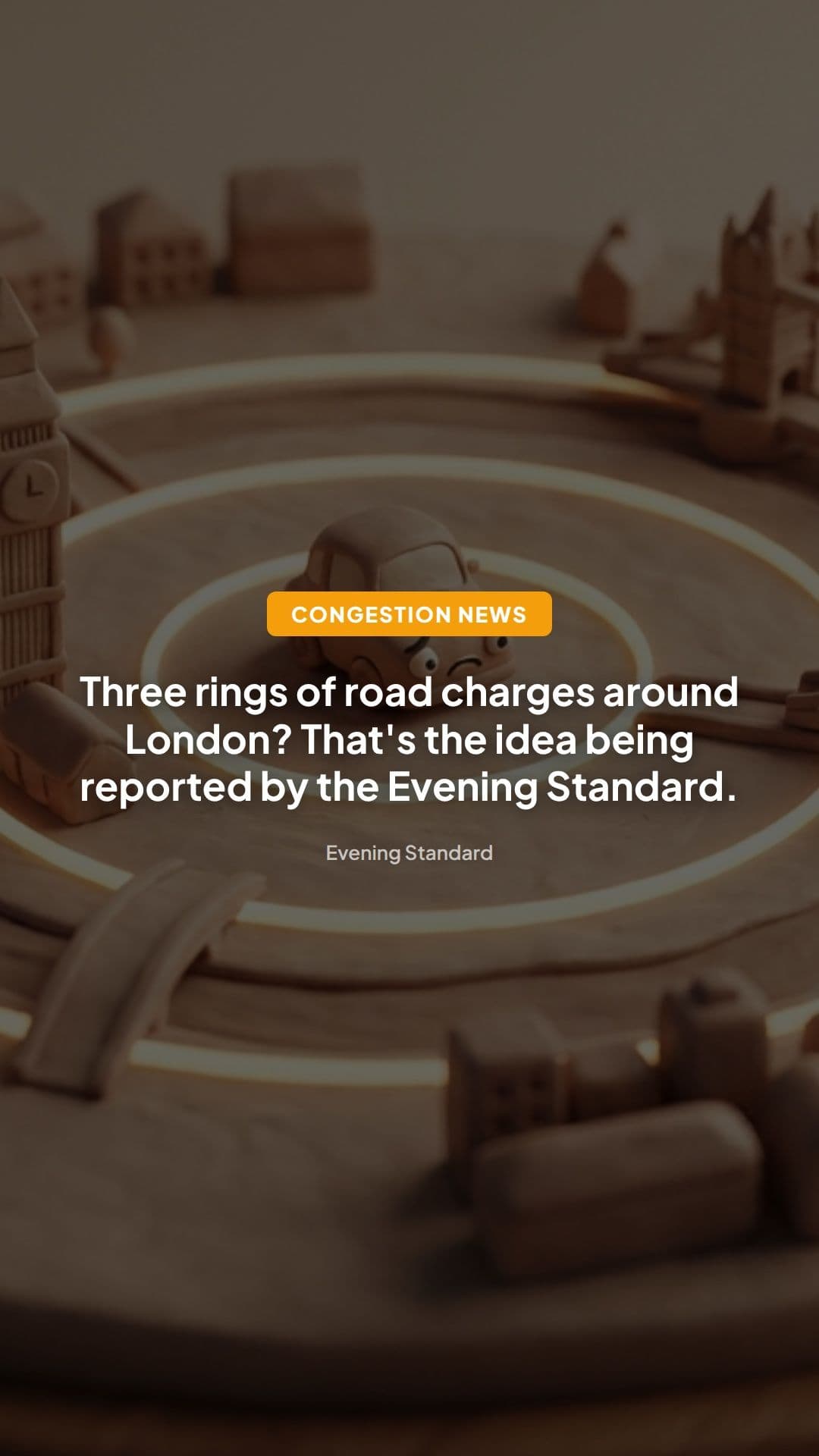
London's Three-Rings Charge Idea: What a Multi-Zone Road-Pricing System Could Mean for Drivers
Imagine driving across London and passing through not one charging boundary but three. Each ring might come with its own rules, its own rate and its own cameras. It sounds like a plot for a very dull board game, but it is the sort of idea now being discussed in the capital, and drivers should pay attention.
The Evening Standard has reported on proposals for a wider, multi-zone road-pricing system for London, with the "three-rings" label attached. The plans are linked to discussions about extending or restructuring the Congestion Charge and ULEZ. Nothing here is a confirmed scheme, so this post sets out what is actually known, how London's charging powers work, and what you can sensibly do now.
What has been reported
The core of the story is a concept rather than a finished policy. According to the Standard's reporting, the idea is a layered, multi-zone approach to charging for road use in London, rather than the current patchwork of separate schemes. It is being discussed alongside debates about whether the Congestion Charge and the Ultra Low Emission Zone should be extended or restructured.
I want to be careful about what this does and does not tell us. The source material does not give us confirmed boundaries, prices, start dates or exemptions, and I am not going to invent them. Anyone quoting precise figures for a "three-rings" scheme at this stage is guessing.
What we can say is that the direction of travel is clear. London has two big, separate charges aimed at different problems: the Congestion Charge targets traffic volumes in the centre, while ULEZ targets vehicle emissions across a far larger area. A multi-zone model would, in principle, tie these ideas together, with the charge depending on where you drive and, potentially, what you drive.
Why this matters more than it first appears
Two charges, two purposes, one confusing picture
Today, a driver in London may face the Congestion Charge, ULEZ, or both, depending on route, vehicle and time of day. Paying one does not cover the other. That is a common trap, and it catches out visitors and occasional drivers in particular. We cover the current Congestion Charge rate and how it works in our guide to the London Congestion Charge rise to £18.
A multi-zone system could simplify things if it replaced overlapping charges with one coherent structure. It could equally make them worse if it added another layer on top. Which of those outcomes happens depends entirely on design details that have not been published.
The history of London's zones is a story of change
Charging zones in London are not set in stone. The central Congestion Charge zone launched in 2003. A western extension arrived in 2007 and was later removed in 2011. ULEZ began in central London and was later widened, with its most recent expansion covering all London boroughs. We have looked at the effects in ULEZ expansion three years on.
That history matters because it shows that boundaries can be redrawn, added to or scrapped, but only through a formal process. A "three-rings" model would not appear overnight.
The money question
Any road-pricing scheme raises the same awkward question: is it a tool to change behaviour, or a source of revenue? Both aims are often present at once. If a driver changes their habits, revenue falls. If revenue is needed, the incentive to change habits weakens. Transport authorities have to balance these, and drivers are entitled to ask hard questions about where the money goes. That debate will follow any multi-zone proposal.
It also sits within a wider national conversation about charging for road use, including the plans we have covered in pay-per-mile tax for EVs and the Highways Bill and road charging.
The legal angle: who can change London's charges, and how
The statutory basis
London's road user charging schemes rest on the Greater London Authority Act 1999. Schedule 23 of that Act allows Transport for London (TfL) to operate charging schemes, and the Mayor of London sets them through a charging scheme order. Making or significantly varying a scheme requires following a formal process, which normally includes public consultation and consideration of objections.
In practical terms, a new ring or a major change to an existing zone would need to be:
- Proposed formally, with the details published.
- Consulted on, so Londoners, businesses and neighbouring authorities can respond.
- Confirmed through the legal order, which sets out the boundaries, charges, exemptions and penalties.
Until all of that happens, a proposal is just a proposal.
The ULEZ court case
The most relevant recent precedent is the High Court challenge to the 2023 ULEZ expansion, brought by several outer London councils. In 2023 the High Court dismissed that challenge, finding that the Mayor had the legal power to extend the scheme to all London boroughs under the existing framework. That does not mean every future proposal would be immune from challenge. Courts look at whether the right process was followed, whether the decision-maker acted within their powers, and whether the consultation was fair. It does show that the legal framework gives the Mayor considerable room to reshape the scheme.
Expect any multi-zone proposal to be tested on process, particularly where it affects boroughs and residents who have no vote in the Mayor's decisions about their own streets.
Penalties and your appeal rights
For the existing charges, the rules on enforcement are already well established, and a new system would likely follow a similar pattern. Failing to pay results in a Penalty Charge Notice (PCN). The usual structure is:
- TfL issues a PCN, typically reduced by half if paid within 14 days. Check TfL's website for the current penalty amounts.
- You can make written representations to TfL, usually within 28 days of the notice.
- If TfL rejects your representations, you can appeal to an independent adjudicator.
Grounds of appeal for road user charging PCNs are set out in regulations and can include the charge having been paid, the vehicle being exempt or eligible for a discount, or the vehicle having been taken without the owner's consent. We have a practical guide on what to do if you believe you have paid but TfL is still chasing you: ULEZ paid but TfL still chasing you. If you miss the deadlines and receive enforcement correspondence, our explainer on out-of-time statutory declarations may help you understand the process.
What drivers should know now
You do not need to change anything today because of a reported proposal. But there are sensible habits worth building, whatever happens next.
1. Treat each charge as separate. Until any rules change, the Congestion Charge and ULEZ are not interchangeable. Check both before travelling into London. TfL's own online vehicle checker is the reliable starting point.
2. Check your vehicle's ULEZ status properly. Compliance depends on the vehicle's emissions standard, not just its age or fuel type. Use the official checker with your registration number, and avoid third-party sites that charge a fee for what TfL offers free.
3. Make sure the DVLA has the right details. If you have recently bought or sold a vehicle, the keeper record matters. A PCN goes to the registered keeper, so an out-of-date record can mean a fine for a car you no longer own. Our guide to receiving a fine for a sold vehicle explains what to do.
4. Keep payment evidence. Save receipts, confirmation emails and screenshots. If a dispute arises, a dated record of payment is among the strongest pieces of evidence you can hold.
5. Watch for scams. Whenever charging changes are in the news, fake payment sites and text messages appear. Only pay through official TfL channels, and be cautious about links in unexpected messages.
6. Check any exemption or discount you rely on. Blue Badge holders, certain vehicle types and residents have historically had specific discounts or exemptions, and these usually need to be registered in advance. If a new structure is introduced, do not assume your existing arrangement carries over. Read the official guidance when it is published.
7. Respond to consultations. If a formal consultation opens, your response counts. You do not need to be an expert. Practical, specific examples of how a change would affect your journeys, your business or your household are often the most useful input.
Who could be most affected
A multi-zone design would not land evenly. Some groups are worth thinking about:
- Outer London residents who currently face fewer charges but rely on their cars for journeys that public transport serves poorly.
- Small businesses and tradespeople who drive into several zones daily and cannot easily pass costs on.
- Carers and people with mobility needs, for whom exemptions and discounts are not a convenience but a necessity.
- Drivers from outside London, who are the least likely to understand a more complex system.
These are reasonable questions for any proposal to answer. They are not predictions about what the scheme will contain.
Looking ahead
The Evening Standard's reporting tells us that the idea of a wider, multi-zone approach is being discussed. It does not tell us that it will happen. Here is what to watch for next:
- Published details: boundaries, charge levels, hours, exemptions and start dates.
- A formal consultation, which is the clearest sign a proposal is becoming real.
- Political reaction from the Mayor, boroughs, and neighbouring authorities outside London, whose residents may be affected.
- Legal scrutiny, particularly if proposals extend charging into areas with strong local opposition.
- Links to national policy, including how any London scheme fits with wider thinking on road pricing and the shift to electric vehicles.
The sensible approach for now is calm preparation rather than alarm. Understand how the current charges work, keep your records in order, and follow official sources rather than rumour. If a three-rings system does emerge from the discussion stage, you will have time to read the detail before it affects your wallet.
This article is general information about UK motoring and road-charging rules and is not legal advice. For official details, consult TfL's website and the Mayor of London's consultation pages, and seek professional advice if you are dealing with a specific penalty or dispute.
Written by
The Parking Ticket Pal Editorial Team
Source-checked parking guidance
Ready to Challenge Your Ticket?
Let our AI analyse your PCN and generate a professional appeal letter in minutes.
Start Free Appeal