
Leicestershire Camera Vans Target Seatbelt Offences
Leicestershire Police is trialling safety-camera vans for seatbelt checks. Find out how warning letters work, who may be spotted and what drivers should do.

The Parking Ticket Pal Editorial Team
21 October 2026
Leicestershire's Safety Camera Vans Are Now Checking Your Seatbelt
You know the vans. Parked on a verge or a bridge approach, they have spent years being associated with one thing: speed. Now, in Leicestershire, they are being pointed at something far more mundane and, in safety terms, far more important. Whether you have clicked a strap across your chest.
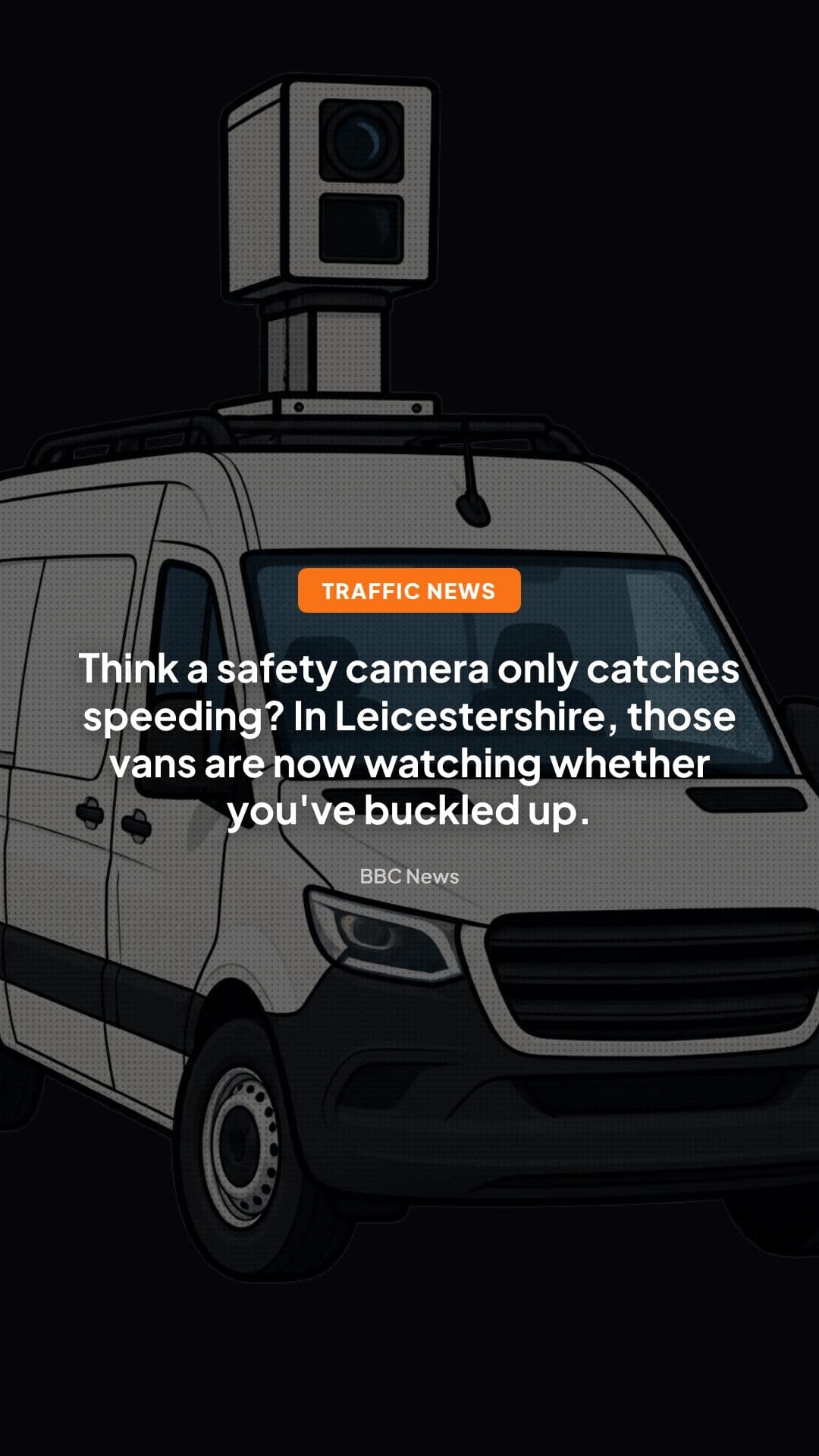
According to BBC News, Leicestershire Police is using safety-camera vans to identify drivers and passengers who are not wearing seatbelts. It is a week-long trial, and anyone caught will receive a warning letter rather than a prosecution. That detail matters, and so does what the trial may signal.
What actually happened
The facts reported so far are short and clear:
- Leicestershire Police is using its safety-camera vans to spot both drivers and passengers who are not belted up.
- The trial runs for one week.
- Those identified will get a warning letter, not a fixed penalty or court summons.
That is the extent of what the source confirms, so it is worth being careful about what we do not know. The report, as summarised, does not tell us what happens if the same person is caught more than once, whether the approach will continue after the week ends, or how the letters are matched to individuals. Those are exactly the questions that decide whether this stays a gentle nudge or becomes routine enforcement.
The "warning only" approach is typical of how new enforcement technology is introduced. A trial period lets a force test whether detection works in real conditions, such as bright sun, tinted glass, dirty windscreens and fast-moving traffic, without risking wrongful penalties while the kit is still being proven.
Why it matters
Seatbelts are still a stubborn problem
Seatbelt wearing is one of the oldest road safety rules in the country. Front seat belts became compulsory in Great Britain in the 1980s, and rear seat belt requirements for adults followed in 1991. Yet police forces still stop drivers who simply do not bother, and passengers, particularly in the back, are often the least consistent.
Unlike speeding, an unbelted occupant is hard to spot from the roadside. An officer on foot or in a patrol car has a split second to notice a diagonal strap across a torso, often through glass, in moving traffic. That is a poor match for human attention, and a very good match for a camera. This is the logic behind the move.
It fits a wider trend
If you read our coverage of AI road safety cameras and the surveillance debate, you will recognise the direction of travel. Camera technology is being repurposed to catch behaviour that used to rely on a lucky police sighting, such as mobile phone use and seatbelt offences. Our piece on AI cameras finding thousands of road offences in the West Midlands covers a similar shift in how enforcement works.
For drivers, the practical consequence is straightforward. The assumption that nobody is watching whether you are belted up is becoming less safe.
The "vans" detail
Safety-camera vans are mobile and can be moved about, so they do not give the predictability of a fixed box. A driver who knows exactly where the speed camera on their commute sits may adjust behaviour for that spot only. If vans are being used for seatbelt checks, the lesson is that the safe habit is to do it every journey, everywhere.
The legal angle
This is general information, not legal advice, and the position can change, so check official sources such as GOV.UK and the Highway Code for the current rules.
The basic rule
In Great Britain, the law requires seat belts to be worn in cars, vans and other goods vehicles where they are fitted. The Highway Code (Rule 99) states you must wear one if available, and the underlying requirements sit in the Motor Vehicles (Wearing of Seat Belts) Regulations 1993 and the Road Traffic Act 1988.
Who is responsible?
This is where many people get caught out:
- Drivers are responsible for making sure that passengers under 14 are correctly restrained, either with a seatbelt or an appropriate child restraint.
- Passengers aged 14 and over are legally responsible for their own seatbelts. They, not the driver, commit the offence if they are unbelted.
- Children generally need a suitable child seat until they reach 12 years old or 135cm in height, whichever comes first. The specifics on seat types are set out on GOV.UK.
That split of responsibility is important when a camera is identifying not only the driver but also passengers. A letter addressed to a vehicle's keeper may relate to someone else in the car. How Leicestershire handles that in practice is something the BBC summary does not explain.
The penalty
Outside a trial like this, the usual position for an adult seatbelt offence is a fixed penalty of £100. If the matter goes to court, the maximum fine is £500. Seatbelt offences do not normally carry penalty points on a licence, although it is still a criminal offence, and drivers should not treat it as trivial.
During this trial, none of that applies. A warning letter has no legal penalty attached to it. But it is a record that police have seen you, and it would be unwise to assume future enforcement would be equally forgiving.
Exemptions
Some people are lawfully exempt from wearing a seatbelt, for example:
- Those holding a valid medical exemption certificate (not simply a doctor's informal note).
- Drivers while reversing, or supervising a learner who is reversing.
- Certain licensed taxi and private hire drivers in specific circumstances, and some delivery drivers on local, stop-start rounds, subject to the conditions in the regulations.
If you rely on an exemption, keep your paperwork accessible and check the exact conditions on GOV.UK. A camera cannot know you are exempt, so a warning letter may arrive anyway and you may need to respond with evidence. If a real penalty is ever at stake and your circumstances are complicated, speak to a solicitor or an organisation such as Citizens Advice.
The civil side people forget
Even without any police involvement, not wearing a belt can cost you in other ways. In civil injury claims, courts have long applied the principle from Froom v Butcher (1975) that compensation can be reduced for contributory negligence where an injured person was not belted and the injury would have been less severe or avoided. The size of any reduction depends on the facts. It is a good reminder that the real stakes of a seatbelt are not a £100 fine.
What drivers should know
1. Do not treat a warning letter as a formality. It is not a penalty, but it signals that the force has your vehicle's details on record in connection with a seatbelt concern. If one arrives, read it carefully and follow any instructions on it.
2. Check who was actually in the car. If a letter arrives and you were not driving, or the details look wrong, respond in line with the instructions given. Do not ignore correspondence from police.
3. Brief your passengers. Particularly those in the back. If you are driving teenagers, remember they are legally responsible for themselves from 14, but as a practical matter the driver will be the one receiving any letter addressed to the vehicle.
4. Check child restraints properly. Because the driver is accountable for under-14s, this is where the legal responsibility lands on you. Make sure the seat is the right type for the child's height and weight and is correctly fitted. GOV.UK has the detailed guidance.
5. Sort out exemption evidence in advance. If you hold a medical exemption, keep the certificate to hand.
6. Do not rely on avoiding vans. Mobile vans can appear anywhere. A habit is more reliable than a map.
7. Mind other distractions too. Camera-based enforcement is not limited to belts. If you want a refresher on where the law stands on handheld devices, our guide to UK mobile phone driving laws and hands-free rules is a useful companion, and our roundup of Highway Code rules drivers miss covers other easy-to-overlook obligations.
Privacy and accuracy questions
It would be naive to pretend there are no questions here. Any system that looks into vehicles raises reasonable queries about accuracy, data handling and how errors are corrected. What does a false positive look like? A hoodie strap, a dark top, a bag across the chest or glare on the glass could, in principle, confuse a detection system. We do not know from the source how Leicestershire's trial handles human review before a letter goes out, and it would be wrong to guess.
Those questions are legitimate and are likely to feature if trials like this grow. For now, a warning-only approach is a sensible place to find the kinks before real penalties are on the table.
Looking ahead
A one-week trial with warning letters is clearly designed to test, learn and publicise. There are several ways this could develop:
- Education first, enforcement later. Forces often use letters as a stepping stone. If detection proves reliable, the next stage could be a more formal approach. That is speculation, not something the report says.
- Wider adoption. If other forces are watching the Leicestershire trial, similar schemes could appear elsewhere. Our earlier coverage of AI road safety trials finding thousands of violations shows how quickly this kind of technology has been attracting interest.
- Clearer rules on passengers. Detecting passengers raises practical questions about who gets contacted and how. Expect that to be tested.
- Public debate on surveillance. Each new use of cameras tends to prompt discussion about proportionality, and that debate is healthy.
For the average driver, the message is refreshingly simple. Nothing about the underlying law has changed. What has changed is the likelihood of being noticed if you break it. The cheapest, easiest and safest response is the one road safety campaigners have been repeating for decades: belt up, every journey, every seat.
This article is general information about UK motoring rules and is not legal advice. For the current law, penalties and exemptions, consult GOV.UK and the Highway Code, or seek professional advice if you are dealing with an actual enforcement matter.
Written by
The Parking Ticket Pal Editorial Team
Source-checked parking guidance
Ready to Challenge Your Ticket?
Let our AI analyse your PCN and generate a professional appeal letter in minutes.
Start Free Appeal