AI road safety cameras in the UK: safer roads or surveillance?
UK trials of AI road safety cameras could spot phone use, speeding and tailgating—but raise concerns over accuracy, bias, GDPR privacy and oversight.

Sophie Dubois
3 July 2026
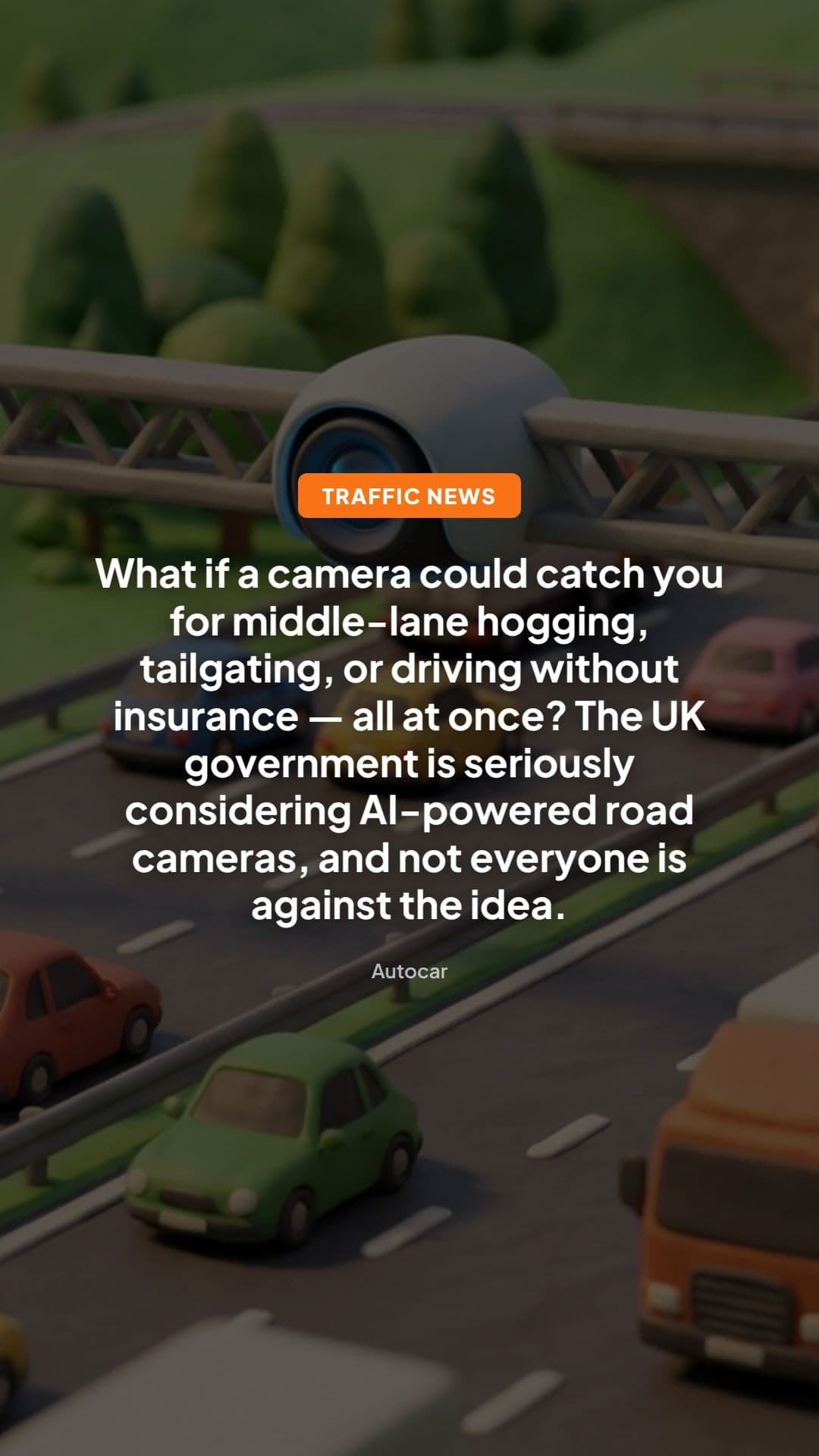
AI-Powered Road Safety Cameras: The Technology Watching Your Every Move on UK Roads
Imagine a camera that doesn't just clock your speed — it reads your body language, detects whether you're distracted, spots an unbelted passenger in the back seat, and flags you to enforcement officers before you've even had the chance to brake. That's not science fiction. It's happening right now on British roads, and the debate about whether we should welcome it or fear it is only just beginning.
What's Actually Happening
Autocar recently published a detailed analysis of AI-powered road safety camera trials and proposals, examining both the promise and the peril of deploying machine-learning systems to monitor driver behaviour at scale. The piece touches on trials already under way across the UK and Europe, considers the potential safety gains, and raises serious questions about accuracy, algorithmic bias, and the erosion of privacy.
But the story deserves far more unpacking than a single article can provide. Because this isn't just a tech story — it's a legal story, a civil liberties story, and a very practical story for the tens of millions of people who get behind the wheel every day in the UK.
The cameras in question go well beyond traditional speed detection. Using computer vision and machine learning, they are being trained to identify:
- Mobile phone use at the wheel — detecting hand-to-face gestures and screen illumination
- Seatbelt non-compliance — identifying whether drivers and passengers are belted up
- Driver distraction and fatigue — analysing eye movements, head position, and micro-expressions
- Tailgating and lane discipline — measuring vehicle spacing and lateral positioning
- Number plate recognition combined with behavioural scoring — building a picture of individual driver risk over time
Transport for London has already expanded AI-assisted mobile speed camera operations across London, and similar systems have been trialled in Highways England corridors. Meanwhile, charities such as IAM RoadSmart have been vocal advocates for wider rollout, arguing that the technology could save hundreds of lives annually.
Why This Matters More Than You Think
The context here is stark. UK road fatalities have plateaued in recent years — around 1,700 people are killed on British roads annually — after decades of steady decline. The low-hanging fruit of traditional enforcement (fixed speed cameras, drink-drive checkpoints) has largely been picked. To push casualties lower, road safety advocates argue we need smarter tools.
And the data on distraction is damning. The Department for Transport estimates that driver distraction contributes to approximately 25% of all road casualties. Mobile phone use at the wheel has surged despite hand-held phone laws being tightened in March 2022 under the Road Traffic Act 1988 (as amended), which now prohibit using a hand-held device for any purpose — not just calling or texting — while driving or supervising a learner.
Traditional enforcement simply can't keep pace. There are around 40 million licensed drivers in the UK and a finite number of traffic police. AI cameras, proponents argue, provide the only scalable solution.
But scale is precisely what makes critics nervous.
The Legal Angle: Rights, Regulations, and Accountability
This is where it gets genuinely complicated — and where drivers need to pay close attention.
What Law Currently Governs AI Camera Use?
There is no single, dedicated piece of UK legislation governing AI-powered road cameras specifically. Instead, a patchwork of existing laws applies:
- The Road Traffic Act 1988 — governs the offences these cameras would detect
- The Data Protection Act 2018 and UK GDPR — regulate how images and behavioural data are collected, stored, and used
- The Surveillance Camera Code of Practice (under the Protection of Freedoms Act 2012) — sets standards for public space surveillance, overseen by the Surveillance Camera Commissioner
- The Equality Act 2010 — relevant where algorithmic bias could result in discriminatory enforcement
The critical issue is evidential weight. For a camera-generated penalty to be legally enforceable, the evidence must meet the criminal standard (beyond reasonable doubt for criminal offences) or the civil standard for fixed penalty notices. AI systems that flag potential offences still require human review before enforcement action is taken — at least in current frameworks.
The Bias Problem
Multiple studies, including research from the Alan Turing Institute, have highlighted that facial recognition and computer vision systems can exhibit higher error rates for people with darker skin tones, women, and older individuals. If an AI camera is more likely to misidentify a Black driver as using a mobile phone than a white driver exhibiting identical behaviour, that constitutes indirect discrimination under the Equality Act 2010. This is not a hypothetical concern — it is a documented pattern in deployed AI systems globally.
Who Is Accountable When the AI Gets It Wrong?
This is arguably the most important unanswered question. If an AI system incorrectly identifies a driver as committing an offence and a penalty is issued, the current appeals infrastructure — Penalty Charge Notices through local authorities or Fixed Penalty Notices through police — does provide a route to challenge. However, obtaining disclosure of the algorithmic decision-making process is far from straightforward.
Under UK GDPR, individuals have the right to meaningful information about automated decision-making (Article 22). If a penalty is issued purely on the basis of an automated system without human review, drivers may have grounds to challenge not just the penalty itself but the process by which it was issued.
What Drivers Should Know Right Now
Here is the practical intelligence you need:
1. Know what these cameras can and cannot currently do legally AI cameras in current UK deployments flag potential offences for human review — they do not autonomously issue penalties. That human-in-the-loop requirement is your most important protection.
2. If you receive a penalty you believe was AI-generated, request full evidence Under the Criminal Procedure and Investigations Act 1996 and civil disclosure rules, you are entitled to see the evidence against you. Ask specifically whether AI or automated systems were involved in identifying the alleged offence, and request details of any human review.
3. Understand your data rights You can submit a Subject Access Request (SAR) to any public authority holding data about you, including CCTV or camera footage. Under the Data Protection Act 2018, they must respond within one month. If camera data is being retained beyond the stated purpose, that may breach UK GDPR.
4. Challenge AI-generated penalties on process grounds If you believe a penalty was issued without adequate human review of AI-flagged evidence, this is a legitimate ground of appeal at both the informal and formal representation stages.
5. The basics still matter most The most effective protection against AI cameras is the same as it's always been: put the phone in the glovebox, belt up every journey, and maintain safe following distances. These systems are specifically optimised to detect the behaviours most drivers think they can get away with.
Looking Ahead: A Surveillance Infrastructure in the Making
The trajectory here is clear. AI road cameras are coming — not as a possibility but as a policy direction backed by road safety charities, government bodies, and enforcement authorities. The question is not whether but how fast and with what safeguards.
What the UK currently lacks is a comprehensive legal framework specifically designed for AI-powered enforcement. The Law Commission has examined autonomous vehicles extensively, but the regulatory gap around AI surveillance infrastructure on public roads remains significant. Parliament will need to address questions of algorithmic transparency, independent audit requirements, bias testing protocols, and meaningful appeal rights before this technology is deployed at scale.
There is also the question of public trust. Research consistently shows that drivers accept speed cameras as legitimate — grudgingly — because the evidence they produce is straightforward and verifiable. An AI system that analyses your facial expressions and body language feels categorically different. Building the public consent necessary for these systems to function legitimately will require transparency that enforcement authorities have not historically been eager to provide.
The cameras are getting smarter. The laws governing them need to catch up — and drivers need to understand both what these systems can do and what rights they retain when technology makes a mistake.
Sources: Autocar, Department for Transport, Alan Turing Institute, Surveillance Camera Commissioner, UK GDPR (Data Protection Act 2018), Road Traffic Act 1988.
Written by
Sophie Dubois
Traffic Law Specialist
Ready to Challenge Your Ticket?
Let our AI analyse your PCN and generate a professional appeal letter in minutes.
Start Free Appeal