
Highway Code: when can drivers look away from the road?
Can drivers ever look away from the road? We examine the Highway Code exception, mobile phone law and the rules motorists must still follow in the UK today.

The Parking Ticket Pal Editorial Team
17 October 2026
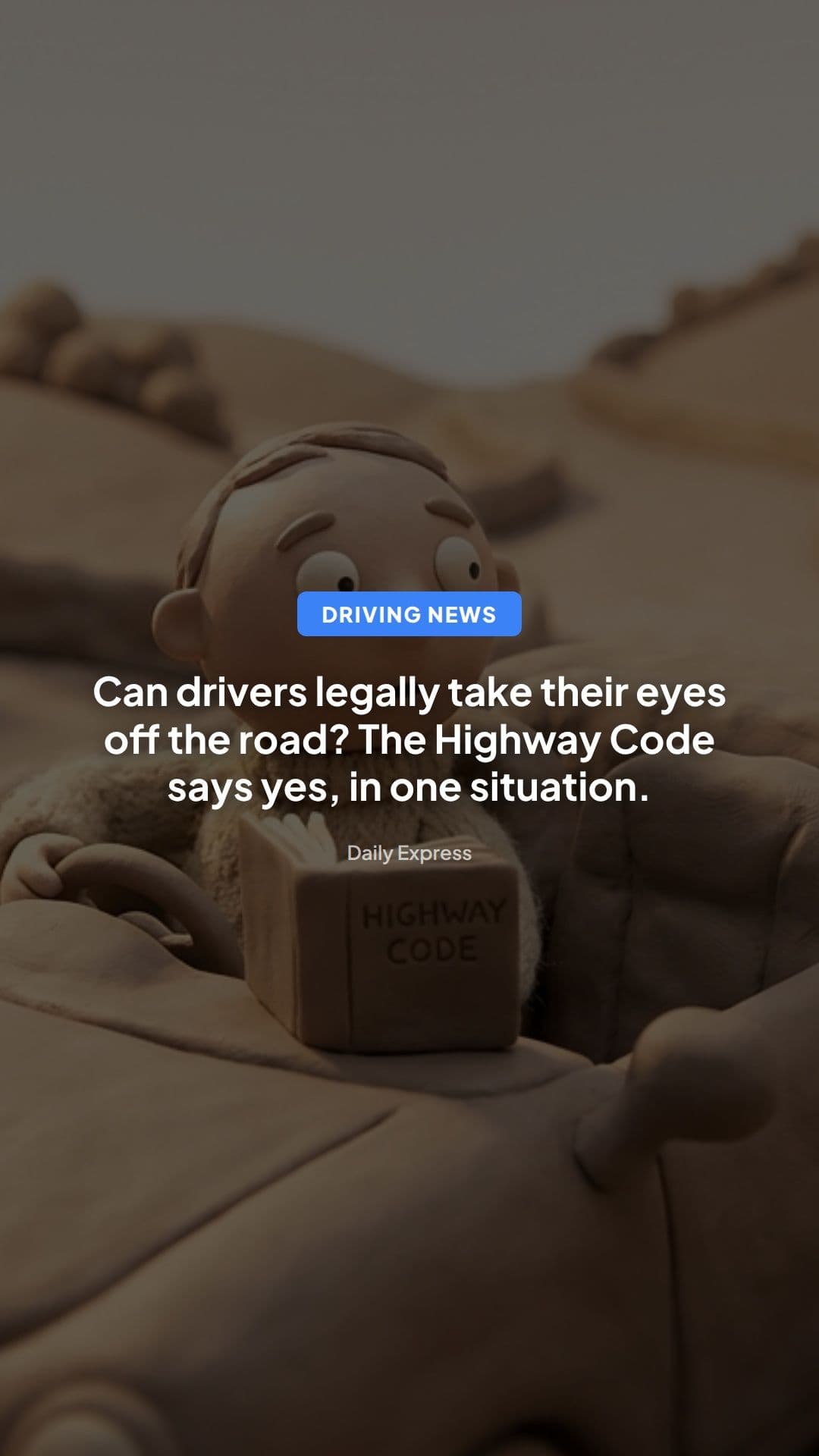
Highway Code Says Drivers Can "Take Eyes Off the Road" in One Situation. Here Is What That Really Means
"Drivers can take their eyes off the road" is the sort of headline that makes motorists stop scrolling, and then start arguing in the comments. After years of tougher enforcement on mobile phones, it sounds like a contradiction. It is not, but the exception is far narrower than the headline suggests. Misreading it could cost you £200 and six penalty points.
What the story says
The Daily Express reports on a limited situation in which the Highway Code allows a driver to briefly divert their gaze from the road. The same piece makes clear that using a handheld mobile phone while driving remains generally prohibited.
The best-known Highway Code provision of this kind concerns self-driving vehicles. Since the April 2022 update, the Code has said that while a vehicle is genuinely driving itself, in a situation it is approved to handle, the person in the driver's seat is not responsible for how it drives. They do not have to watch the road continuously and may look at non-driving content on the vehicle's built-in screen.
The conditions attached are what matter:
- The vehicle must be authorised or approved as self-driving, not merely fitted with driver assistance.
- It must be operating in a situation it is designed and approved for.
- You must be ready to retake control when the vehicle prompts you, such as when it reaches the limits of what it can handle.
- The permission applies to the vehicle's built-in screen, not to your handheld phone.
So the headline is accurate in a technical sense, but it describes a scenario most UK drivers will not be in for some time, if at all.
Why it matters: the gap between marketing and law
Cars have been sold for years with names and features that suggest they can drive themselves. Adaptive cruise control, lane centring, "hands-off" highway modes and traffic-jam assist all take over some of the work. In law, though, they are driver assistance systems. You are still the driver, and you remain responsible for what the car does.
That distinction matters because a headline like this invites a dangerous assumption: "my car has lane assist, so I can check my messages." You cannot. If your vehicle has not been approved as self-driving, the usual rules apply in full. Eyes on the road, hands ready, attention on the task.
There are two reasons the confusion is likely to grow:
- The technology is spreading. Even mainstream cars now offer systems that steer, brake and accelerate with very little input.
- The law is catching up. The Automated Vehicles Act 2024 sets up the framework for authorising self-driving vehicles in Great Britain, with the main regime expected to be phased in over the next couple of years. Timelines have shifted before, so check current government guidance rather than assuming a date.
The legal angle
Handheld phones: the baseline rule
The main offence is under regulation 110 of the Road Vehicles (Construction and Use) Regulations 1986. Since 25 March 2022 it has covered far more than calling or texting. It is an offence to hold and use a phone or similar device while driving for any interactive function, including:
- Calling or messaging
- Scrolling social media or playing games
- Taking photos or videos
- Using the camera or browsing the internet
The offence applies even if you are stopped at traffic lights, in queuing traffic or with the engine on. The engine being off is not the test. Whether you are "driving" in law is.
The penalty is a £200 fixed penalty and six penalty points. If the case goes to court, the maximum fine is £1,000, or £2,500 for drivers of buses or goods vehicles, and disqualification is possible. Drivers within their first two years of holding a licence face having it revoked under the Road Traffic (New Drivers) Act 1995 if they reach six points.
There are narrow exceptions. You may use a handheld phone to call 999 or 112 in a genuine emergency when it is unsafe or impractical to stop. You may also make a contactless payment, for example at a drive-through, if the vehicle is stationary.
Hands-free is not a free pass
Using a phone through a cradle, Bluetooth or voice control is not covered by the handheld offence, but it is not risk-free. Under regulation 104 of the same regulations, you must be in a position to have proper control of your vehicle and a full view of the road and traffic ahead. Police can also pursue careless driving (section 3 of the Road Traffic Act 1988) or, in serious cases, dangerous driving (section 2) if your attention was clearly elsewhere. A device that blocks your view, or an interaction that takes your attention away for too long, can lead to prosecution even if you never touched the phone.
Self-driving: where responsibility shifts
The Automated Vehicles Act 2024 changes who is responsible when a vehicle is genuinely driving itself. In outline:
- A vehicle must be authorised as self-driving before it can be treated this way.
- When it is driving itself, the person in the driver's seat is described as a "user-in-charge". They have immunity from many offences that arise from the driving itself, such as dangerous driving or speeding.
- Responsibility for the driving shifts towards the authorised self-driving entity, typically the manufacturer or a licensed operator.
That immunity is not total. A user-in-charge is expected to remain fit and able to drive, so being drunk in the driving seat is still a problem. They still have responsibilities for matters outside the driving task, such as insurance, and keeping the vehicle roadworthy. The detail of exactly which duties remain with the user-in-charge is set out in the Act and in secondary legislation, so read the official guidance rather than relying on summaries, including this one.
On insurance, the Automated and Electric Vehicles Act 2018 already provides that insurers are the first port of call for accident victims when a listed vehicle is driving itself. As far as I am aware, there are no vehicles currently approved for private use that let UK drivers treat them as self-driving in this way, but this is a fast-moving area, so check the Department for Transport's current position.
What drivers should know: practical advice
1. Check what your car is, not what it is called
Look in the handbook for wording such as "driver assistance" or "driver must remain attentive." If the manufacturer says you must keep watching the road, then in law you are the driver. Features with names like "Autopilot", "Pilot Assist" or "hands-off mode" do not change that, and a name on the dashboard is not an authorisation.
2. Never treat your handheld phone as part of the exception
Even if you do one day own an approved self-driving vehicle, the Highway Code allowance relates to the built-in screen. A phone in your hand is a different matter. Be cautious about how this might play out, especially as the system may hand control back to you with little warning.
3. Know what "ready to retake control" means
If a self-driving system prompts you to take over, you need to be able to respond promptly. Being absorbed in a film or a message and ignoring the alert could create real problems if there is an incident. The detail of how this is judged will develop as the regime beds in, but the principle is clear: you cannot disengage entirely.
4. Set up your phone before you set off
For ordinary driving, the simplest approach is the safest:
- Mount your phone securely before moving off, positioned so it does not block your view.
- Set your sat nav route before you start, or have a passenger do it.
- Use "Do Not Disturb While Driving" modes where available.
- If you need to use your phone, find a safe place to stop. Pulling up on a hard shoulder or in a place where you are causing an obstruction is not a good plan.
5. Remember the normal glances
The Highway Code does not expect your eyes to be glued to the bonnet. Checking mirrors, speedometer and a properly mounted sat nav is part of driving. The danger is in glances that become long, repeated or about something unrelated to driving. If you are ever challenged, how long and how often you looked away, and in what circumstances, would be relevant.
6. Be careful with smartwatches and other devices
The 2022 changes were framed around "interactive communication devices," so smartwatches, tablets and similar devices can fall within the offence if you hold and use them. For more on this, see our guide to smartwatches while driving, and our explainer on UK mobile phone driving laws and hands-free rules.
7. If you are stopped or fined
If you receive a fixed penalty or are summonsed for a phone-related or careless driving offence, take the paperwork seriously and check deadlines. For anything contested, particularly where a licence is at risk, speak to a solicitor who specialises in road traffic law rather than relying on general articles. A related read is our piece on why drivers can be fined at traffic lights.
Looking ahead
The headline may be catchy, but it reflects something real: the law is slowly preparing for a world where the person in the driver's seat is not always the one driving. As the Automated Vehicles Act is implemented, expect more detailed rules on authorisation, on what a user-in-charge may and may not do, and on how responsibility is shared when something goes wrong. Expect also more public debate about whether drivers can really stay "ready to take over" when they have been invited to look away.
In the meantime, nothing changes for the overwhelming majority of motorists. If you are driving a conventional car, or one with driver assistance, you are driving. Your eyes belong on the road, your phone belongs out of your hand, and the "eyes off the road" exception belongs to a technology that, for most of us, has not yet arrived.
Key takeaways
- The Highway Code allowance relates to genuinely approved self-driving vehicles, not driver assistance.
- Handheld phone use while driving can mean a £200 fine and six points, even when stationary in traffic.
- Hands-free is not automatically safe. Careless or dangerous driving charges can still apply.
- Even in a self-driving context, you must remain ready to take back control.
- This article is general information, not legal advice. For your own situation, consult official guidance on GOV.UK or a qualified professional.
Written by
The Parking Ticket Pal Editorial Team
Source-checked parking guidance
Ready to Challenge Your Ticket?
Let our AI analyse your PCN and generate a professional appeal letter in minutes.
Start Free Appeal