Smartwatch while driving: UK law, fines and points
Is using a smartwatch while driving illegal in the UK? We explain the handheld phone rules, potential fines and points, and how to avoid accidental offences.

Carlos Mendoza
23 June 2026
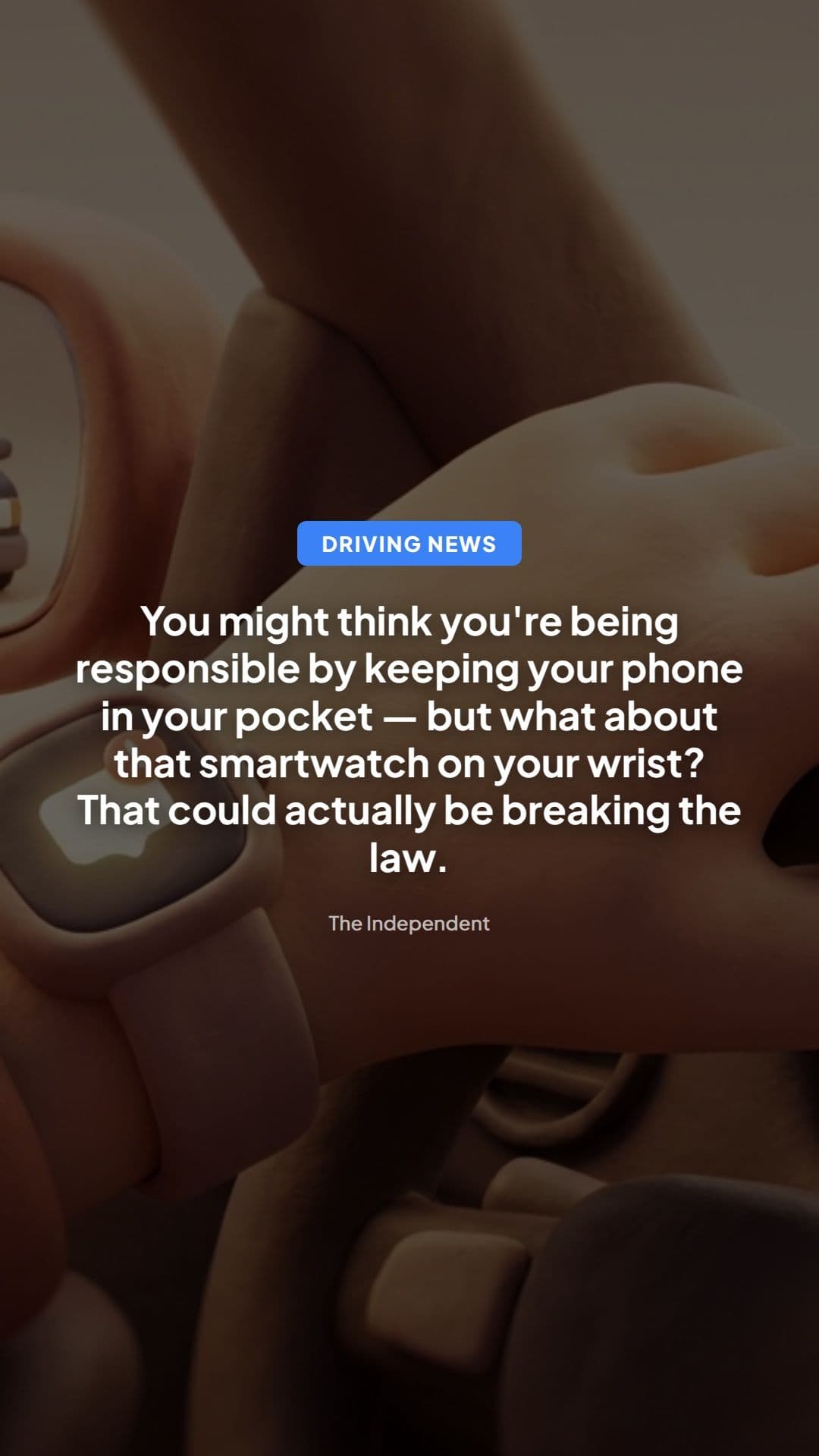
Is Using a Smartwatch While Driving Illegal? What UK Drivers Really Need to Know
You're sitting at a red light. Your wrist buzzes. Without thinking, you glance down and tap your smartwatch to dismiss a notification. It takes less than two seconds. Harmless, right?
Wrong — and it could cost you £200 and six penalty points.
That's the stark warning emerging from recent RAC guidance, which has prompted widespread coverage including a detailed explainer in The Independent. But the headlines only scratch the surface of what is actually a surprisingly nuanced area of UK law — one that could catch out millions of drivers who genuinely believe they're doing nothing wrong.
What the RAC Guidance Actually Says
The RAC's guidance makes clear that interacting with a smartwatch whilst driving — whether you're dismissing a notification, checking a message, or swiping through a fitness app — may constitute an offence under UK law. This isn't a new rule, exactly. It's more a clarification of how existing legislation applies to technology that didn't exist when those laws were originally drafted.
The issue has gained fresh urgency because smartwatch ownership in the UK has surged dramatically. According to industry figures, tens of millions of Britons now wear some form of connected wearable device. Many of those people drive every single day, and a significant proportion will be interacting with their wrists without any awareness that they may be breaking the law.
Why This Matters More Than You Might Think
Here's the thing that makes this story genuinely important: we're not talking about people making obviously reckless decisions. We're talking about drivers who have actively tried to be responsible — who bought a smartwatch precisely so they wouldn't need to reach for their phone — inadvertently committing an offence they didn't know existed.
That's a meaningful distinction. The public conversation around mobile phones and driving has been running for two decades. Most drivers understand, at least in principle, that using a handheld phone behind the wheel is illegal and dangerous. But smartwatches occupy a grey area in people's minds. They feel different. They're attached to your body. They're designed for quick, glanceable interactions. Surely they can't be treated the same as scrolling through Instagram on your iPhone?
As it turns out, the law may well treat them exactly the same — depending on how you use them.
The Legal Framework: What the Law Actually Says
The key piece of legislation here is the Road Vehicles (Construction and Use) (Amendment) (No. 4) Regulations 2003, which introduced the original mobile phone driving ban. This was significantly strengthened by the Road Safety Act 2006 and then updated again in February 2022, when the government closed a loophole that had previously allowed drivers to use phones for non-interactive purposes such as taking photos.
The 2022 amendment was crucial. It extended the law to cover any use of a handheld device — not just calls or texts. The offence now applies whenever a driver uses a device that is "held" in their hand to perform an "interactive communication function." The penalty is a £200 fixed penalty notice and six penalty points. For new drivers within their first two years of passing their test, six points means an automatic licence revocation.
So where do smartwatches fit in? The critical question is whether a smartwatch constitutes a "handheld device" within the meaning of the regulations. Technically, a smartwatch is worn on the wrist rather than held in the hand — which might seem to take it outside the scope of the law. But legal experts and motoring organisations have cautioned that this distinction may not protect drivers as much as they'd hope.
There are two potential legal routes a prosecution could take:
- The handheld device argument — If a driver physically lifts their wrist and manipulates the watch with their other hand, a court could reasonably conclude they are "holding" the device in a functional sense, bringing it within the scope of the regulations.
- Careless or dangerous driving — Even where the handheld device law doesn't strictly apply, police retain the power to prosecute under the Road Traffic Act 1988 for driving without due care and attention (careless driving) or dangerous driving. Glancing at a wrist-mounted device and becoming momentarily distracted is precisely the kind of behaviour these provisions are designed to capture.
The Highway Code also comes into play. Rule 149 states that drivers must exercise proper control of their vehicle at all times and should not allow anything to distract them. Smartwatch interaction — however brief — clearly falls within the spirit of that rule.
What Drivers Should Know: Practical Advice
Given the legal ambiguity, the safest approach is to treat your smartwatch exactly as you would your mobile phone while driving. Here's what that means in practice:
Before you set off:
- Enable Do Not Disturb mode on your smartwatch. Both Apple Watch and most Wear OS devices allow you to set this automatically when a connected drive is detected, or to activate it manually before you start the engine.
- Turn off haptic notifications — if your wrist isn't buzzing, you won't be tempted to check.
- Use theatre mode if your watch supports it. This keeps the screen dark and silences alerts entirely.
On the road:
- Never interact with your watch whilst moving, even at slow speeds or in queuing traffic. The law applies whenever the engine is running and the vehicle is on a public road.
- Don't dismiss notifications, change tracks, or check fitness data. Even a two-second interaction can constitute an offence.
- Pulled over safely and engine off? That's a different matter — but make sure you're genuinely stationary in a safe location, not simply at a red light.
If you're stopped by police:
- Be aware that officers have discretion. A brief, involuntary glance at a notification might not result in a prosecution, but deliberate interaction almost certainly could.
- If you receive a fixed penalty notice you believe is unjust, you have the right to contest it in court — though doing so means risking a higher fine if unsuccessful.
The Broader Picture: A Law Struggling to Keep Up With Technology
This story is really part of a much larger narrative about UK road law and its relationship with rapidly evolving technology. The 2022 mobile phone regulations were themselves an attempt to future-proof the law — but even those updated rules were written before the current generation of smartwatches became mainstream consumer products.
The government and the DVSA are aware of the challenge. As vehicles become increasingly connected and wearable technology becomes more sophisticated, the line between "using a device" and simply "existing in a world full of screens" becomes harder to draw. Head-up displays, voice assistants, in-car entertainment systems — all of these raise similar questions about distraction and legal liability.
What's notable about the smartwatch issue is that it highlights a fundamental tension in how we regulate driver behaviour: the law focuses on the device, but the real danger is the distraction. A driver who glances at a smartwatch for two seconds is arguably no more dangerous than one who looks at a sat-nav or adjusts the heating — activities that are currently legal.
Looking Ahead: Expect Clearer Guidance, and Possibly New Rules
It seems likely that the government will eventually need to address smartwatches specifically, either through updated regulations or formal guidance from the DVSA. The current situation — where millions of drivers are potentially committing offences without realising it — is neither fair nor sustainable.
In the meantime, the RAC's guidance serves as a timely reminder that ignorance of the law is not a defence. The safest, most legally sound approach is simple: if it has a screen and it's on your body, don't touch it while you're driving.
The two seconds it takes to swipe away a notification aren't worth £200, six penalty points, and the very real possibility of causing a collision. Switch the watch to silent, keep both hands on the wheel, and deal with whatever buzzed when you arrive safely at your destination.
Your wrist can wait.
Written by
Carlos Mendoza
Parking Technology Analyst
Ready to Challenge Your Ticket?
Let our AI analyse your PCN and generate a professional appeal letter in minutes.
Start Free Appeal