
Havering Bus Stop PCN Appeal Allowed: What Drivers Learn
A Havering bus stop PCN appeal was allowed. Learn how evidence, road markings and the council's legal duties can help challenge a restricted bus stop penalty.

The Parking Ticket Pal Editorial Team
2 November 2026
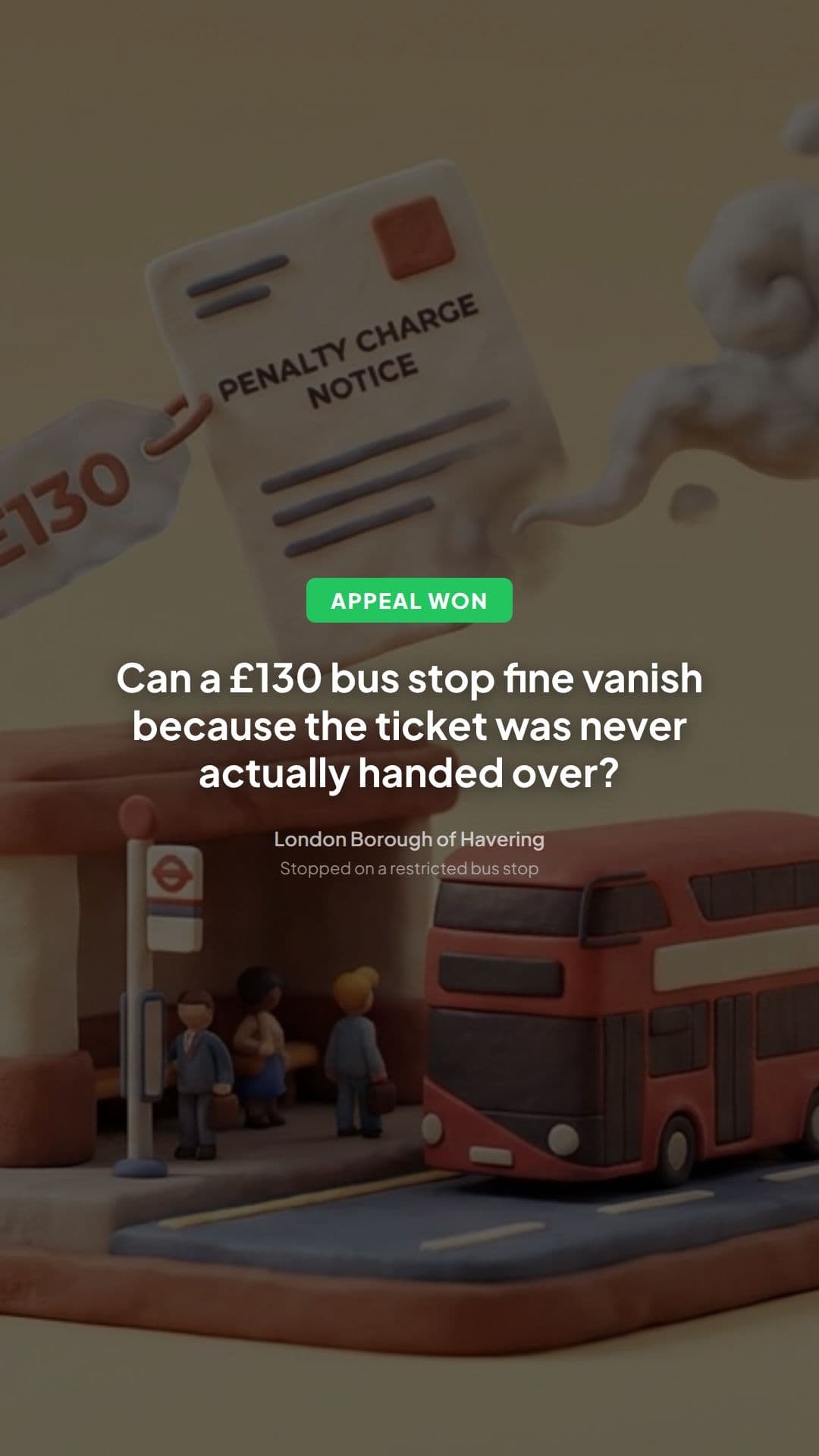
Stopped at a Bus Stop, Not Handed the Ticket: How a Havering Driver Won Her Appeal
Most drivers who get a parking ticket assume the argument is about one thing: were they in the wrong place? But a penalty charge notice (PCN) is not just an accusation. It is a legal document that has to reach you in a particular way. A recent Havering case shows what happens when the council cannot prove it did that, even where nobody disputes the vehicle was stopped where it should not have been.
The case: a bus stop, a car and a birth
The contravention was "stopped on a restricted bus stop". In London, this is commonly known as PCN code 47. Bus stops are usually protected by clearway markings and signs, and stopping on them is prohibited, even briefly. For more on how these codes work, see our guide to understanding PCN codes.
The vehicle was stopped at the location. The appellant, the registered keeper, did not deny it. She attended the hearing with her brother, who had been driving that day. She also produced a witness statement from her husband, who had been a passenger.
She also gave the adjudicator her daughter's birth certificate. It showed the child was born soon after the PCN was issued. The adjudicator's written reasons do not spell out the explanation for the stop, so we should not guess at the details. But the timing suggests the circumstances were pressing.
Havering Council produced its own evidence:
- a copy of the PCN
- the civil enforcement officer's (CEO's) notes
- photographs
- a record that the PCN was handed to the driver
That last point turned out to be the crux of the case.
The arguments
The driver's side. The appellant accepted the car was there and explained why. But the key issue was something else: whether the PCN had been properly served. Her brother, the driver, said he had not been handed the notice. Her husband, a passenger, backed up the account in a witness statement.
The council's side. The council relied on the paperwork. The CEO had recorded that the notice was given to the driver. It was a straightforward position: the officer saw a contravention, issued a PCN, handed it over, and recorded having done so.
The decision
The adjudicator allowed the appeal.
The adjudicator identified the issue as whether the PCN was properly served. Having heard from the appellant and the driver, and having had the chance to question them on their evidence, the adjudicator was "persuaded" the PCN was not handed to the driver. Since it was not served as the law requires, the appeal succeeded.
Notice what the adjudicator did not say. There was no finding that the car was not on the bus stop, and no ruling that the stop was excusable. The case was won on procedure, not on the underlying contravention.
The legal reasoning in plain English
Why service matters
Councils enforce parking through a statutory scheme. It gives them the power to issue penalty charges, but it also sets rules for how they must do it. If a council skips a required step, the penalty can fall even where the parking was clearly wrong.
The rule at issue here is Regulation 9 of the Civil Enforcement of Parking Contraventions (England) General Regulations 2007. In simple terms, where a CEO has reason to believe a penalty charge is payable for a stationary vehicle, the officer may serve the PCN in one of two ways:
- Fixing it to the vehicle, typically the familiar windscreen envelope, or
- Giving it to the person who appears to be in charge of the vehicle, in other words handing it to the driver.
So the officer has a choice, but must actually do one of those things. The council here said it had used the second method. The appellant's evidence was that it had not happened.
Other routes exist
The regulations also provide for other methods in limited circumstances. One example is posting a notice where a vehicle drives away while the officer is partway through issuing it. Those routes have their own conditions. The adjudicator's reasons here focus solely on the handing-over route, so it is not clear that any other method was in play.
Who has to prove what?
In these tribunals, the council generally carries the burden of showing that the contravention occurred and that the PCN was properly issued and served. The standard is the balance of probabilities, meaning "more likely than not". That is much lower than the "beyond reasonable doubt" test used in criminal courts.
This matters because the CEO's note is evidence, not a guarantee. It sits on one side of the scales. If the tribunal hears credible evidence pointing the other way, it is entitled to prefer it.
The importance of live evidence
The adjudicator stressed hearing from the appellant and driver and being able to test their evidence. That is a reminder that credibility matters. Written papers can be persuasive, but a witness who gives a clear, consistent account and answers questions well can change the outcome.
We cannot tell from the reasons whether the CEO attended the hearing or how the notes were challenged. What we do know is that, on the evidence, the adjudicator was satisfied that the PCN was not handed over.
Is procedural failure really enough?
Yes, where the failure goes to whether the PCN was validly served. Tribunals can allow appeals on specified legal grounds, which include procedural impropriety by the authority. The adjudicator's decision here is a good illustration of why those grounds exist. Councils get their enforcement powers on the condition that they follow the rules.
What this case does not mean
It is worth being realistic. This decision turned on its own facts and on the adjudicator's assessment of the witnesses. It is not a rule that saying "nobody handed me the ticket" will win an appeal. Tribunals weigh the evidence in each case, and many appeals fail when the account is inconsistent or the council's evidence is more convincing.
Nor does the birth certificate excuse the bus stop contravention. Compelling circumstances can be relevant to a council's discretion or to a tribunal's recommendation in some cases, but this appeal was allowed because of service, not sympathy.
Lessons for drivers
1. A PCN has two hurdles: the contravention and the process
Most people focus on whether they were parked correctly. But an appeal can also ask whether the council did everything the law requires. If the contravention is clear but the paperwork or service is flawed, the outcome may still be in the driver's favour. Our guide to formal representations for UK parking fines explains how councils respond to challenges.
2. Pay attention to how the notice reached you
If you receive a PCN, note how it arrived: on the windscreen, handed to you, or by post. That detail can matter. If the PCN was said to be handed to the driver, the driver's account of what actually happened could be central evidence.
3. Evidence from people who were there can matter
The husband's witness statement and the brother's live evidence were part of what persuaded the adjudicator. Where others witnessed events, their accounts may help. Statements that are consistent with each other and with the facts tend to carry more weight than vague or conflicting ones.
4. Attending a hearing can make a difference
The adjudicator emphasised having heard from the witnesses in person. Hearings give a tribunal the chance to test evidence and judge credibility. Many tribunals now offer remote hearings, and our guide to online tribunal hearings for PCN appeals explains how they work. For an overview of the process, see navigating the traffic penalty tribunal process.
5. Be honest and keep your account consistent
The appellant did not deny the vehicle was at the location. She accepted that and focused on the issue that mattered. Credibility is hard to rebuild once it is damaged, and a candid account on the undisputed facts can strengthen the argument on the disputed ones.
If you are weighing up an appeal where the amount at stake is significant, or the facts are complicated, official guidance from the relevant tribunal or independent advice from a qualified adviser can help you judge your own position.
How this compares with other bus stop cases
Bus stop appeals often hinge on different points, such as whether the markings and signs were adequate or whether the vehicle was genuinely stopped. If you are interested in those angles, take a look at our write-ups of the Kingston bus stop PCN appeal and the Lambeth bus stop PCN appeal. Together they show that bus stop PCNs can fail for several quite different reasons.
Key takeaway
A council has to prove it served your PCN in a way the law allows, not just that you stopped in the wrong place. In this Havering case, the driver's contravention was not in dispute, but the adjudicator was not satisfied the notice had been handed over as recorded, and that was enough to win the appeal.
This article is general information and commentary on a published tribunal decision. It is not legal advice and does not reflect the outcome you might expect in any other case. If you are dealing with a PCN, check the guidance provided by your council and the relevant tribunal, and consider independent professional advice where the stakes are high.
Written by
The Parking Ticket Pal Editorial Team
Source-checked parking guidance
Ready to Challenge Your Ticket?
Let our AI analyse your PCN and generate a professional appeal letter in minutes.
Start Free Appeal