Lambeth Bus Stop PCN Appeal Allowed: A Driver’s Lesson
A Lambeth bus stop PCN appeal was allowed. Learn what to check on restricted bus stop signs, evidence and council paperwork before challenging a penalty.

The Parking Ticket Pal Editorial Team
12 August 2026
When Sick Happens: The Taxi Driver, the Bus Stop, and the Law of Genuine Emergencies
Why This Case Matters
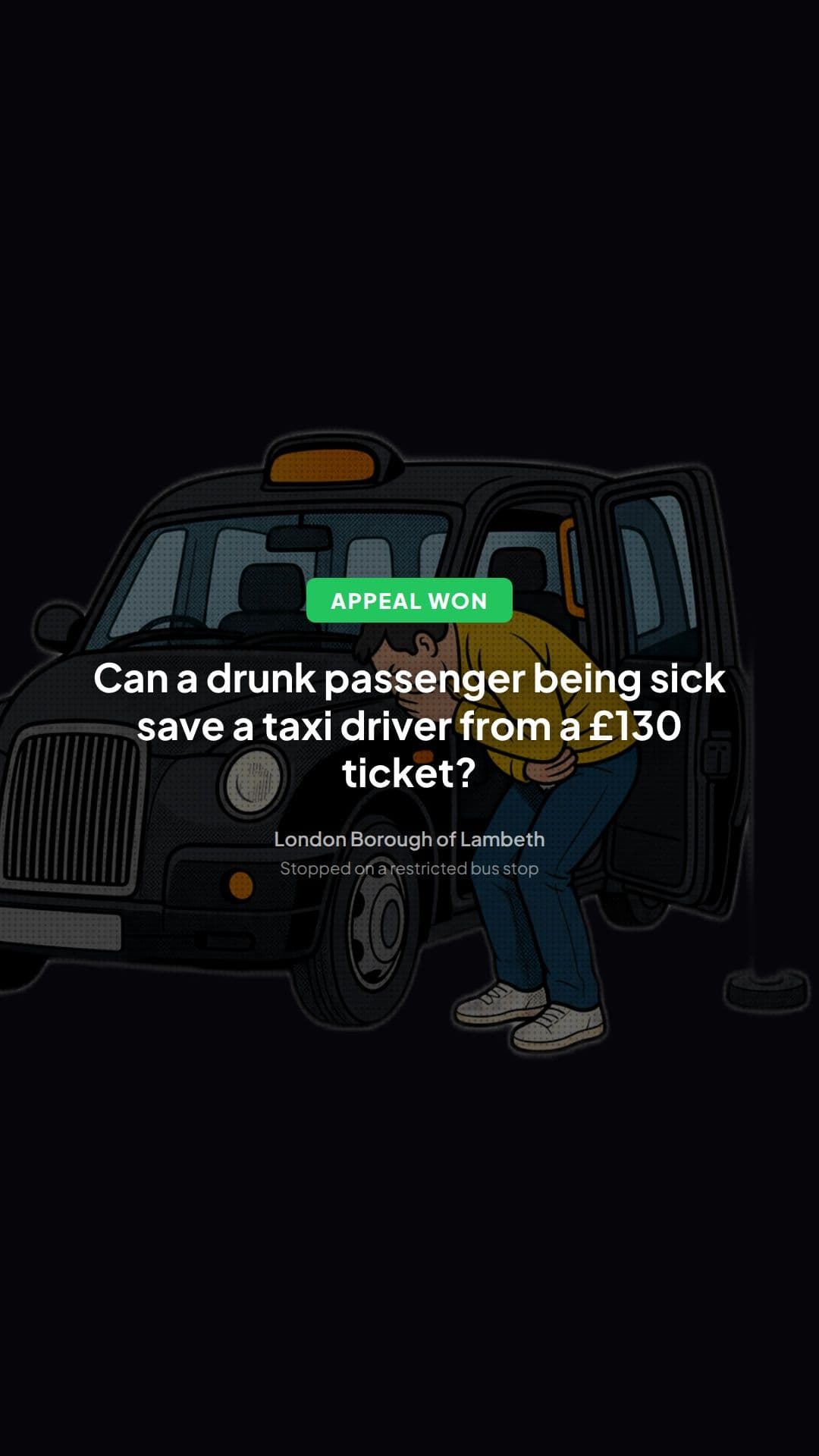
Picture the scene: it's gone midnight, you're driving a licensed taxi, and a drunk passenger in the back suddenly starts vomiting. Do you keep driving to the nearest legal parking spot, risking a filthy cab and a distressed passenger, or do you pull over immediately, wherever you happen to be, even if that's a bus stop?
Most people's gut instinct says stop the car. But parking enforcement doesn't run on gut instinct, it runs on rules, cameras, and penalty charge notices (PCNs). This Lambeth case, heard at the London Tribunals (which handles parking appeals for the capital), shows what happens when real-world necessity collides with strict traffic regulations, and offers a rare example of an adjudicator siding firmly with the driver.
The Case: A Bad Night on Waterloo Road
The facts are refreshingly simple, at least on their face. In the early hours of Friday, 14 June 2013, a licensed London taxi driver was on a fare that had started in Holborn. His route took him over Waterloo Bridge and onto Waterloo Road, a stretch that includes a restricted bus stop.
According to the driver, one of his passengers, who was drunk, began being sick inside the cab. He pulled over so the passenger could get out and vomit outside the vehicle rather than inside it. Unfortunately for him, the spot he happened to stop at was a bus stop, and Lambeth Council's CCTV enforcement system caught the moment. A PCN was issued at 00:28, timestamped in the small hours of the morning.
Bus stop contraventions are taken seriously in London. Bus stops are protected precisely because even a few seconds of obstruction can disrupt bus services and inconvenience passengers relying on public transport. Camera enforcement in these zones tends to be strict and largely automatic, which is exactly why this case is interesting: it shows what happens when a driver pushes back against that automatic process with a human explanation.
The Arguments: Vomit Versus Video
The driver's defence rested on a single, well-supported claim: he stopped because of a genuine, sudden emergency, not because he wanted to load, unload, or wait at the bus stop for any ordinary reason. Crucially, he didn't just assert this himself. He obtained a written statement from the passenger involved, confirming that they had indeed been sick and that the stop happened for that reason.
Lambeth Council, for its part, didn't accept the story at face value. Its argument was that the CCTV footage didn't actually support what the driver was describing. In other words, the council was essentially saying "the pictures don't back up your version of events," implying the stop looked more like an ordinary, unjustified halt at a restricted location rather than a genuine medical emergency.
This is a common pattern in PCN appeals: the council relies on the objectivity of camera evidence, while the driver relies on context and corroboration that the camera alone can't capture.
The Decision: Adjudicator Sides With the Driver
The adjudicator allowed the appeal. Having reviewed the CCTV footage themselves, they explicitly rejected the council's characterisation of it, stating that "the activity seen at the cab is entirely consistent with the appellant's account." Combined with the supporting statement from the passenger, the adjudicator accepted the driver's version of events in full.
The reasoning was clear and short: an emergency situation prevailed, and therefore the appeal succeeded.
The Legal Reasoning, Unpacked
There's an important legal principle sitting quietly behind this decision, one that doesn't get spelled out in the transcript but underpins the whole outcome: genuine emergencies can justify what would otherwise be a contravention.
Parking and traffic rules are generally applied strictly. Adjudicators don't usually have much sympathy for "I was only there for a minute" or "there was nowhere else to stop." The system is built on clear lines, and blurring them tends to undermine enforcement. But there's a recognised exception for situations that are genuinely unavoidable and outside the driver's control, such as sudden medical events. Readers interested in how this principle applies more broadly to emergency vehicles and unavoidable stops may find our piece on emergency vehicle exemptions a useful companion read.
A few things made the difference here:
The evidence had to actually match the story. It wasn't enough for the driver to simply claim an emergency. The adjudicator looked at the CCTV footage and found that what it showed, presumably the vehicle stopping abruptly, a passenger getting out quickly, activity consistent with someone being unwell, lined up with the driver's account. If the footage had shown something inconsistent, such as the driver calmly waiting at the bus stop for several minutes with no obvious urgency, the outcome would likely have been very different.
Independent corroboration strengthened the case significantly. The passenger's written statement was pivotal. It's one thing for a driver facing a fine to say "someone was sick in my cab." It's another for the person who was actually sick to confirm it in writing. This turned a self-serving claim into a corroborated account, which carries far more weight before a tribunal.
The council's scepticism wasn't enough on its own. Lambeth argued the CCTV didn't support the driver's account, but crucially, they didn't provide a compelling alternative explanation for what the footage did show. Simply asserting that evidence is inconsistent isn't the same as demonstrating it. The adjudicator reviewed the footage independently and reached their own conclusion.
Lessons for Drivers
This case, while unusual in its specifics, offers some genuinely useful takeaways for any driver who might find themselves stopping somewhere they shouldn't, for reasons entirely beyond their control.
Get evidence at the time, not after the fact. The passenger's statement was central to this appeal succeeding. If you're ever forced into an emergency stop, try to get contact details or a written account from anyone who witnessed or was involved in the situation, while it's still fresh. Memories fade, and people move on.
CCTV can help you as much as it can hurt you. It's tempting to assume that camera footage always favours the council. In this case, the footage was reviewed independently by the adjudicator and found to support the driver, not undermine him. If you believe footage backs up your account, don't be put off by the council's interpretation of it; ask for it to be reviewed properly.
"Emergency" has to mean genuinely unavoidable. This isn't a loophole for convenient stops. A sudden illness, a medical episode, or another genuinely uncontrollable event is very different from simply misjudging traffic or deciding a bus stop was the easiest place to wait. Adjudicators will scrutinise whether the situation was truly beyond the driver's control.
Detail matters more than drama. The driver didn't need an elaborate defence. He explained clearly what happened, when, and why, and backed it up with one solid piece of supporting evidence. Appeals often succeed or fail on the strength of a few well-chosen facts rather than lengthy argument.
Professional drivers face particular scrutiny, but also particular protections. As a licensed taxi driver dealing with a member of the public in his vehicle, this driver had a duty of care that arguably justified prioritising the passenger's welfare over strict compliance with parking restrictions. Anyone in a similar profession facing a PCN in comparable circumstances should consider seeking advice on formal representations, since these situations often turn on how persuasively the context is presented.
If you're dealing with a PCN and believe genuine emergency circumstances applied, it's worth looking at how to structure a formal representation clearly and factually, since the burden will be on you to show, not just assert, that the situation was unavoidable.
Key Takeaway
A parking contravention isn't automatically excused just because you had a good reason to stop, but if you can show, through evidence rather than assertion, that you faced a genuine emergency entirely outside your control, and that the evidence available actually supports your account, a tribunal can and will allow the appeal. In this case, a passenger's vomiting turned a routine bus stop PCN into a lesson in how corroborated honesty beats an assumption dressed up as CCTV analysis.
Written by
The Parking Ticket Pal Editorial Team
Source-checked parking guidance
Ready to Challenge Your Ticket?
Let our AI analyse your PCN and generate a professional appeal letter in minutes.
Start Free Appeal