
China Targets Car Touchscreens in Safety Crackdown
China plans safety evaluations for vehicles with large touchscreens before road approval. What the proposed rules could mean for drivers and car design.

The Parking Ticket Pal Editorial Team
15 October 2026
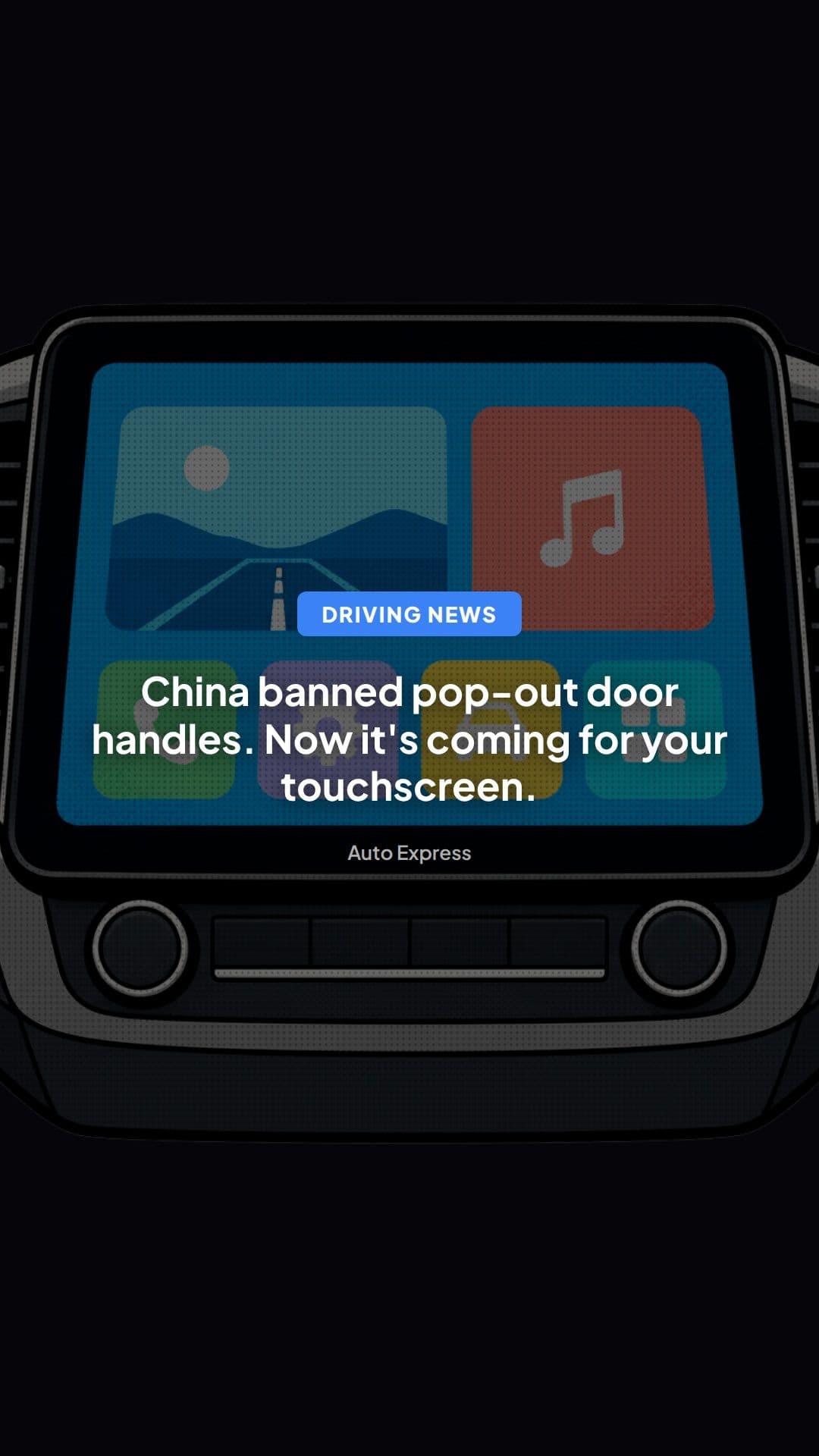
China Targets Car Touchscreens: What It Means for UK Drivers
Picture a dark, wet evening on the A-road home. The demister is fogging up, so you reach for the climate controls, which are now three menus deep on a glossy screen. Your eyes leave the road for a second, then two. Most drivers with a modern car have had a moment like this, and regulators are starting to take notice.
According to Auto Express, China's Ministry of Industry and Information Technology (MIIT) has said vehicles with large touchscreens must undergo safety evaluations before receiving road approval. It comes hot on the heels of the country's move against pop-out door handles. Nothing has changed for UK drivers overnight, but the story says a lot about where car design and regulation may be heading.
What happened
Two pieces of news sit side by side here.
Door handles first. China's regulators moved against flush, pop-out door handles, the retractable kind that sit flat against the bodywork and are often electrically operated. As widely reported, the concern is that if power is lost, such as after a crash, people may struggle to get out or be rescued. The requirement has been described as a mechanical release that works without electrical power. Check the Auto Express report and official Chinese announcements for the exact scope and dates, as the detail matters.
Now touchscreens. Per the source, the MIIT says vehicles with large touchscreens must go through safety evaluations before they are approved for the road. The summary does not set out the test criteria, screen size thresholds or deadlines, so it would be wrong to guess. What we can say is the direction of travel. Regulators are no longer treating the infotainment screen as a gadget bolted onto a car. They are treating it as part of the vehicle's safety system, to be assessed like brakes, lighting or seatbelts.
That shift in thinking is the real story.
Why it matters
Screens have taken over the dashboard
Over the past decade, physical buttons and dials have been replaced in many cars by touch-sensitive panels and menus. For manufacturers, the appeal is obvious. A screen is cheaper than a bank of switches, easier to update by software and gives a clean, minimalist look in the showroom.
For drivers, the trade-off is attention. A physical dial can be found by touch, while a screen usually needs a glance. Even a short glance away from the road at 60mph covers a lot of ground. Drivers have been vocal about this, which we've covered in our posts on why UK drivers dislike car touchscreens and the debate over touchscreen climate controls.
The same logic links doors and screens
It might seem odd to group door handles and touchscreens together, but the thread is the same. Both are cases where convenience, styling and cost-saving have pushed a safety-relevant function into electronics. When something that used to be a simple mechanical action becomes software-dependent, regulators begin asking what happens when it fails, or when a driver is distracted by it.
Why China's moves carry weight
China is the world's largest car market and a major exporter, and Chinese brands are increasingly visible on UK roads. Chinese rules apply to cars approved for sale in China, not to cars sold in Britain. UK-market vehicles are approved under UK rules. But global manufacturers often prefer to design one cabin for many markets. A requirement in a huge market can therefore nudge design choices elsewhere, though how far is for the industry to decide.
The legal angle: what applies in the UK
There is currently no UK law that bans large touchscreens or requires them to undergo a specific screen safety evaluation. Here is what does exist, as general information.
Vehicle approval and construction rules
New cars sold in Great Britain must meet type approval requirements, which draw on international (UNECE) technical regulations, alongside the domestic Road Vehicles (Construction and Use) Regulations 1986. These cover many safety areas. They are not, at present, a dedicated "touchscreen test" in the way the Chinese move appears to be.
Your own responsibility as a driver is also relevant. The Construction and Use Regulations require a driver to be in a position to have proper control of the vehicle and a full view of the road and traffic ahead. Screens that show video-type content within the driver's view are also restricted by the regulations.
Using screens while driving
Since the 2022 change to the mobile phone rules, it is an offence to hold and use a phone or similar device while driving. The penalty is £200 and six penalty points. That rule is aimed at handheld use. It does not on its face make it illegal to touch a fixed, built-in infotainment screen.
That does not mean a screen is a free pass. If fiddling with the display means you drive without due care and attention, you could face a careless driving charge, and in serious cases dangerous driving, under the Road Traffic Act 1988. Police look at the standard of driving, not just the device involved. If a screen distraction contributes to a collision, the legal and insurance consequences can be serious. For a refresher on the phone rules, see our guide to UK mobile phone driving laws and hands-free rules.
Euro NCAP is already nudging the market
Here the UK has a quieter version of the same pressure. Euro NCAP, the independent safety rating body, has introduced updated protocols from 2026 that reward cars for keeping physical controls for key functions, such as indicators, hazard lights, wipers, horn and emergency call. It is not law, and a rating is not a legal requirement. But manufacturers care deeply about star ratings, so it influences design. Our post on Euro NCAP's overhaul of driver assistance testing looks at the wider picture.
Door handles and emergency exit
On door handles, the UK has no equivalent ban that we are aware of, though cars sold here must meet applicable approval standards. If you are interested in the wider question of what happens to drivers in emergency scenarios, our piece on whether you can get a PCN if you are trapped touches on a related theme.
What drivers should know
You do not need to wait for a regulator to make safer choices. Here are some practical points, particularly if you are shopping for a new or used car.
1. Test the controls on your test drive, not just the acceleration. Try adjusting the temperature, fan speed, demisting and wipers while driving, ideally with a passenger or dealer present and in a safe, legal manner. Ask yourself how many taps each task takes and how long your eyes leave the road.
2. Look for physical controls for the essentials. Dedicated buttons or dials for demisting, hazard lights, volume and wipers are far easier to use without looking. Check the Euro NCAP rating and its commentary where available.
3. Learn the manual door release before you need it. Whatever car you drive, find out how the doors open if the power fails, both from inside and outside. Sit in the back seat and try it, because rear emergency releases are often hidden. Show family members and regular passengers. It is a five-minute job that could matter in a real emergency.
4. Know what happens if the 12V battery goes flat. In some cars with electronic handles, a flat low-voltage battery can complicate getting in. Your handbook should explain the backup method. Keep it in mind, particularly if the car sits unused for long periods.
5. Set up before you set off. Pre-set your navigation, climate and audio while parked. Use voice control where it works reliably, and pull over safely if something needs more attention. Do not hold a phone, even to follow a map.
6. Treat parking apps and payments the same way. If you use an in-car or phone app to pay for parking, do it before you drive off, not at the lights. Our guide to PayByPhone app errors and proving payment explains how to protect yourself when technology lets you down.
7. Keep your insurer informed and your records tidy. If you are in a collision, be aware that investigators can look at what you were doing at the time. Using any device carelessly could affect an insurance claim. Read your policy and speak to your insurer or a broker if you are unsure.
8. If you have been charged with an offence, take proper advice. This post is general information, not legal advice. If you face a driving charge, the official GOV.UK guidance and a qualified solicitor are the right places to start.
Looking ahead
Several things are worth watching.
Will the UK follow? There is no sign from this story that the UK will adopt Chinese-style pre-approval testing for touchscreens. The UK government's approach so far has leaned towards letting standards, ratings and existing law do the work, rather than banning specific designs. That could change if evidence of screen-related distraction accumulates, and the Chinese example may feed into the debate.
Will carmakers quietly bring buttons back? Some already are. Between consumer pushback, Euro NCAP's new emphasis on physical controls and regulatory attention abroad, many manufacturers have reason to rethink all-touch cabins. Expect more marketing that stresses "tactile" controls.
What about Chinese brands in the UK? Chinese manufacturers are growing in the UK market. Their UK-sold cars must meet UK approval requirements, whatever happens in China. But how they respond to a tougher home regime may shape the interiors they bring here. It is too early to say exactly how.
What about software? One genuinely new challenge is that over-the-air updates can change how a car's screen works after you have bought it. Regulators will need to decide how safety evaluations apply to a system that can be rewritten. This is a question the Chinese announcement hints at but, based on the source, does not fully answer.
The bottom line
China's moves on door handles and touchscreens show regulators becoming less willing to accept that sleek design and safety are separate conversations. For UK drivers, the immediate effect is nil, but the lesson is useful. When you choose a car, judge it on how it works at 60mph in the rain, not how it looks on the showroom floor. And when you are behind the wheel, remember that the law cares about how you drive, whatever the screen in front of you looks like.
This article is general information about UK motoring rules and is not legal advice. For official guidance, see GOV.UK, and speak to a qualified professional if you face a specific legal issue.
Written by
The Parking Ticket Pal Editorial Team
Source-checked parking guidance
Ready to Challenge Your Ticket?
Let our AI analyse your PCN and generate a professional appeal letter in minutes.
Start Free Appeal