
Car Touchscreen Climate Controls: Why No Ban Is Planned
Euro NCAP says touchscreen climate and audio controls are not time-critical. What the proposed safety rules could mean for UK drivers and new cars today.

The Parking Ticket Pal Editorial Team
13 October 2026
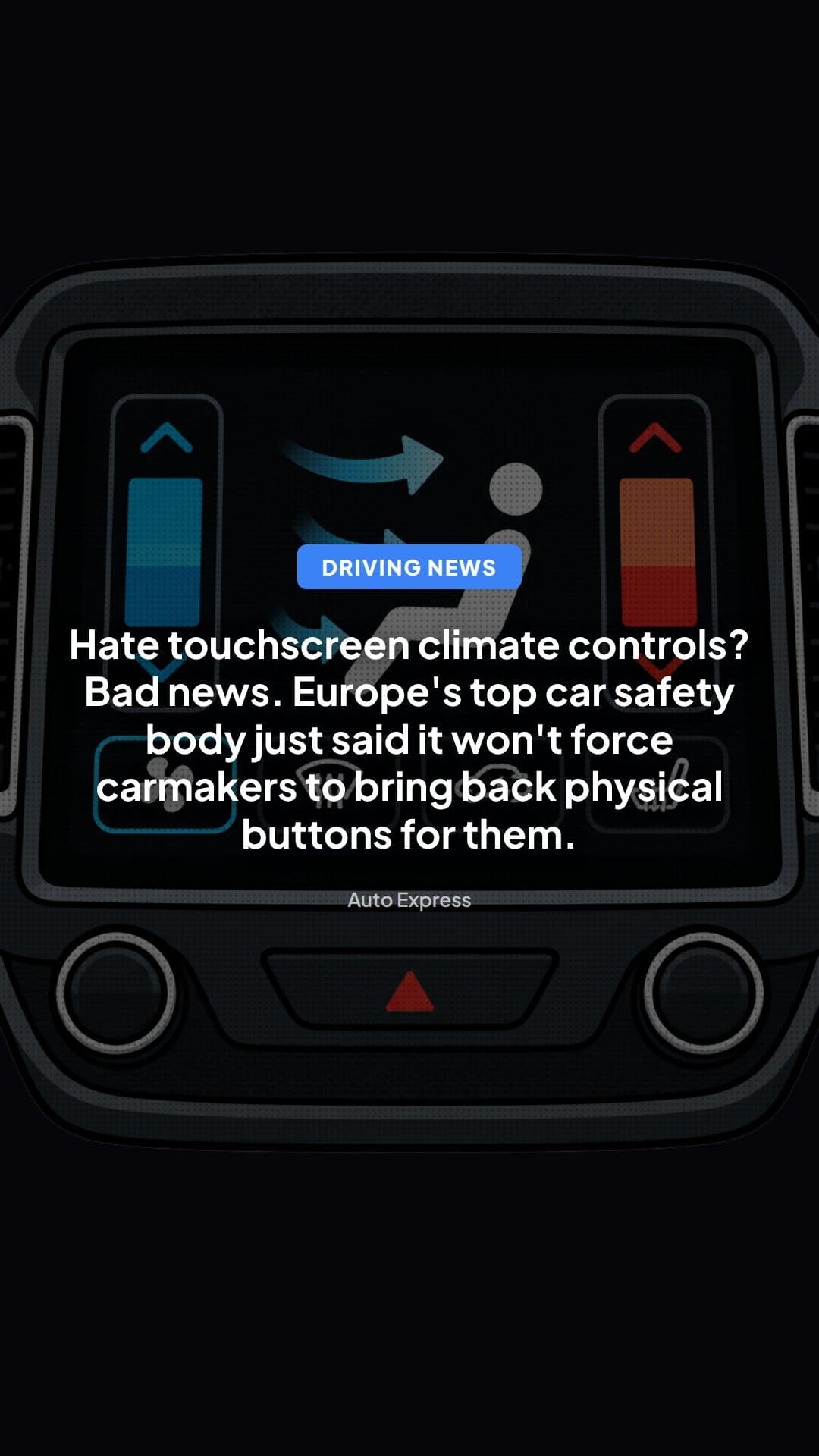
Touchscreen Climate Controls Escape the Crackdown: What Drivers Need to Know
Anyone who has jabbed at a glossy dashboard screen to stop the windscreen fogging, while a lorry fills the mirror, will have wondered whether carmakers have gone too far. Safety experts have been asking the same question, and a new twist suggests the cure may not be as complete as many motorists hoped.
According to Auto Express, Euro NCAP safety experts have said climate and audio controls are not considered time-critical functions. That means they are not currently covered by the proposed restrictions on touchscreen controls. In plain English, your car's heating, air conditioning and stereo can still be buried in a menu without costing the manufacturer its safety rating.
What actually happened
The story needs a little unpacking, because it is easy to read "no ban" and assume something dramatic has been decided. Nothing has been banned or legalised here. Euro NCAP is an independent safety rating body, not a lawmaker. It cannot forbid a carmaker from fitting a touchscreen, and it cannot fine anyone.
What it can do is shape what manufacturers build. A top star rating is a powerful marketing tool, and brands tend to design cars to hit the criteria. Euro NCAP's upcoming assessment approach, as widely reported, rewards cars that keep physical controls for a short list of functions considered safety-critical. These include hazard warning lights, indicators, windscreen wipers, the horn and emergency call functions. The reasoning is that these are things you may need to operate instantly, by feel, without looking away from the road.
The clarification reported by Auto Express is that climate and audio controls do not make that list. Euro NCAP's experts do not regard them as time-critical, so a car that hides the temperature dial three taps deep is not marked down on that basis.
Two details are worth emphasising:
- The restrictions are proposed and rating-based. They are incentives for manufacturers, not legal requirements for drivers or vehicles.
- "Not time-critical" is a judgement call. It does not mean climate controls are risk-free to use on the move. It means they sit lower in the priority order than the horn or the hazards.
Why it matters more than it sounds
At first glance this looks like a niche technical footnote. In practice, climate control is the function many drivers fiddle with most, and the one where a poorly designed interface is most annoying.
Think about a typical journey. You pull away on a cold morning and the windscreen mists up. You need the demister, the fan speed and perhaps the rear screen heating. In a car with physical buttons, that is a muscle-memory job. In a car where those functions live on the screen, it can mean looking away from the road, finding the right menu, and prodding a flat, featureless surface that gives no tactile feedback.
Euro NCAP's view appears to rest on a distinction. A hazard light or a wiper is something you need immediately in response to an event outside the car. A warmer cabin is something you want, but can usually wait a few seconds for. That is a reasonable argument in a lot of cases. It is a weaker one when the "comfort" control is actually a visibility control, as it is when your windscreen is fogged up and you are doing 60mph.
That is the grey area. Demisting is a safety function in practice, even if it is filed as climate control on paper. Critics will reasonably say the line has been drawn in the wrong place, and the debate is unlikely to end here. If you want a wider look at how drivers feel about all this, our earlier posts on why UK drivers hate car touchscreens and drivers turning against in-car touchscreens and safety tech cover the consumer sentiment in more depth.
The legal angle: who is responsible when the screen distracts you?
This is where many drivers get caught out. Because there is no regulation stopping carmakers burying controls in menus, the legal burden of safe use falls squarely on you, the driver.
Built-in screens and the mobile phone law. The offence of using a hand-held phone while driving, under regulation 110 of the Road Vehicles (Construction and Use) Regulations 1986, is aimed at hand-held devices. A screen built into your dashboard is generally treated differently, so adjusting your climate settings is not itself the phone offence. We cover the current position in our guide to UK mobile phone driving laws and hands-free rules.
Careless and dangerous driving. The absence of a specific offence does not mean there is no offence. Under section 3 of the Road Traffic Act 1988, driving without due care and attention is an offence. If you are looking at a screen rather than the road and something goes wrong, the issue is not what you were touching but whether your driving fell below the standard expected of a competent and careful driver. Where the consequences are serious, more serious charges can follow. The penalties are not trivial, and they can include penalty points, fines and, in the worst cases, disqualification or a custodial sentence.
The Highway Code. The Code advises drivers to avoid distractions and to stay in proper control of the vehicle at all times, and it specifically lists things like tuning the radio as distractions. Breaching the Code is not itself an offence, but it can be used in court to establish whether someone drove carelessly. The Code also expects you to be able to see clearly before you set off, which includes clearing misted or iced windows.
Insurance and civil claims. If you are involved in a collision, the question of what you were doing in the moments before may come up with your insurer or in any civil claim. The fact that a manufacturer made a function awkward to reach is unlikely to be a defence for you personally. This is general information, not legal advice. If you face a prosecution or a serious dispute, speak to a qualified solicitor.
What drivers should know and do
You cannot rewrite how your car is designed, but you can reduce your exposure to the problem.
When buying or leasing
- Test the interface properly on your test drive. Do not just admire the screen. Try to turn on the demister, change the fan speed and adjust the temperature while the car is moving at a safe speed with the dealer's agreement. Count how many taps it takes.
- Look for physical shortcuts. Many cars have a permanent strip of touch or physical buttons for the demister and temperature. Those make a big difference.
- Check voice control. Ask whether it handles climate commands reliably. A voice system that only understands precise phrases can be just as distracting as a menu.
- Consider a second look at a different trim. Some models offer physical controls on certain versions, so check before you sign.
- Read independent reviews. Motoring journalists increasingly comment on how usable the controls are, and that can be as informative as the safety star count.
Day to day
- Set up before you move off. Sort the temperature, fan, seat heating and music while stationary and parked up, ideally before you pull out.
- Use the automatic climate setting. Most modern cars with climate control can hold a set temperature on their own, which cuts the need for constant adjustment.
- Learn the steering wheel buttons. Many cars duplicate volume and track skipping there.
- Pre-condition if you can. Some cars, particularly electric ones, allow cabin warming or cooling to be scheduled from an app before you set off. This also helps with misted windows.
- If you need the screen, stop safely. Pull over somewhere legal and safe, not on a motorway hard shoulder unless it is an emergency. Remember that being stationary at traffic lights does not mean you have stopped driving in the eyes of the law, particularly for handheld devices.
- Keep your screen settings sensible. Reduce brightness at night so the display does not distract or dazzle you.
Hire cars and unfamiliar vehicles
Rental and courtesy cars are where touchscreen frustration is most acute, because you have no muscle memory. Spend a few minutes in the car park before leaving, finding the demister, wipers and climate settings. It is a small habit that could save you a lot of stress, and perhaps more.
Looking ahead
Do not expect this to be the final word. Euro NCAP's approach is evolving, and the pressure on carmakers is clearly pointing towards more physical controls overall, even if climate and audio are not yet on the mandatory list. Manufacturers read these protocols closely, and some have already said publicly that they are bringing back buttons in response to customer feedback. Consumer demand may do more than any rulebook.
There are a few things to watch:
- Whether the "time-critical" list expands. If real-world evidence shows climate controls, especially demisting, are a safety issue, pressure to extend the list will grow.
- Whether legislators step in. At present the debate is about ratings, not law. Any move to regulate interface design would be a significant change, and we have not seen a firm UK proposal.
- How other safety tech evolves. Driver monitoring and assistance systems are changing what cars ask of us. Our coverage of Euro NCAP's ADAS test overhaul and driver monitoring cameras shows how quickly this area is shifting.
The bottom line
The headline is "no ban", but the practical message is more subtle. Climate and audio controls remain fair game for touchscreen-only designs, so the responsibility for using them safely sits with you. Choose a car whose controls suit your habits, set things up before you drive, and treat any prolonged screen fiddling on the move as a risk to both your safety and your licence.
This article is general information about UK motoring rules and is not legal advice. For official guidance, see the Highway Code and GOV.UK, and seek professional advice if you are facing a prosecution or a dispute.
Written by
The Parking Ticket Pal Editorial Team
Source-checked parking guidance
Ready to Challenge Your Ticket?
Let our AI analyse your PCN and generate a professional appeal letter in minutes.
Start Free Appeal