Why UK drivers hate car touchscreens — and what’s next
UK drivers are fed up with touchscreen-only car controls. We look at safety risks, usability, and whether buttons and voice control should replace big screens.

David Chen
6 April 2026
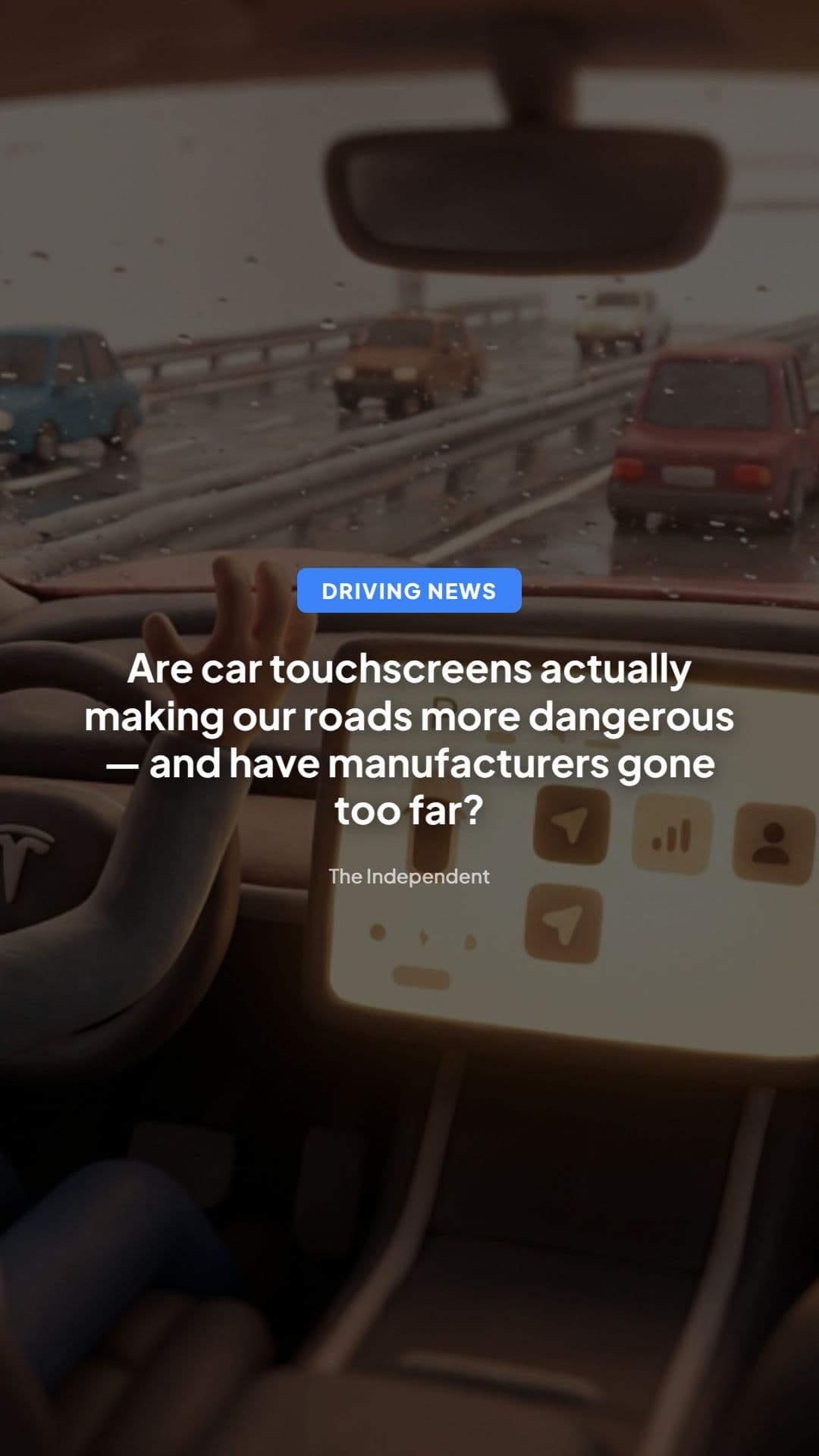
Are Touchscreens Making Our Cars Dangerous? The Safety, Legal, and Practical Truth
Imagine you're cruising along the M25, the rain is hammering down, and you need to turn on the heated rear windscreen. Ten years ago, that was a single button press. Today, in a growing number of modern cars, it means navigating two or three menu layers on a touchscreen — eyes off the road, fingers hunting for a virtual button that might have moved since the last software update. Sound familiar? For millions of UK drivers, it's an increasingly daily frustration.
A recent investigation by The Independent found that drivers are pushing back hard against the industry-wide shift towards touchscreen-dominated car interiors, with many arguing that the removal of physical buttons has made driving not just more annoying, but genuinely more dangerous. The headline said it all: "No one was clamouring to get rid of buttons." And they're absolutely right. So what's actually going on — and does the law have anything to say about it?
What's Actually Happening on Our Dashboards
Over the past decade, car manufacturers have engaged in what can only be described as a button cull. Inspired largely by Tesla's minimalist, screen-first philosophy, brands from Volkswagen to Volvo have stripped physical controls from their interiors at a remarkable rate. Climate controls, heated seats, media functions, even hazard lights — all increasingly buried within touchscreen menus or activated through voice commands.
The Independent piece highlighted the particular frustration of drivers who find that basic, safety-critical functions now require multiple steps on a touchscreen interface. Volvo, notably, has gone further than most — its recent models rely heavily on voice control and a central Android-based touchscreen, with relatively few physical buttons remaining.
The argument from manufacturers has always been the same: touchscreens look sleek, they're easier to update via software, and they appeal to tech-savvy buyers. But the data — and drivers themselves — are telling a different story.
Why This Actually Matters
This isn't simply a matter of personal preference or nostalgia for the good old days of chunky knobs and satisfying clicks. There are real safety consequences to consider.
Research from Lund University in Sweden — widely cited in UK road safety discussions — found that drivers using touchscreen systems took significantly longer to complete simple tasks compared to those using traditional controls. In some cases, drivers' eyes were off the road for more than ten seconds to complete a basic function. At 70mph, that's covering nearly 200 metres effectively blind.
The RAC and AA have both raised concerns about this trend. The AA, in particular, has pointed out that modern infotainment systems have become a significant source of cognitive distraction — not just visual distraction. Searching through menus requires mental effort that diverts attention from the road even when you're technically looking at it.
And here's the thing that manufacturers rarely acknowledge: physical buttons are tactile. An experienced driver can reach for a familiar button without looking, guided by muscle memory and feel. A touchscreen offers no such feedback. Every interaction demands visual confirmation.
The Legal Angle: Where Does UK Law Stand?
This is where things get genuinely interesting — and where many drivers don't realise they may already be on the wrong side of the law without knowing it.
Under Rule 149 of the Highway Code, drivers must not use a hand-held mobile phone or similar device while driving. But the broader legal framework goes further. Section 3 of the Road Traffic Act 1988 makes it an offence to drive without due care and attention, or without reasonable consideration for other road users. Fiddling with a complex touchscreen menu while moving could — and increasingly does — fall under this provision.
The Road Traffic Act 1988, Section 2 covers dangerous driving, which is defined as driving that falls far below the standard expected of a competent and careful driver. Prosecutors have successfully argued that extended distraction — including from in-car technology — can meet this threshold in serious cases.
More specifically, Regulation 110 of the Road Vehicles (Construction and Use) Regulations 1986 prohibits using a device that distracts a driver from the road. While this was originally aimed at mobile phones, legal experts have noted that its wording is broad enough to potentially capture touchscreen interactions that cause significant distraction.
It's also worth noting that DVSA (Driver and Vehicle Standards Agency) guidance for the practical driving test explicitly assesses candidates on their ability to use vehicle controls safely. Examiners are already watching for over-reliance on screens.
Crucially, if you're involved in an accident and it can be shown that you were interacting with a touchscreen at the time, your insurer may challenge your claim. Distraction is increasingly cited in insurance disputes, and the burden of proof doesn't have to be high.
What Drivers Should Know: Practical Advice
Whether you're buying a new car or already driving one loaded with screens, here's what you need to know to stay safe — and legal.
Before you buy:
- Test the interface thoroughly before signing anything. Ask to sit in the car for 15 minutes and try to complete basic tasks: change the temperature, turn on the rear windscreen heater, switch the radio station. If it takes more than two taps, think carefully.
- Look for physical shortcut buttons — some manufacturers, including BMW and Ford, have retained physical buttons for the most commonly used functions even when moving to touchscreen systems.
- Check for voice control quality. Good voice control can partially offset the loss of physical buttons, but it needs to work reliably in British accents and noisy environments. Test it properly.
If you're already driving a screen-heavy car:
- Customise your home screen if the system allows it. Many Android Automotive-based systems (used by Volvo, Polestar, and others) let you pin your most-used shortcuts to a persistent toolbar.
- Learn the voice commands for your most-used functions before you need them on the road.
- Pull over if you need to navigate deep into menus. It sounds obvious, but the temptation to "just quickly" adjust something while moving is how accidents happen — and how prosecutions begin.
- Familiarise yourself with the system at home, parked on your driveway, before driving. The more automatic the interactions become, the safer you'll be.
Know your rights if something goes wrong:
- If a manufacturer's poorly designed interface contributed to an accident, there may be grounds to raise a product liability argument under the Consumer Rights Act 2015, which requires goods to be of satisfactory quality and fit for purpose.
Looking Ahead: Is the Tide Turning?
There are encouraging signs that the industry is beginning to listen. Hyundai and Kia have quietly reintroduced physical buttons for climate control in several recent models after significant customer pushback. Even Volkswagen — which received a torrent of criticism for the touchscreen-only controls in its Golf Mk8 — has since revised the interior to restore some physical buttons.
The Euro NCAP safety organisation, which rates new cars sold in Europe (and whose ratings are widely used in UK purchasing decisions), has signalled that it is developing new assessment criteria for driver distraction caused by infotainment systems. From 2026, this is expected to become a formal part of the rating process — meaning manufacturers who persist with cumbersome touchscreen designs could see their safety scores suffer.
The UK government's Future of Transport strategy and ongoing work by the Department for Transport on connected and automated vehicles also touches on human-machine interface standards, though specific regulation of touchscreen design remains underdeveloped compared to the pace of technological change.
The truth is simple: drivers never asked for buttons to be removed. They were removed because it was cheaper for manufacturers, easier to update remotely, and looked good in press photos. The backlash we're seeing now is the inevitable consequence of prioritising aesthetics over usability — and safety.
The question is whether regulators will act before someone pays a much higher price than a frustrating drive.
Source: The Independent — "No one was clamouring to get rid of buttons: Why drivers are fed up with car touchscreens"
Written by
David Chen
Consumer Rights Expert
Ready to Challenge Your Ticket?
Let our AI analyse your PCN and generate a professional appeal letter in minutes.
Start Free Appeal