14m Parking Tickets in Britain: Why Fines Keep Rising
With 14m+ parking and traffic penalties issued in 2024–25, we examine council PCNs and private parking charges, debt risks and your rights to appeal.

Lisa Rodriguez
11 May 2026
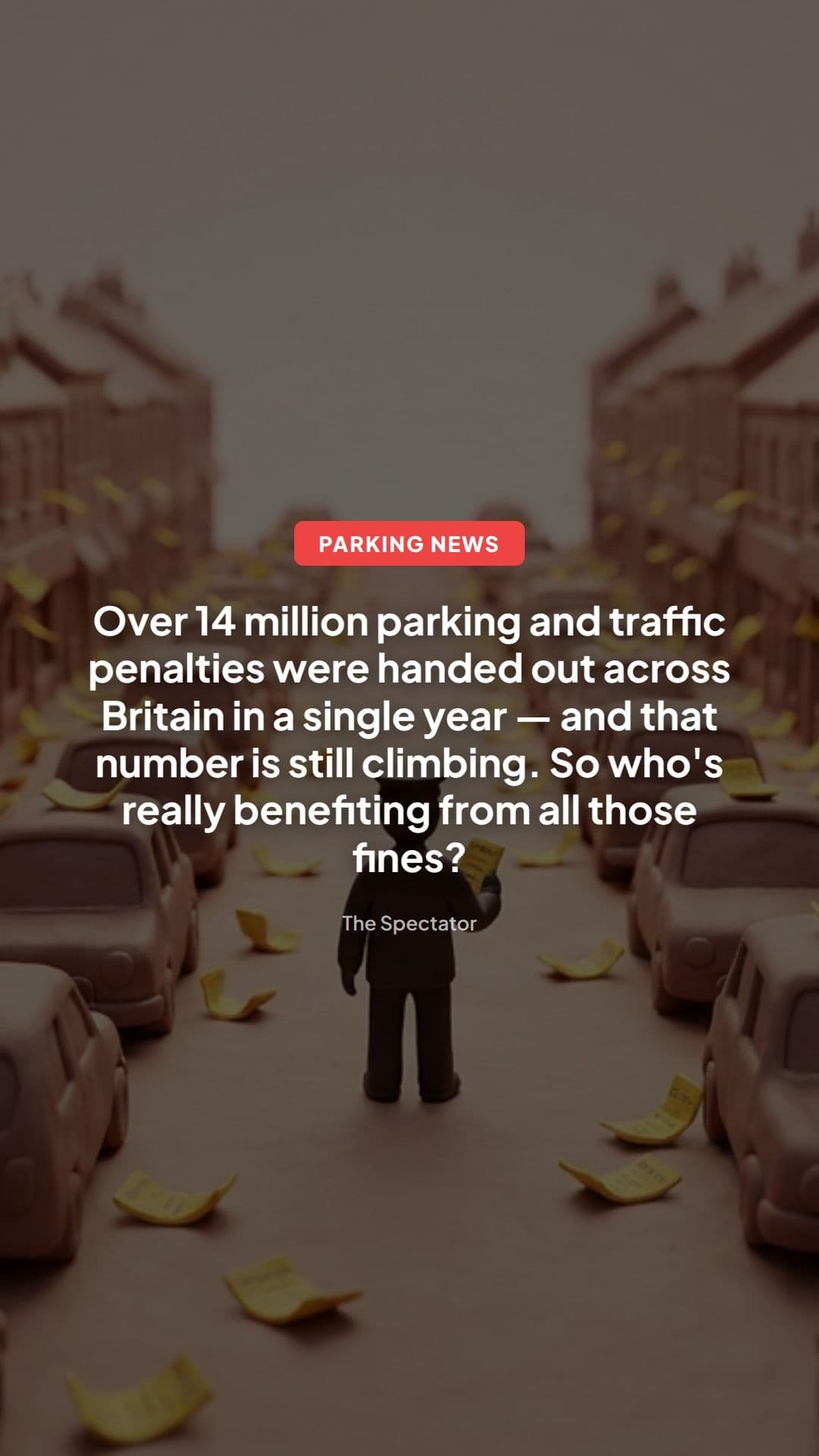
Britain's Parking Fine Tsunami: What 14 Million Penalties Tell Us About the System — and How to Fight Back
There is something almost absurdly British about the following scenario: a country with crumbling roads, overwhelmed GP surgeries, and a cost-of-living crisis that has squeezed millions to breaking point — and yet the machinery of parking enforcement has never been more productive. In 2024–25, more than 14 million parking and traffic penalties were issued across England, Wales, and Scotland. That is roughly one fine for every five drivers on UK roads. The tickets, it seems, are the one thing that keeps coming without delay.
The Spectator recently drew attention to this phenomenon, framing it as a symptom of a broader national dysfunction. But the numbers deserve far more than a passing column. Behind every one of those 14 million penalties is a driver — sometimes genuinely in the wrong, often bewildered, occasionally being pursued by a system that has every financial incentive to issue fines and precious little reason to be lenient.
The Scale of the Problem
Let us be clear about what 14 million penalties actually means. That figure encompasses Penalty Charge Notices (PCNs) issued by local councils under civil enforcement powers, Parking Charge Notices issued by private operators on private land, and traffic contraventions captured by cameras — bus lanes, box junctions, moving traffic offences, and more.
The private sector's contribution to this total has grown dramatically. Since the Parking (Code of Practice) Act 2019 began reshaping the regulatory landscape, private parking operators have issued tens of millions of notices. A significant proportion of these remain contested or unpaid, feeding directly into what the Spectator rightly identifies as a growing personal debt crisis. Debt collection agencies, bailiffs, and county court judgments are the downstream consequences of fines that escalate rapidly when ignored.
The revenue dimension is equally striking. Council parking enforcement in England alone generates hundreds of millions of pounds annually. Whilst local authorities are legally required to ring-fence surplus parking income for transport and highway purposes under the Road Traffic Regulation Act 1984, scrutiny of how that money is actually spent remains frustratingly limited.
Why This Matters Beyond the Headlines
The Spectator piece touches on public frustration, but the deeper issue is one of systemic design. Parking enforcement in the UK operates on a model that is structurally tilted against the driver.
Consider the incentive structure. Private parking companies — many of which are members of either the British Parking Association (BPA) or the International Parking Community (IPC) — earn revenue directly from the notices they issue. Even after the long-delayed Private Parking Code of Practice capped private fines at £100 (or £60 if paid within 14 days) in 2023, the volume of notices has continued to climb. A cap on the fine amount does nothing to reduce the number of fines issued.
Councils face a different but related pressure. With central government funding squeezed, parking enforcement has quietly become a revenue stream that many local authorities have come to depend upon. The political incentive to reduce enforcement is therefore weak, even when residents and businesses argue that aggressive ticketing is damaging high street footfall and community goodwill.
Meanwhile, unpaid fines compound. A council PCN that starts at £50 or £70 can double if not paid within the discount window, then escalate further once referred to enforcement agents. For drivers already struggling financially, a single overlooked ticket can spiral into a debt of several hundred pounds within months.
The Legal Framework: Your Rights in Plain English
Understanding the legal architecture is essential, because the rules for council-issued PCNs and private parking notices are fundamentally different — and that distinction matters enormously.
Council PCNs are issued under the Traffic Management Act 2004 and its associated regulations. They carry statutory authority. If you ignore a council PCN, it can ultimately be enforced via a Warrant of Control, allowing certificated enforcement agents (bailiffs) to attend your property. There is a formal appeals process: informal representation to the council, then formal representation, and finally an independent appeal to the Traffic Penalty Tribunal (outside London) or London Tribunals (within the capital). These tribunals are genuinely independent and overturn a meaningful proportion of the cases brought before them.
Private Parking Charge Notices, by contrast, are not fines in any legal sense. They are contractual claims — the operator argues that by parking on their land, you entered into a contract and breached its terms. This means they must prove their case in the County Court if they wish to enforce. Crucially, under the Protection of Freedoms Act 2012, private operators can pursue the registered keeper of a vehicle rather than the driver — but only if they have followed strict procedural rules, including issuing a Notice to Keeper within specified timeframes (typically 28–56 days from the contravention).
Failure to adhere to these procedural requirements is one of the most common grounds on which private parking claims are defeated. The POPLA (Parking on Private Land Appeals) service handles appeals for BPA members, whilst the IAS (Independent Appeals Service) covers IPC members. Both provide a free first stage of appeal before any court action.
What Every Driver Should Know Right Now
The volume of penalties being issued makes it more important than ever that drivers understand how to respond effectively. Here is what the data — and the law — tell us you should do:
- Act within the discount window. For council PCNs, paying within 14 days typically halves the penalty. If you intend to appeal, submit your informal representation within 28 days to preserve the discount if the appeal fails.
- Never ignore a private parking notice. Ignoring it does not make it go away. After a Notice to Keeper is issued, the operator can register a County Court claim. An uncontested CCJ will damage your credit rating for six years.
- Check the procedural compliance. For private notices, verify that the Notice to Keeper arrived within the required timeframe and contains all mandatory information under Schedule 4 of the Protection of Freedoms Act 2012. A missing or late notice can invalidate the entire claim.
- Photograph everything. If you believe a sign was unclear, missing, or misleading, photograph it immediately. Signage failures are a legitimate ground of appeal for both council and private notices.
- Request the evidence pack. Both councils and private operators are required to provide evidence — CCTV footage, warden notes, photographs — upon request. Gaps or inconsistencies in that evidence can support a successful appeal.
- Use the independent appeals process. Too many drivers pay fines they could successfully challenge simply because the appeals process feels intimidating. Independent adjudicators at the Traffic Penalty Tribunal and POPLA are not there to rubber-stamp the issuing authority's decision.
Looking Ahead: A System Under Pressure
The 14 million figure is not just a statistic — it is a warning signal. Public trust in parking enforcement is eroding, and that erosion has consequences. When drivers perceive the system as predatory rather than regulatory, compliance falls, appeals rise, and the administrative burden on councils and tribunals increases.
There are tentative signs of political movement. The Parking (Code of Practice) Act 2019 was a step toward greater accountability for private operators, though its full implementation has been painfully slow. Discussions around a National Parking Platform — a unified system for paying and managing parking across councils — suggest that some policymakers recognise the current fragmentation is untenable.
But structural reform requires political will, and that will has historically been in short supply when it comes to parking. Councils need the revenue. Private operators have powerful lobbying voices. And drivers, despite their numbers, remain a diffuse and underorganised constituency.
What is clear is that the current trajectory — more enforcement, more automation, more debt — is not sustainable. A system that generates 14 million penalties in a single year is not keeping roads clear and communities safe. It is, at least in part, generating revenue at the expense of the very people it claims to serve.
Until that changes, the most powerful thing any driver can do is know their rights, challenge unfair notices, and refuse to treat a parking ticket as an automatic bill rather than what it often is: a claim that deserves scrutiny.
The source article from The Spectator raises important questions about enforcement culture in Britain. The legal framework outlined above reflects the position as of mid-2025 and applies to England and Wales; Scottish parking law differs in certain procedural respects.
Written by
Lisa Rodriguez
Automotive Journalist
Ready to Challenge Your Ticket?
Let our AI analyse your PCN and generate a professional appeal letter in minutes.
Start Free Appeal