
Surrey ULEZ Signs Row: £15m in Driver Penalties Explained
Surrey County Council is refusing ULEZ signs and cameras until driver protections are agreed. Explore the £15m penalties row and what it means for motorists.

The Parking Ticket Pal Editorial Team
14 November 202610 min read
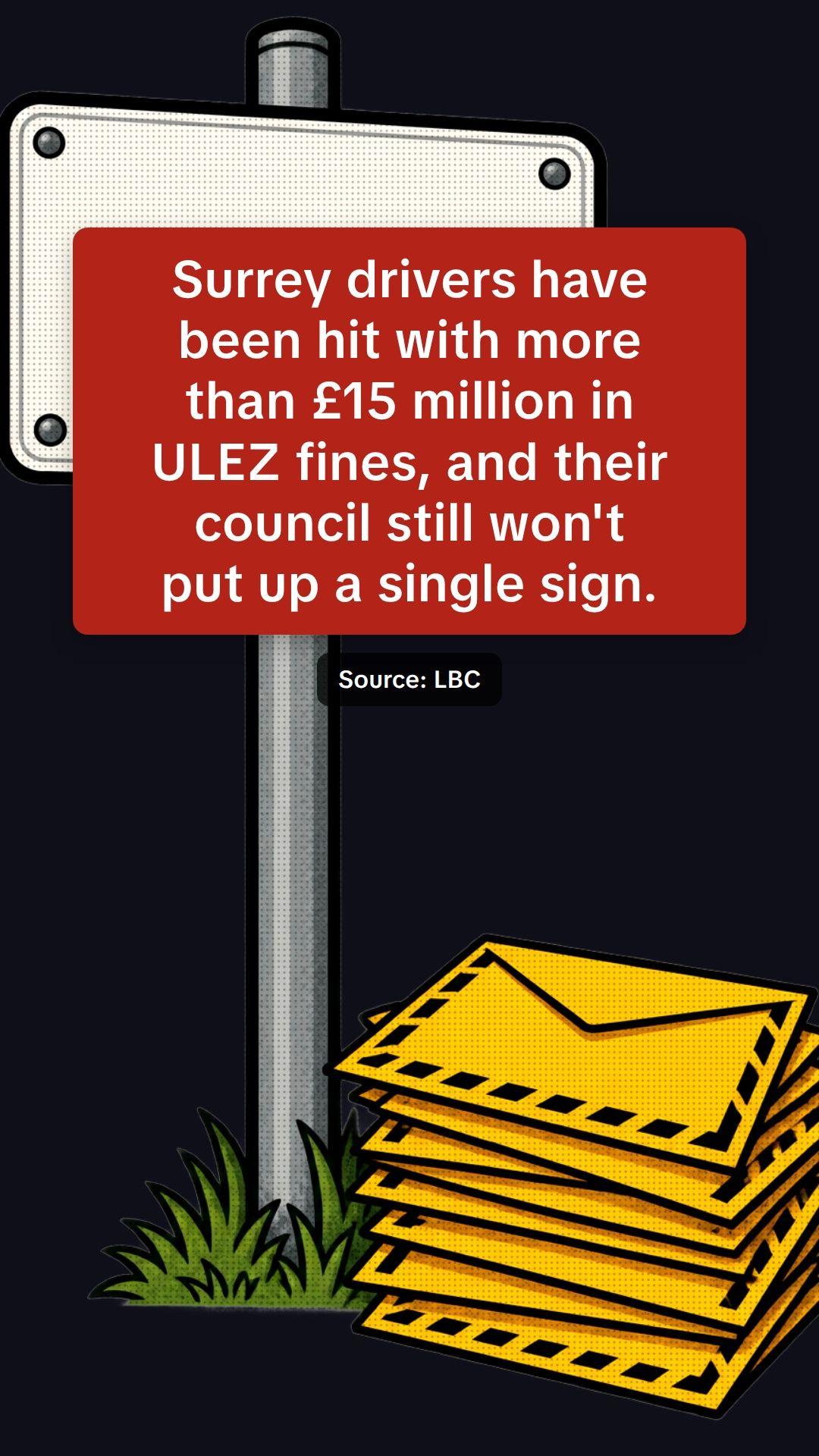
Surrey says no to ULEZ signs: what the stand-off means for drivers
Imagine being fined £180 for driving through a zone you never knew you had entered. For many drivers living just beyond the Greater London boundary, that is not a hypothetical. It is the heart of a row that shows no sign of ending, with Surrey County Council still refusing to let ULEZ signs and cameras go up on the roads it controls.
According to LBC's report, the council is holding its ground until measures are agreed to reduce the impact on drivers. The same report says Surrey residents have received more than £15 million in ULEZ penalty notices. This post looks at what is going on, why it matters, and what drivers on the London fringe can do.
What happened
Since the Ultra Low Emission Zone expanded to cover all London boroughs in August 2023, the boundary has run straight through some of the busiest commuter corridors in the south east. Surrey shares a long border with London, so thousands of its residents cross into the zone for work, school runs, hospital appointments or family visits.
Surrey County Council has opposed the expansion from the start. As the highway authority for most roads in the county, it has a say over what is installed on them. Signs warning drivers that they are approaching a charging zone, and enforcement cameras, need its agreement if they are to sit on Surrey roads. The council's position, as reported, is that it will keep resisting until agreed measures are in place to soften the impact on motorists.
Meanwhile, the report says Surrey residents have been issued more than £15 million in penalty notices. That figure comes from the report, and it is worth treating as a headline total rather than a detailed breakdown. It does not tell us how many drivers were involved, how many notices were paid, cancelled or successfully challenged, or how many were repeat contraventions.
Why it matters
Warnings versus the law
The first thing to grasp is that a lack of signs in Surrey does not switch off the charge. The ULEZ applies to vehicles driven within the zone, and the zone is defined by the scheme order, not by what is bolted to a lamppost in Surrey. The signs that matter legally are those on the road network within the zone itself, and at its entry points on the London side.
Advance warning signs on approach roads are a courtesy and a safety aid. They help drivers decide to turn off, plan an alternative route, or check whether their car complies. Where they are missing, the practical effect is that drivers are more likely to cross the boundary by accident, especially visitors, delivery drivers and anyone unfamiliar with the area.
The money question
A £15 million total across a county of this size attracts attention, and it feeds a wider argument about whether the scheme is about air quality or revenue. The charge itself is £12.50 a day for non-compliant vehicles. A penalty charge notice for non-payment is £180, reduced to £90 if paid within 14 days. Those figures can stack up quickly for someone who drives through repeatedly without realising, because each day can generate its own notice.
That is why the missing signs matter to people. A single mistaken crossing is annoying. Several in a fortnight, before the first notice has even landed on the doormat, can become a four-figure problem.
The politics
This dispute is also part of a longer legal and political fight. In 2023, Surrey County Council was among the councils that took the Mayor of London to the High Court over the expansion. The challenge failed. Since then, resistance has been expressed through practical levers, and the power to refuse consent for infrastructure on council roads is one of the few that neighbouring authorities still hold.
The legal angle
How ULEZ enforcement works
ULEZ is a road user charging scheme operated by Transport for London under powers in the Greater London Authority Act 1999 and the regulations made under it. Penalty charge notices are issued to the registered keeper, based on automatic number plate recognition. Enforcement is civil, not criminal, so a penalty is not a fine in the strict sense and does not go on your licence.
Standards for exemption are based on emissions. Broadly, petrol cars generally need to meet Euro 4 and diesel cars Euro 6, though there are exemptions and discounts in specific cases. You can check any registration number on TfL's online vehicle checker, which is the most reliable starting point.
Challenging a penalty notice
If you receive a PCN, you can make representations to TfL. The grounds are set out in the regulations and typically include situations such as:
- the charge had been paid, or the vehicle was exempt or eligible for a discount
- the vehicle was not in the zone at the time
- the vehicle was taken without the keeper's consent, for example if it was stolen
- you were not the keeper when the contravention took place, for instance after selling the car
- the penalty exceeds the amount applicable in the circumstances
- a procedural impropriety on the part of the authority
If TfL rejects your representations, you can appeal to London Tribunals, the independent adjudication service. Timings are strict, so read the notice carefully and keep to the deadlines.
Do missing signs help?
This is the question most Surrey drivers ask, and the honest answer is: it depends. Signs on approach roads that do not exist cannot, by themselves, be relied on to cancel a notice. The question for an adjudicator is usually about the scheme's signing at and inside the zone and whether the contravention occurred. Inadequate or confusing signage at the boundary itself could be relevant to an appeal, but a complaint that Surrey never put up advance warnings is not a guaranteed defence. Anyone considering this argument should gather evidence, such as dated photographs of the location, and read official guidance first. For high-value or complicated cases, independent advice is sensible.
What drivers should know
Check before you cross
Do not assume the lack of a sign means you are outside the zone. Check where the boundary lies on the road you use, and check your vehicle's compliance before you travel. A satnav or mapping app can flag the zone, but do not rely on it alone.
Pay by midnight on the third day
If you realise you have driven a non-compliant vehicle in the zone, you can pay the daily charge after the event. TfL's usual rule is that payment must be made within a set period after travel. Check the current deadline on TfL's website, as it can change, and do not leave it to memory.
Keep records
If you regularly cross the boundary, a simple log helps. Note dates, routes and whether you paid. If a notice arrives that looks wrong, you will want to prove what happened. For ideas on how to handle payments that TfL seems not to have recorded, see our post on what to do if you have paid but TfL is still chasing you.
Watch for camera errors and mistaken identity
ANPR is not perfect. Misread plates and cloned plates do happen. Our guide to avoiding unnecessary ULEZ fines caused by camera mistakes covers the evidence worth gathering.
Do not ignore notices
Unpaid penalties can escalate. Left unresolved, they can be registered as debts and passed to enforcement agents. Anyone worried about that stage should read our explainer on what your rights are when bailiffs chase an innocent motorist. It is far easier to respond early, even if only to ask for more time or to submit representations.
Businesses and tradespeople
If you drive for work, the cost of crossing the boundary can be significant. Our piece on businesses still hit by ULEZ charges at the boundary looks at how it affects traders. If you employ drivers, check that fleet vehicles and any hire or pool cars are compliant.
A few common misunderstandings
- "There was no sign, so the notice is void." Not automatically. Signage can be part of an argument, but it is not an on and off switch.
- "Surrey refused signs, so Surrey drivers are exempt." No. The charge depends on the vehicle and where it was driven, not on your home address.
- "It is only a fine." It is a civil penalty, but unpaid penalties can lead to escalating costs.
- "The council will refund me." The council's stance does not create a right to compensation. The route is through TfL's representations process and London Tribunals.
Looking ahead
The standoff is unlikely to be resolved by goodwill alone. Surrey says it wants agreed mitigation for drivers before it changes course. What that mitigation might look like is not spelled out in the source report, and it would be unwise to guess. Possible areas for negotiation in disputes like this include scrappage support, clearer boundary information and arrangements for residents who regularly cross the border, but none of those has been confirmed here.
There are several things to watch:
- Whether TfL changes its signing strategy. It could rely more heavily on signs on the London side of the boundary, and more digital information, to reduce accidental contraventions.
- Whether the Surrey penalty total keeps rising. If the figure grows, pressure on both sides to find a compromise will grow too.
- Whether other neighbouring authorities follow Surrey's lead or settle. Councils around London have taken different approaches, and the outcome in one place can influence another.
- Whether the Government or regulators step in. The relationship between road user charging, local highway powers and fair warning to motorists is the sort of issue that attracts calls for clearer national rules.
For drivers, the practical reality is simple. Until there is a settlement, you cannot count on signs to tell you when you are about to enter the zone. The responsibility, fairly or not, lands on you. Know the boundary, know your vehicle's status, pay promptly where a charge applies, and keep good records. If a notice arrives that you believe is wrong, challenge it in time, using the official process.
This article is general information about UK motoring rules and is not legal advice. For decisions about your own penalty notice, check TfL's official guidance and the London Tribunals website, and seek independent advice if the stakes are high.
Written by
The Parking Ticket Pal Editorial Team
Source-checked parking guidance