
Redbridge Bus Stop PCN Refused: Lessons for Drivers
A Redbridge bus stop PCN appeal was refused. Learn why stopping on restricted bus stops is risky, what evidence matters and how to challenge correctly.

The Parking Ticket Pal Editorial Team
8 November 2026
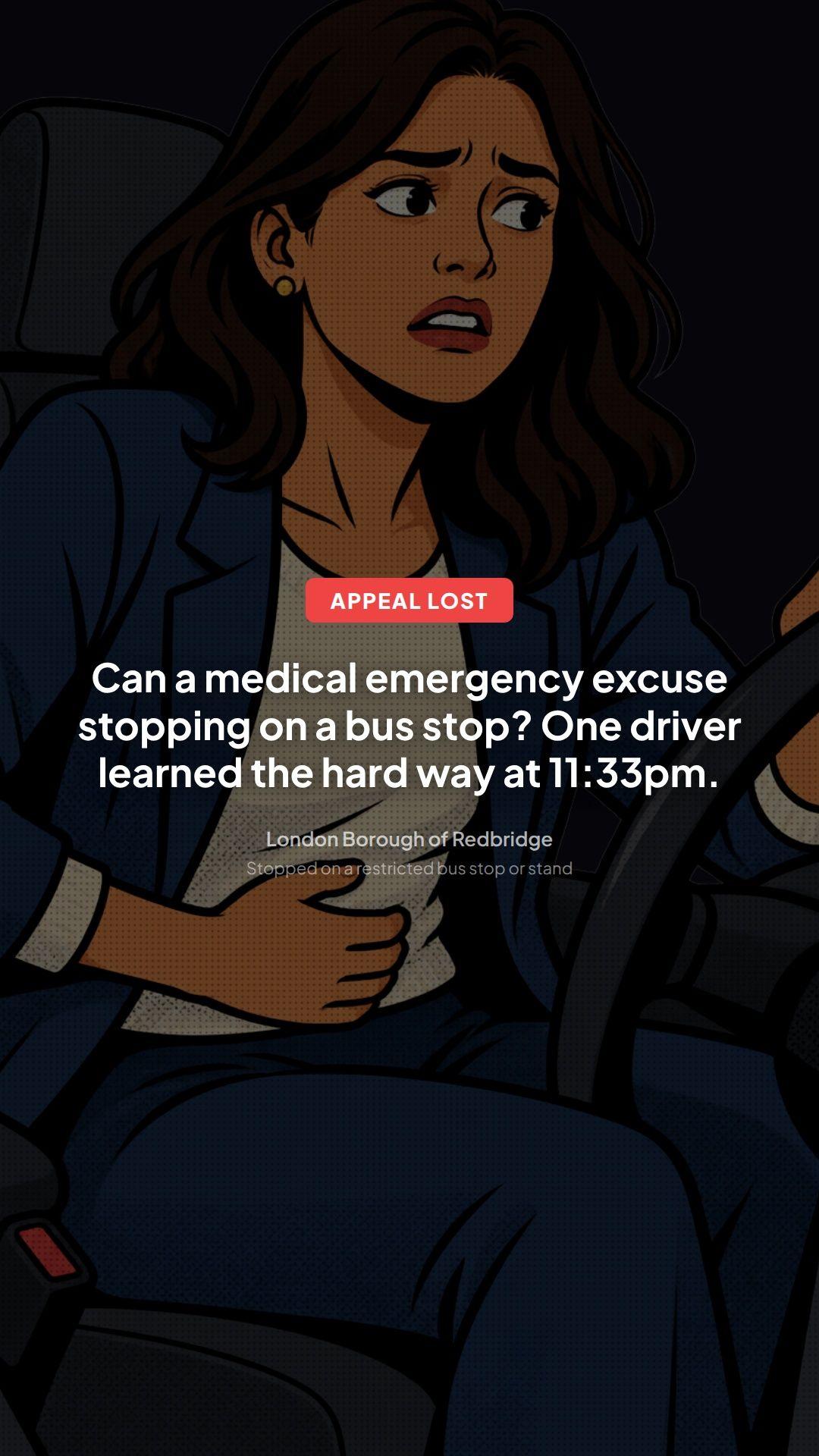
Stopped for a Medical Emergency, Fined at a Bus Stop: Why This Redbridge Appeal Failed
Most of us have felt it: a sudden, urgent need for a toilet while driving, with nowhere obvious to go. A driver in Barkingside found herself in exactly that position. She pulled over, dealt with a medical emergency, and later received a penalty charge notice (PCN). Her appeal was refused.
The case shows a distinction that trips up many drivers: mitigation is not the same as a defence. A good reason for stopping can make a council sympathetic, but it does not change whether the contravention happened.
The Case: What Happened
On 1 June 2018 at 23.33, the driver's vehicle was stopped on a restricted bus stop in the High Street, Barkingside, in the London Borough of Redbridge. The authority issued a PCN for "stopped on a restricted bus stop or stand". In London this is commonly known as contravention code 47. If you want to understand how these codes work, our guide to understanding PCN codes is a good starting point.
The driver did not dispute that she had stopped there. She explained that she had a urinary tract infection and needed urgent access to a lavatory. She was not trying to avoid paying for parking or take a shortcut. She had a pressing health need and stopped where she could.
The Arguments
The driver's case
Her argument was personal and sympathetic: she was unwell, the need was urgent, and she stopped for a short time because she had to. Few people would see that as careless or selfish parking.
The council's case
The Redbridge case was simple. The vehicle was stopped on a restricted bus stop on that date and at that time, and that is a contravention. The authority had also already considered the driver's circumstances at an earlier stage and had not cancelled the PCN.
Notice what the council did not need to argue. It did not need to say the driver was unsympathetic or that the infection was invented. Its case rested on the stop itself.
The Decision
The adjudicator refused the appeal. In summary:
- The vehicle was stopped on a restricted bus stop at the place and time alleged.
- Stopping to use a lavatory is not something the rules allow on a restricted bus stop. The adjudicator also listed loading, unloading, manoeuvres, and setting down or picking up passengers as things that do not make stopping there permissible.
- The driver's explanation went to mitigating circumstances, which the authority had already considered, and which do not amount to a defence or exemption.
- The adjudicator has no power to quash a penalty on the basis of mitigation.
The appeal was dismissed.
The Legal Reasoning in Plain English
Bus stops are treated strictly
Bus stop restrictions exist to keep the kerb clear so buses can pull in close to the pavement. That helps passengers, including people with mobility problems, wheelchair users and parents with pushchairs, board safely.
Because of that purpose, restrictions on stopping at a marked bus stop are generally tight. Many other restrictions allow things like loading or dropping off passengers. The adjudicator's reasoning was that a restricted bus stop is not one of those places, and that using a lavatory is not an exception.
Contravention first, circumstances second
Think of a PCN appeal as a two-step process.
- Did the contravention occur? This is a question of fact and law. Was the vehicle where the authority says, at the time it says, and did the restriction apply?
- If it did, is there a legal ground for cancelling the penalty? Appeal grounds are set out in regulations. Broadly, they include that the contravention did not occur, that the penalty exceeded the amount applicable, that there was a procedural impropriety by the authority, or that the traffic order was invalid. There are others, such as the driver not being the owner at the relevant time.
Here, the adjudicator found the contravention occurred and the driver's circumstances did not fit a legal ground. A personal emergency, however real, is not among the listed grounds as such.
Mitigation is for the council's discretion
Councils have discretion to cancel a PCN even where a contravention technically happened. Government statutory guidance to councils encourages them to consider compelling or compassionate reasons when deciding whether to enforce. That is the stage where mitigation does its work.
In this case, the authority had already looked at the driver's circumstances and decided to keep the PCN in place. The adjudicator's role is different. They decide appeals by making findings of fact and applying the law as it stands. They are not there to substitute their own view of fairness.
Why adjudicators can't just "be kind"
This can feel harsh, but there is a principle behind it. Adjudicators are independent decision-makers applying the same rules to everyone. If they could cancel penalties because a story was sympathetic, outcomes would depend on how persuasive or detailed an explanation was rather than on the law. In some cases an adjudicator may recommend that an authority reconsider a penalty, but whether to follow that recommendation remains with the council. Nothing in this decision suggested that happened here.
Lessons for Drivers
These points are general commentary on the case, not advice for your own situation.
1. Mitigation and defence are different things
A defence says the contravention did not happen, or that the law provides a ground for cancellation. Mitigation says the contravention happened, but there is a good reason to be lenient. Tribunals can only act on the first. If your explanation is mostly a reason you needed to stop, expect it to be treated as mitigation.
2. Put your mitigation to the council early and properly
Because mitigation is for the authority's discretion, the stage at which you raise it matters. Councils respond to clear, evidenced explanations. Medical evidence, dated and relevant to the incident, is more persuasive than a bare assertion. Our guide to formal representations for PCNs explains how to structure a challenge to the council. Do not assume an adjudicator will rescue the situation later.
3. Bus stops can catch you out at any hour
This stop was enforced at 23.33. Many drivers assume a late-night road is quiet and that bus stops matter less. Whether a restriction applies depends on the markings and signs, which can state when they operate. Some apply around the clock. Always check the signs and road markings rather than relying on a feeling that no buses are running.
4. A genuine need does not suspend the rules
Hazard lights, a short stay and a good reason do not by themselves change the legal position at a restricted bus stop. It is worth knowing which spots are riskier before an emergency happens: bus stops, red routes and similar places can be unforgiving even for very short stops.
5. Compare similar cases before you decide how to respond
Bus stop cases turn on their facts, such as markings, signs, the vehicle's position and the time. Some bus stop appeals succeed where the evidence shows a problem with the restriction itself. For contrast, see our write-ups of a Kingston bus stop appeal that was allowed, a Lambeth bus stop appeal that was allowed and a Camden bus stop appeal that was refused. The difference usually lies in the evidence, not in sympathy.
Where the stakes are significant, or you are unsure how the rules apply to your situation, official guidance from the relevant tribunal or independent professional advice is worth seeking.
What Could Have Changed the Outcome?
We only have the adjudicator's summary, so it would be wrong to speculate about evidence that was or was not produced. But the reasoning shows what would not have helped: restating the emergency to the adjudicator. The case would have needed a ground the law recognises, such as a problem with the signs or markings, a procedural failing by the authority, or evidence that the contravention did not occur. Nothing in the decision suggests such a ground was raised.
Key Takeaway
A good reason for stopping is not the same as a legal reason for being allowed to stop. At a tribunal, the question is whether the contravention happened and whether the law gives a ground for cancelling the penalty. Sympathy belongs with the council's discretion, so make that case clearly, with evidence, and as early as you can.
This article is general commentary on a published tribunal decision and does not constitute legal advice.
Written by
The Parking Ticket Pal Editorial Team
Source-checked parking guidance
Ready to Challenge Your Ticket?
Let our AI analyse your PCN and generate a professional appeal letter in minutes.
Start Free Appeal