
Nurse’s Parking Fine After Lift Emergency: Her Rights
Nurse trapped in a lift while caring for a baby received a parking fine. We examine her appeal options, PCN rules and the risk of court action under UK law.

The Parking Ticket Pal Editorial Team
23 October 2026
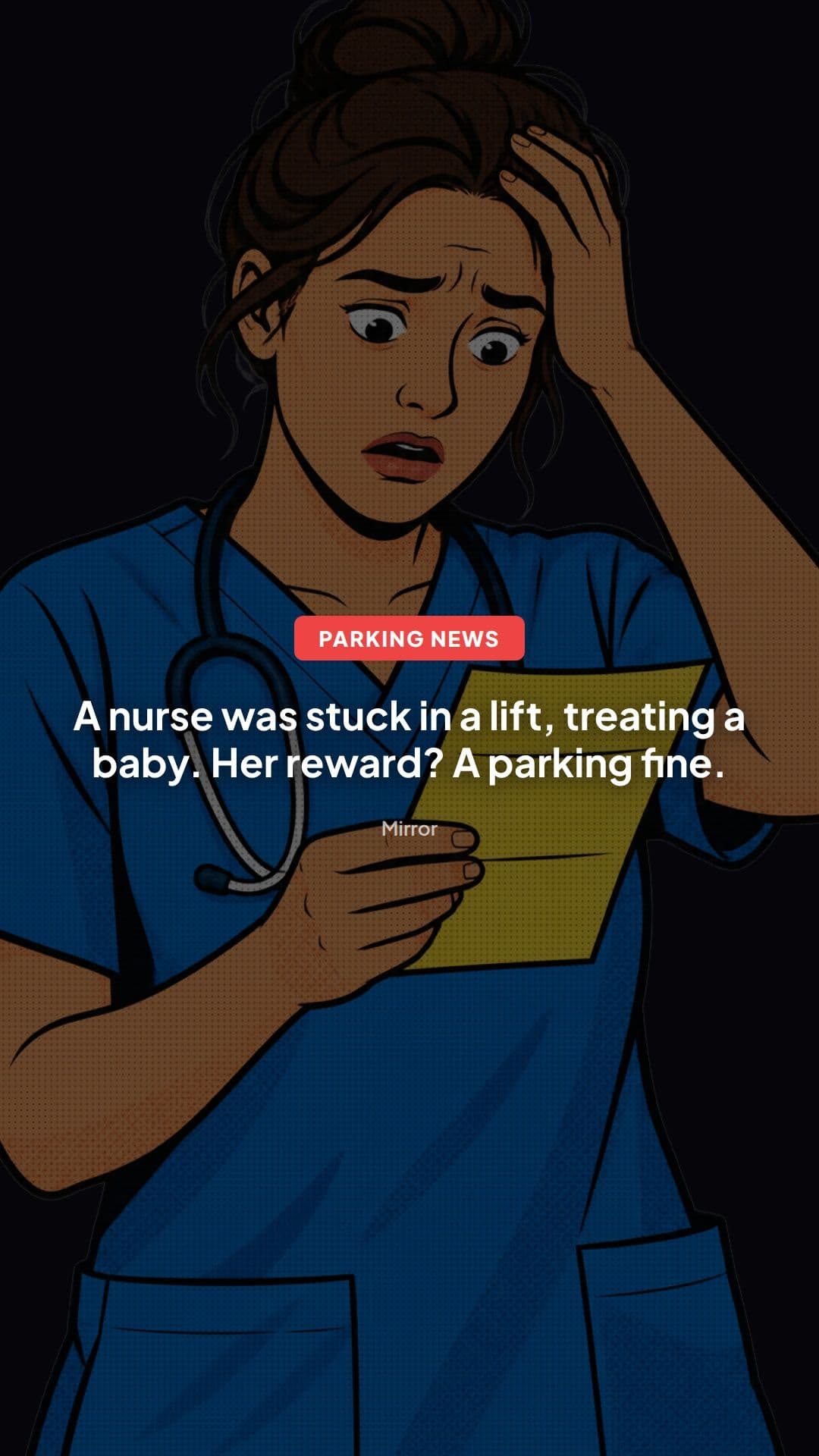
Nurse trapped in a lift while treating a baby handed a parking fine: what the case tells us
Most of us have had that sinking feeling of returning to the car and finding a ticket tucked under the wiper. Few of us can say we missed the deadline because we were stuck in a lift, caring for a baby.
That is the situation reported by the Mirror. A nurse says she was trapped in a lift while attending to an infant, then received a parking notice she believes should never have been issued. She now faces possible court action over it. It is a story that tends to provoke instant outrage. It also happens to be a very useful case study in how UK parking enforcement actually works, and where the real pressure points are.
What happened
The Mirror's report, as summarised, says the nurse became trapped in a lift while she was treating a baby. She later received a parking notice, and the matter has escalated to the point where court action is possible.
The summary leaves some gaps, and it is worth being honest about them. It does not make clear whether the notice came from a council or a private operator, how long she was stuck, or what the operator has said in response. We are not going to guess at those details here. Instead, this post looks at what the story raises in general terms, because the answers depend heavily on one question: who issued the notice?
Why it matters
Stories like this resonate because they expose a mismatch between how parking enforcement is designed and how real life behaves. Systems built on timestamps, ANPR cameras and automated letters are efficient at spotting a car that stayed too long. They are poor at recognising why.
Several wider issues sit underneath this one story.
Emergencies don't respect time limits. Healthcare workers, carers and parents are often dealing with situations that cannot be paused. A parking system that only sees "vehicle present for X minutes" will always generate some unfair outcomes.
Automation shifts the burden. Once a notice is issued, the motorist has to prove their innocence, often to a party that has already decided the charge is due. This is true of both council and private enforcement.
Court threats escalate quickly. Many people receive a letter threatening court action and assume the fight is lost. In reality, a threat is just a threat until a claim is actually issued, and even then there are defences available.
Hospital and healthcare site parking is already a sore point for staff and patients. If this topic interests you, our post on NHS parking charges gives wider context, and private parking crackdown calls after a nurse's £266 charge covers a related case.
The legal angle: it depends on who sent the notice
UK parking enforcement runs on two quite different legal tracks. Much of the confusion, and a lot of the anxiety, comes from mixing them up.
If it is a council PCN
A Penalty Charge Notice from a local authority is issued under the Traffic Management Act 2004 and its associated regulations. This is a statutory process with defined stages:
- Informal challenge, usually within 14 days of the notice, which can allow the discounted rate to remain available in some cases.
- Formal representations to the council after a Notice to Owner is issued.
- Appeal to an independent tribunal, either the Traffic Penalty Tribunal in England outside London and Wales, or London Tribunals in the capital, if the council rejects your representations.
The legal grounds for challenge are set out in regulations, and include situations such as the alleged contravention not having occurred, or a procedural impropriety by the council. "Mitigating circumstances" such as a medical emergency are not technically a statutory ground in the same way. However, councils are expected to consider them, and tribunal adjudicators can recommend that a council exercises its discretion. A well-evidenced emergency can make a real difference at the informal or formal representation stage.
Councils generally cannot take you to a county court over an ordinary PCN. Unpaid PCNs follow a different route, via a charge certificate, registration of the debt at the Traffic Enforcement Centre, and potentially enforcement agents. So if the nurse's notice was from a council, "court action" would typically mean something different from a standard civil claim.
If it is a private parking charge
Private operators are not issuing fines. They are claiming a contractual charge, based on the idea that by parking you agreed to the signed terms. The key points:
- The Supreme Court case of ParkingEye v Beavis [2015] UKSC 67 established that a parking charge can be enforceable where the operator has a legitimate interest and the charge is not extravagant. That case involved a charge of £85, and it remains the leading authority.
- If the operator pursues the registered keeper rather than the driver, it generally needs to follow the strict requirements of Schedule 4 of the Protection of Freedoms Act 2012. This sets out what a notice must say and when it must be sent.
- Operators who are members of an Accredited Trade Association (the BPA or the IPC) can access DVLA keeper data. Members must follow the relevant code of practice and offer an independent appeals service. The BPA uses POPLA and the IPC uses the Independent Appeals Service. Our guide to BPA versus IPC membership explains the difference.
- Private operators can issue a county court claim, and this is where "possible court action" becomes real. A claim is a serious step, though it is not an automatic loss for the motorist.
The government has also been developing a new Private Parking Code of Practice, with proposals around a consistent charge cap and a standard grace period. The status and timing of those rules have shifted over time, so check current official guidance rather than assuming they apply. Our post on the 10-minute grace period in private car parks is a useful starting point.
What counts as a good defence in a case like this?
Without knowing the facts of this particular case, we can still talk about what tends to matter in situations where a driver was physically prevented from leaving or returning on time.
Contemporaneous evidence is everything. Useful material might include:
- A lift engineer's call-out record or a maintenance company log
- A fire and rescue service incident reference, if they attended
- Building management records of the fault
- A statement or confirmation from an employer or hospital about the emergency
- Photos or screenshots with timestamps, such as phone call logs to emergency services or the lift's alarm line
- The parking payment record and the time of the notice
Show the timeline clearly. The strongest appeals set out when the driver entered, when the emergency began, when they were released, and when they reached the vehicle. Gaps invite scepticism.
Argue both facts and fairness. An appeal can say that the driver did not choose to overstay and could not have done anything differently. It can also point to the operator's discretion to cancel. Operators often cancel in sympathetic, well-documented cases, particularly once publicity enters the picture.
Check the operator's own responsibilities. If the lift was part of the car park itself, the question of who is responsible for maintaining it may become relevant. This is not a guaranteed defence, but it is a legitimate point to raise.
Our post on a £120 private parking fine overturned after a medical stop shows how an unplanned medical situation can feature in an appeal, and can you get a PCN if you're trapped looks at a related scenario.
What drivers should know: practical tips
This is general information rather than legal advice, but the following points apply to almost anyone who receives a notice they believe is unfair.
1. Identify who issued it
Check the letterhead and the wording. A council PCN will refer to a "Penalty Charge Notice" and the Traffic Management Act. A private notice will usually say "Parking Charge Notice" and refer to a contractual charge. Everything that follows depends on this. Our guide to council PCNs versus private charges breaks it down.
2. Do not ignore it
Ignoring letters is the most common way a manageable problem turns into an expensive one. Deadlines matter, and escalation often adds costs.
3. Appeal in writing and keep copies
Use the formal channels. For a council PCN, our guides to informal PCN appeals and formal representations are a good place to start. For private charges, see our walkthrough of the POPLA appeals process.
4. Gather evidence straight away
Lift logs, call records and CCTV can be overwritten or lost. If an incident causes a delay, request records promptly and keep anything that has a timestamp.
5. Be factual, not emotional
Even in a sympathetic case, appeals work best when they are calm, chronological and supported by documents. Explain what happened, attach the proof, and state clearly what outcome you are asking for.
6. If a court claim arrives, take it seriously
A claim form comes with strict response deadlines. Missing them can lead to a judgment in default. Read the paperwork carefully, check the official government guidance on responding to a money claim, and consider seeking independent advice from a body such as Citizens Advice or a solicitor, especially if the sum is large or you are unsure of your position.
7. Consider pressure points beyond the formal route
Where a case is sympathetic, contacting the landowner, hospital trust or employer can sometimes help. They may be able to intervene with the operator. This is not a substitute for the formal process, but it can run alongside it.
Looking ahead
The nurse's case is a reminder that parking enforcement, for all its automation, still depends on discretion at several key points. Councils can cancel notices on compassionate grounds. Private operators can drop a claim at almost any stage. Whether that discretion is used well often depends on how clearly a driver explains what happened and how well they can prove it.
There is also a broader policy debate. Calls for fairer private parking rules, clearer grace periods, and better treatment of healthcare workers have been growing. A more standardised code, if and when it takes full effect, could narrow the room for disproportionate outcomes. Until then, drivers are largely reliant on the existing appeals framework and, in practice, on their own paper trail.
For anyone who works in healthcare, social care or emergency response, the lesson is a practical one. If a situation outside your control keeps you from your vehicle, record it as it happens. Note times, take screenshots, and ask for incident references. Those small steps can be the difference between a quick cancellation and a drawn-out dispute.
The Mirror's report is based on the nurse's own account, and we don't yet know how the operator will respond or how the matter will end. What we can say is that there are established routes for challenging notices like this, and that a calm, well-evidenced response is almost always the strongest starting point.
This article is general information about UK parking rules and is not legal advice. If you are facing a court claim or a significant debt, consider speaking to Citizens Advice, a solicitor, or another qualified adviser.
Written by
The Parking Ticket Pal Editorial Team
Source-checked parking guidance
Ready to Challenge Your Ticket?
Let our AI analyse your PCN and generate a professional appeal letter in minutes.
Start Free Appeal