
Laila Rouass Driving Ban: 20mph Speeding Penalties
Actress Laila Rouass was banned after speeding at 26mph in a 20mph zone. Learn how UK speeding points, court hearings and bans work.

The Parking Ticket Pal Editorial Team
27 October 2026
Banned for 26mph in a 20 zone: what the Laila Rouass case teaches every driver
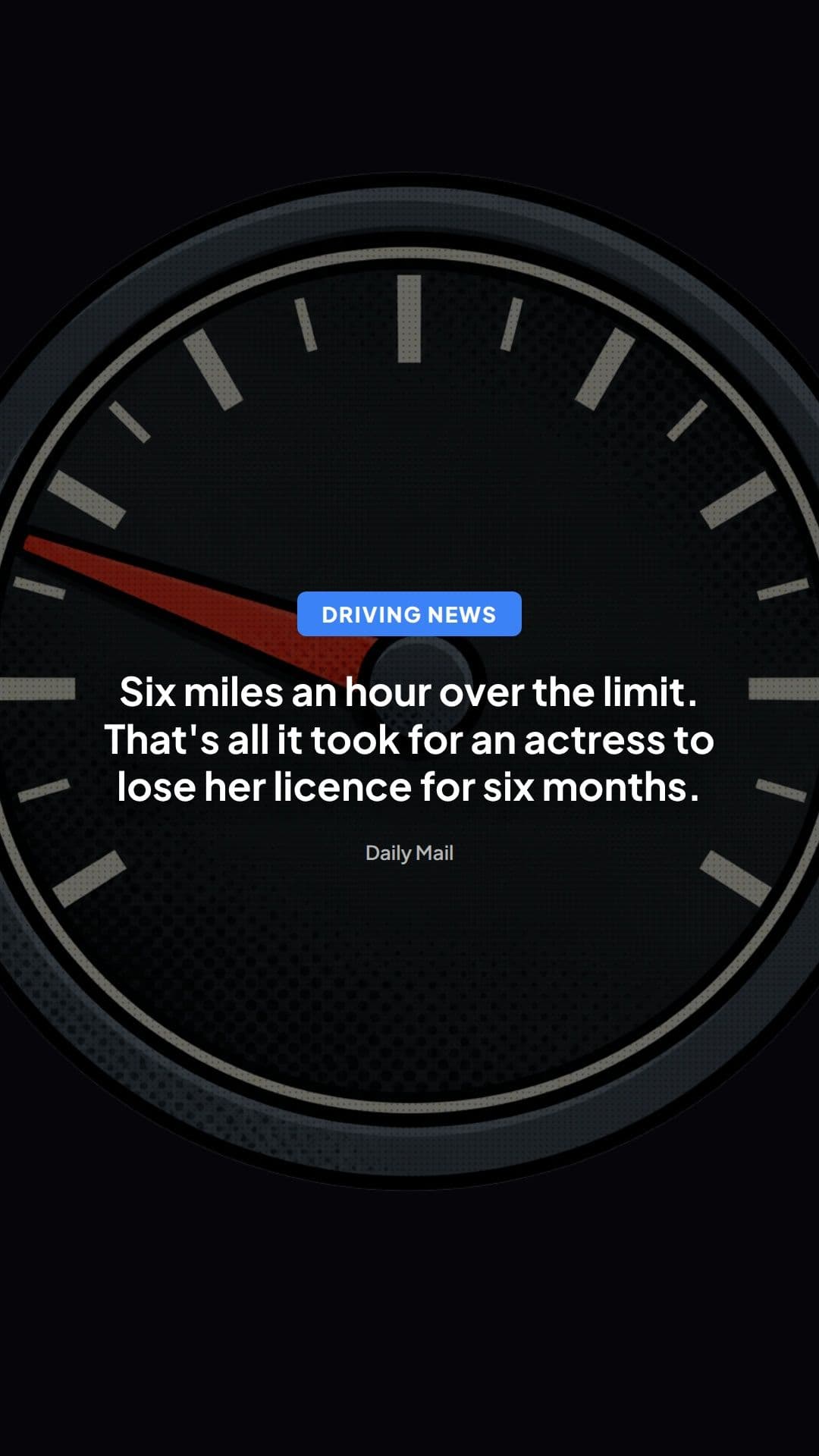
Six miles per hour doesn't sound like much. It's less than a brisk jog. Yet according to the Daily Mail, that margin, 26mph in a 20mph zone, ended with actress Laila Rouass being banned from driving. Add a missed court date and a stranded-abroad explanation, and you have a story that shows how the system works once a speeding allegation turns into a court case.
This isn't about one person. It's about how seemingly minor speeding offences can escalate, and what happens when you aren't in the courtroom.
What happened
The Daily Mail reports that Rouass was caught travelling at 26mph in a 20mph zone and was disqualified from driving. She did not attend court. Her explanation was that she was stuck in Dubai because of flight disruption.
The report, as summarised, doesn't tell us several things that matter for understanding the outcome:
- how many points she already had, if any
- the length of the ban
- whether she had received notice of the hearing in time
- whether the case was dealt with in open court or on paper
So we should be careful about what we infer. What we can do is look at how the law normally works, and why an outcome like this is possible.
Why a ban for 26mph is unusual, and what might explain it
On its own, 26mph in a 20mph limit is at the lower end of speeding offences. Under the Sentencing Council's guidelines for magistrates, offences are split into bands according to speed and limit. The lowest band attracts a fine based on income and, usually, 3 penalty points. Disqualification is reserved for higher bands or for aggravating circumstances.
So a ban for a single low-band offence would be out of the ordinary. The more common route to disqualification is totting up. Under section 35 of the Road Traffic Offenders Act 1988, a driver who reaches 12 or more penalty points, counting offences committed within three years of each other, faces a minimum six-month ban. The court must impose it unless it finds "exceptional hardship" or other mitigating circumstances that justify not doing so.
I want to be clear that the report as summarised doesn't say this is what happened. It's simply the most usual way a driver ends up banned over a modest speeding offence. Readers should treat it as context, not as fact about this case.
Why 26mph can still lead to prosecution
Some drivers assume small overshoots are ignored. There's a grain of truth here, but it's often misunderstood.
Police guidance, issued by the National Police Chiefs' Council, sets a threshold at which enforcement is typically considered: 10% of the limit plus 2mph. In a 20mph zone, that works out as 24mph. At 26mph you're over it. In practice that means:
- You could be offered a fixed penalty (£100 and 3 points).
- You could be offered a speed awareness course, if you're eligible. This is at police discretion, and generally isn't available if you've done one within the past three years.
- Or you could be summonsed to court.
Crucially, these are thresholds for enforcement, not legal speed limits. The offence under section 89 of the Road Traffic Regulation Act 1984 is exceeding the limit, full stop. The 10% plus 2 approach is a guide to when forces choose to act, not a defence.
That's one reason our earlier piece on speeding myths that could cost drivers dearly is worth a read. And if you want to understand why more 20mph zones means more of these cases, see 20mph speed limits: safer streets or tougher enforcement.
Why it matters: 20mph is where small overshoots happen
There's a practical point hiding in this story. In a 20mph zone, the gap between "legal" and "enforceable" is tiny. At 30mph, 10% plus 2 gives you 35mph. At 20mph, it gives you 24mph. Drift up by a few miles per hour on a gentle downhill, and you've crossed it.
Add the following and the risk is clear:
- 20mph limits are increasingly common on residential and urban roads.
- The change from 30 to 20 can be subtle, and signage or roundel markings are sometimes easy to miss.
- Speedometers typically read slightly high rather than low, but not every driver watches them closely in town.
None of that excuses speeding in an area where the limit has been set for pedestrian safety. But it explains why ordinary drivers, rather than reckless ones, end up on the wrong side of the line.
The legal angle: what happens when you don't turn up
The most instructive part of the story is arguably the non-attendance. What does the law say?
Courts can proceed in your absence
For most summary offences, including speeding, magistrates can hear the case without the defendant if the court is satisfied the person was properly served with the summons or notice. This comes from section 11 of the Magistrates' Courts Act 1980. If the case proceeds, the court can convict and sentence in your absence, including by imposing a disqualification.
Many speeding cases also go through the Single Justice Procedure, where a magistrate considers the case on paper without a hearing. Drivers receive a notice and are expected to respond with a plea and any information about their circumstances by the deadline. Ignoring it doesn't pause the process.
An excuse isn't the same as a defence
Being stranded abroad is a genuine, sympathetic reason for being unable to attend. But courts generally expect to be told in advance, with evidence, so they can consider an adjournment. A last-minute explanation after sentence is a different matter. The court's question is usually whether it was told, whether the absence was deliberate, and whether it's fair to proceed.
Routes back if a case went ahead without you
If someone is convicted and sentenced in their absence, there are mechanisms that may help. These are general descriptions, not advice on any individual case:
- Statutory declaration (section 14, Magistrates' Courts Act 1980): if you genuinely did not know about the proceedings, you can make a declaration to that effect within 21 days of finding out. If accepted, the proceedings are treated as void and start again.
- Reopening the case (section 142): a court can reopen a case where it's in the interests of justice, generally within 28 days of sentence.
- Appeal to the Crown Court: against sentence or conviction, subject to strict time limits.
- Exceptional hardship argument: where a totting-up ban is at issue, a driver can argue that disqualification would cause exceptional hardship. Courts treat this strictly, and ordinary inconvenience rarely qualifies.
The common thread is time limits. They're short, and missing them can close doors. Anyone in this position should speak to a solicitor promptly or check the official guidance on GOV.UK.
What drivers should know: practical takeaways
1. Treat every court or SJP notice as urgent. Open post from the court or police immediately. Deadlines for returning forms are usually short, and the consequences of missing them can include being convicted and sentenced without your input.
2. Keep your address up to date with the DVLA. Notices are sent to the registered keeper's address. If you've moved and haven't updated your record, you may not see papers until it's too late. Failing to keep it current is itself an offence.
3. If you can't attend, tell the court in writing, early, with evidence. Travel disruption, illness or work commitments can sometimes justify an adjournment, but courts want proof, such as booking confirmations, airline notices or medical letters. Don't assume silence will be understood.
4. Know your points position. Check your licence record on GOV.UK. Points stay on your record for four years from the offence date for most speeding offences, but it's the three-year window between offences that matters for totting up. Knowing where you stand tells you what a "minor" offence could really cost.
5. If offered a speed awareness course, think carefully. It avoids points, but it's not guaranteed and generally you can only take one in a three-year period. It's usually cheaper in the long run than a conviction.
6. In 20mph zones, add a mental buffer. Because the enforcement threshold is just 24mph, many drivers find using cruise control or a speed limiter where available genuinely useful. Another tip is simply to drive at 18 to 19mph on the approach to schools and residential streets.
7. Don't rely on a high-profile excuse working for you. A story about flight chaos is relatable, but it doesn't change how the law treats absence. Whether the court proceeds depends on service, notice and the facts, not on how sympathetic the reason sounds in a headline.
Looking ahead
Cases like this tend to prompt familiar debates. Some argue that low-speed 20mph limits are being enforced too strictly, while safety campaigners argue that the difference between 20mph and 26mph is exactly what matters for pedestrians. Without wading into either side, the direction of travel is clear: more 20mph limits, more automated enforcement and more reliance on paper-based court processes.
For drivers, that makes administrative discipline as important as careful driving. Responding on time, keeping details current and understanding your points position are the unglamorous habits that stop a small speeding offence snowballing.
It's also a reminder that headline details can be incomplete. We don't know the full background to this particular ban, and it would be unfair to speculate. What we can say is that the mechanics of the system, thresholds, totting up and proceeding in absence, are well established, and anyone could end up navigating them.
If you're facing a speeding summons, a potential totting-up ban or a conviction in absence, take it seriously and get qualified advice from a solicitor or an organisation such as Citizens Advice. Time limits are tight, and the stakes, especially if you rely on your licence for work, are real.
This article is general information about UK motoring law and is not legal advice. Source: Daily Mail reporting on the Laila Rouass case.
Written by
The Parking Ticket Pal Editorial Team
Source-checked parking guidance
Ready to Challenge Your Ticket?
Let our AI analyse your PCN and generate a professional appeal letter in minutes.
Start Free Appeal