Disabled parking without a Blue Badge? UK rules explained
Can pensioners park in disabled bays without a Blue Badge? We explain UK rules, exceptions, local variations and how to avoid a PCN when parking.

Marcus Campbell
25 April 2026
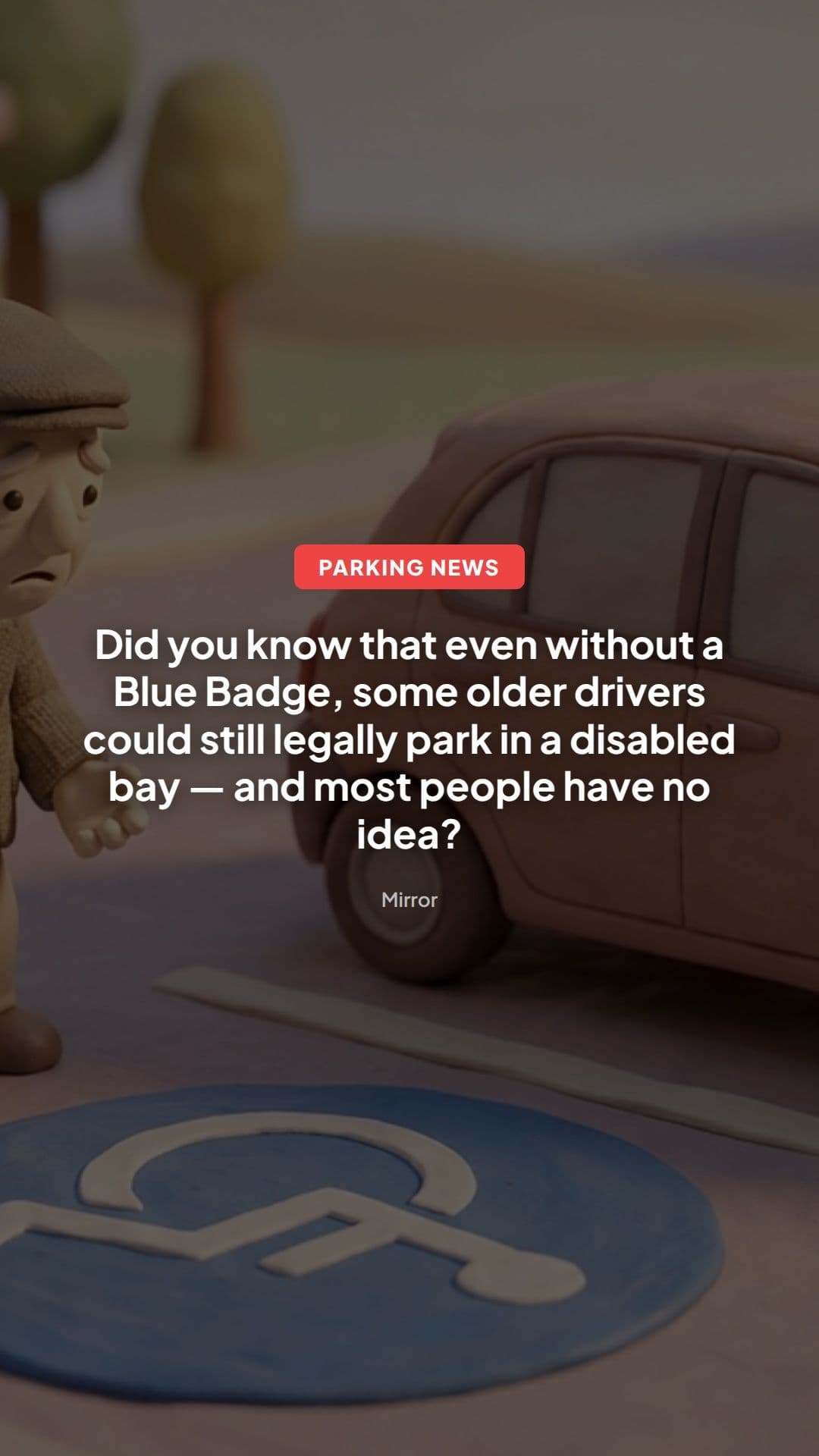
Pensioners Without a Blue Badge May Still Be Able to Use Disabled Parking Bays — Here's What You Need to Know
A recent report in the Mirror has highlighted a genuinely confusing area of UK parking law that affects millions of older people. But the reality is far more nuanced — and far more interesting — than the headline suggests.
The Moment That Sparked the Question
Picture the scene: an 82-year-old woman with severe arthritis pulls into a disabled bay outside her local supermarket. She doesn't have a Blue Badge — her application was rejected months ago, despite her obvious mobility difficulties. A parking warden approaches. She braces herself for a fine.
Does she deserve one?
The answer, perhaps surprisingly, is: it depends. And that ambiguity sits at the heart of a debate that affects an estimated 12 million people aged 65 and over in the UK, many of whom live with significant mobility challenges but fall outside the formal Blue Badge eligibility criteria.
A recent piece in the Mirror highlighted this grey area, noting that some older people without a Blue Badge may, in certain circumstances, still be permitted to use disabled parking bays. It's a story that deserves considerably more unpacking — because the rules are patchwork, the enforcement is inconsistent, and the consequences of getting it wrong can be costly.
What the Story Actually Says
The Mirror report draws attention to a genuine gap between who needs accessible parking and who qualifies for it under the formal Blue Badge scheme. It notes that local variation plays a significant role — some councils operate their own concession schemes, and some private car parks apply different rules entirely.
The piece touches on the confusion many pensioners face: they may have been told by a GP, a carer, or even a well-meaning family member that their age or condition entitles them to use a disabled bay. In some cases, that's partially true. In others, it's a misunderstanding that leads directly to a Penalty Charge Notice.
What the article doesn't do — and what we'll do here — is explain why this confusion exists, what the law actually says, and what older drivers (and their families) should realistically do about it.
Why This Confusion Exists: Background and Context
The Blue Badge scheme was introduced under the Chronically Sick and Disabled Persons Act 1970 and is now administered under the Road Traffic Regulation Act 1984 and associated regulations, most recently updated by the Blue Badge Improvement Service guidance from the Department for Transport. It provides a nationally recognised badge that permits holders to park in designated disabled bays, on yellow lines for up to three hours, and in other restricted areas.
The problem is that the scheme was designed around disability — not age. And while many older people are disabled in the legal sense, a significant number fall into a frustrating middle ground: they struggle to walk long distances, they may have balance issues or chronic pain, but they don't meet the automatic eligibility criteria (such as receiving the higher rate mobility component of Disability Living Allowance or Personal Independence Payment) and they don't quite clear the bar for non-automatic eligibility, which requires a formal assessment.
Roughly 2.5 million Blue Badges are in circulation in England alone. Yet disability charities and Age UK have consistently pointed out that many people who genuinely need accessible parking are being turned away — while, simultaneously, some badges are being misused. It's a system under pressure from both ends.
The Legal Angle: What the Rules Actually Say
Let's be direct about the law, because this is where a lot of people come unstuck.
On-street disabled bays — the ones marked with the wheelchair symbol on a blue background, typically accompanied by a sign — are legally enforceable under the Traffic Management Act 2004 in England and Wales. Only vehicles displaying a valid Blue Badge may park in these bays. There is no legal exemption for age, regardless of what a pensioner has been told.
Off-street car parks — including supermarket car parks, retail parks, and privately managed facilities — operate under contract law rather than highway law. This is a crucial distinction. Private operators set their own terms and conditions. Some do make provisions for older customers or those with temporary mobility difficulties, but this is entirely at their discretion. There is no legal obligation to do so, and a private parking charge notice (PCN) issued for using a disabled bay without a badge is generally enforceable, provided the signage was adequate.
However, there are some genuine exceptions and lesser-known provisions worth knowing:
- Temporary concession schemes: A small number of local authorities operate their own concession schemes for residents who don't hold a Blue Badge but have documented mobility needs. These are entirely local, entirely discretionary, and vary enormously. Some councils in Scotland and Wales have historically been more progressive in this area.
- Loading exemptions: In some on-street disabled bays, a vehicle may legally stop briefly to drop off or collect a disabled person — even without a badge — provided no loading restriction is in force. The key word is stop, not park.
- Motability and care vehicles: A vehicle being used to transport a Blue Badge holder can use a disabled bay even if the badge holder is not driving — but the badge must be displayed. The badge belongs to the person, not the vehicle.
- Hospital and NHS sites: Some NHS trusts operate their own accessible parking concessions that sit outside the standard Blue Badge framework. These are site-specific and should be checked directly with the facility.
What Drivers — and Their Families — Should Know
If you're an older driver, or you're supporting an elderly relative, here's what actually matters in practice:
1. Age alone is never enough. There is no age at which you automatically qualify for a Blue Badge or gain the right to use a disabled bay. The scheme is needs-based, not age-based.
2. Reapply if you've been rejected. Blue Badge applications are assessed by local councils, and the quality of assessments varies. If you or a relative was rejected but has since seen a decline in mobility — or if the original application was poorly evidenced — a fresh application with detailed supporting medical information is worth pursuing. GP letters, occupational therapist reports, and physiotherapy notes all strengthen a case.
3. Check your local council's website. Some councils do operate supplementary schemes or have specific provisions for residents awaiting a Blue Badge decision. These aren't widely advertised, but they exist.
4. Don't rely on verbal advice. If a car park attendant, a GP receptionist, or even a well-meaning neighbour tells you it's "fine" to use a disabled bay without a badge, that advice has no legal standing. The only thing that protects you is a valid, properly displayed Blue Badge.
5. Private car parks are not the same as public roads. If you use a disabled bay in a supermarket car park without a badge and receive a charge notice, you may have grounds to appeal — but only on procedural grounds (inadequate signage, no landowner authority, etc.), not on the basis of mobility needs alone.
6. Consider requesting a formal needs assessment. If a Blue Badge application has been refused and you believe the decision was wrong, you have the right to request a review. Some councils also offer independent assessments through occupational therapists.
Looking Ahead: A System in Need of Reform
The confusion highlighted by the Mirror story isn't accidental — it reflects a system that hasn't kept pace with an ageing population. The UK's over-65 demographic is growing rapidly, and with it, the number of people who occupy that frustrating grey zone between "fully able-bodied" and "formally disabled."
There are growing calls from disability charities, Age UK, and motoring organisations for a review of Blue Badge eligibility criteria to better reflect the lived reality of older people with progressive conditions. There's also an argument for greater transparency from private parking operators about what concessions, if any, they make for vulnerable customers.
Until those changes come — and there's no imminent sign of them — the responsibility falls on individuals to navigate a system that is, at best, inconsistently applied and, at worst, actively confusing.
The bottom line is this: if you or someone you care for genuinely struggles with mobility, the Blue Badge application process is the right route — even if it takes persistence. Using a disabled bay without one, however understandable the impulse, carries real financial and legal risk. And in a system this fragmented, knowing the rules in your specific area isn't just useful — it's essential.
Always check your local council's Blue Badge guidance and any specific provisions offered by private car park operators before making assumptions about your eligibility to use accessible parking.
Written by
Marcus Campbell
Former Traffic Warden
Ready to Challenge Your Ticket?
Let our AI analyse your PCN and generate a professional appeal letter in minutes.
Start Free Appeal