
Cyclists Face £50 Fine or Road Safety Video at Red Lights
Cyclists caught jumping red lights or using zebra crossings unlawfully could face a £50 fine or a 47-second safety video. What the new scheme means.

The Parking Ticket Pal Editorial Team
14 October 2026
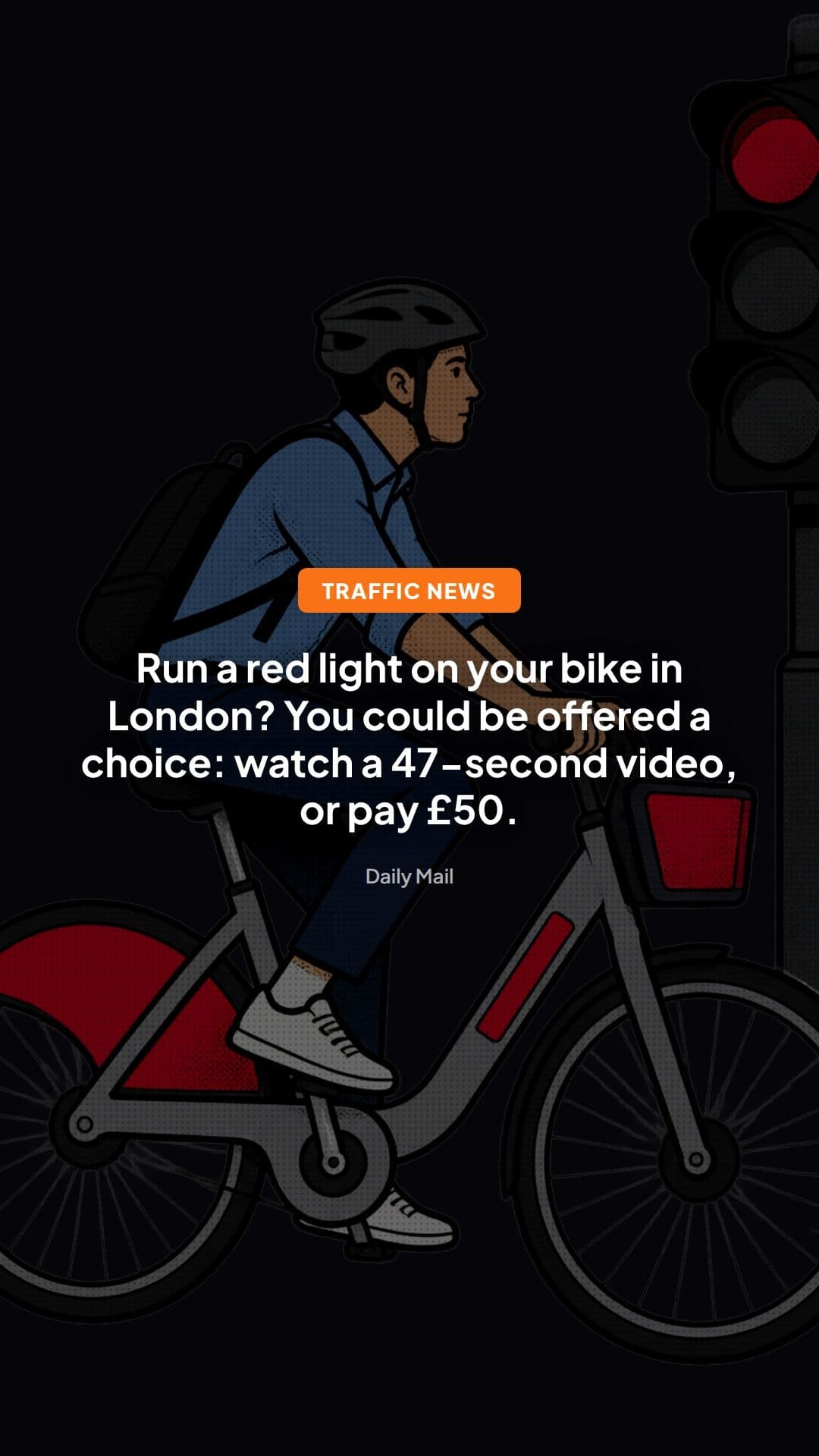
Watch a 47-Second Video or Pay £50: Is the Cyclist "Sin Bin" the Future of Road Policing?
Most of us have seen it. You are waiting at a red light, a cyclist glides through the junction, and everyone nearby either tuts or holds their breath. For years the frustration has run both ways. Cyclists say they are overlooked and endangered by drivers. Drivers say riders seem to treat red lights as optional. Now one police force has proposed a middle path, and it takes less time than making a cup of tea.
According to the Daily Mail's report, a police force is introducing a "sin bin" approach for cyclists caught going through red lights or ignoring zebra crossings. Riders will be offered a choice: watch a 47-second road safety video, or pay a £50 fine.
It sounds almost too simple, so it is worth looking at what it means, how it fits with the law, and what drivers should take from it.
What the story says
The scheme, as reported, targets two specific behaviours:
- Cyclists going through red traffic lights
- Cyclists failing to respect zebra crossings
Instead of automatically receiving a financial penalty, the rider is given the option of a short educational intervention. The reported video lasts 47 seconds. The alternative is a £50 fine.
The source article does not, as far as the summary tells us, set out every operational detail, so it would be wrong to guess how riders will be stopped, how the video will be delivered, or what happens if someone declines both options. Anyone wanting specifics should check the force's own announcements.
Why "sin bin" is a loaded phrase
The term borrows from sport, where a player who commits a foul sits out for a short spell before returning to the game. It suggests a proportionate, quick, non-criminal consequence.
That framing matters because enforcement against cyclists has long been awkward. Cycling offences are generally minor, but they can feel serious when they involve a pedestrian stepping onto a crossing. Officers have discretion, but a stop can eat into their time. Prosecution in court is out of proportion for most of these incidents.
A short video offers a middle option that officers can use on the spot without much paperwork. Whether it works depends on whether riders genuinely engage with the content or simply click through it.
The existing legal position for cyclists
Many people assume cyclists operate in a legal grey area. They do not. Pedal cyclists are subject to the same traffic signal rules as other road users.
Red lights. Under section 36 of the Road Traffic Act 1988, failing to comply with a traffic light signal is an offence, and that applies to people on bikes as well as drivers. Cyclists can be offered a fixed penalty notice, which has typically been £50. If a case goes to court instead, the maximum fine is considerably higher.
Zebra crossings. The Zebra, Pelican, Puffin, Toucan and Pedestrian Crossings Regulations 1997 and the Highway Code set the expectations. Vehicles, which include bicycles, must give way to pedestrians who have stepped onto a zebra crossing. The Highway Code also places greater responsibility on those who can cause the most harm, a principle known as the hierarchy of road users, which was strengthened in the 2022 update.
Penalty points. One point often misunderstood is that a cyclist cannot be given penalty points for a cycling offence, because riding a pedal cycle does not require a driving licence. A fixed penalty or court fine is the usual consequence. Cycling offences do not endorse a driving licence.
Careless or dangerous cycling. More serious conduct can fall under other offences, such as careless or inconsiderate cycling and dangerous cycling under the Road Traffic Act 1988, which can carry heavier penalties if prosecuted. A video scheme is clearly not aimed at that end of the spectrum.
How does a video option fit in?
The idea of offering education instead of a penalty is not new. Police forces across England and Wales already use out-of-court disposals and diversion schemes. For drivers, the best-known example is the speed awareness course, offered through the National Driver Offender Retraining Scheme (NDORS) for certain low-level offences if you meet eligibility criteria.
The cyclist video option follows the same logic: keep minor offences out of the court system, and try to change behaviour rather than simply collect money. The £50 fine remains in the background as the alternative, matching the level of a standard fixed penalty for these offences.
There is a legitimate debate here. Supporters would say education is more likely to produce lasting change than a fine, especially for occasional offenders. Critics might ask whether 47 seconds is enough to alter habits, or whether the scheme could feel like a soft touch. Both points are fair, and the real-world results, not the headlines, will answer them.
Why drivers should care
You might wonder what a story about cyclists has to do with a motoring and parking audience. Quite a lot.
1. It shows where enforcement priorities are heading. Police and councils are increasingly focused on conflict points between road users, such as junctions, crossings, and shared spaces. The same attention that is now falling on cyclists in this scheme often lands on drivers too.
2. Drivers face stricter consequences for the same behaviour. A driver who goes through a red light faces a fixed penalty of £100 and three penalty points, and the points can add up quickly. The contrast with a cyclist's no-points, £50-or-video choice is stark, and it explains some of the resentment between the two groups. It is also a reminder that your own margin for error at signals is thin.
3. Many junctions are shared spaces. Advanced stop lines, cycle lanes, and crossings all create situations where drivers and riders interact at close quarters. Our guide to mandatory cycle lane violations covers the driver's side of that interaction.
Practical takeaways for drivers
Do not rely on cyclists to follow the rules. Even if a scheme like this works well, some riders will still run lights. Approach junctions expecting the unexpected, particularly on green when you are moving off, and when turning left across a cycle lane.
Treat crossings as a hard stop. At a zebra crossing, a driver must give way to anyone who has stepped onto it, and good practice is to slow down and be ready for anyone waiting. Do not assume a cyclist approaching a crossing will stop. Cover your brake and check.
Leave proper space when overtaking. The Highway Code advises leaving at least 1.5 metres when passing cyclists at speeds up to 30mph, and more at higher speeds. A rider who has just run a red does not lose that protection.
Do not take matters into your own hands. Confronting a cyclist, blocking them, or driving aggressively in response to a perceived offence can land you in far more serious trouble than the rider. If you witness something worrying, most forces have online portals for submitting dashcam footage. Check your local force's website, and be aware that footage may be used as evidence in both directions.
Know your own signals. Do not enter a box marked for cyclists at an advanced stop line while the light is red. Drivers are expected to stop at the first line. For a refresher on rules that catch out even experienced motorists, see our overview of Highway Code rules drivers often miss.
If you also ride a bike. Many drivers cycle too. If you are stopped and offered a penalty or a diversion option, ask for the details in writing and make sure you understand the deadline. If you disagree that an offence took place, you generally have the right to ask for the matter to be dealt with in court rather than accept a fixed penalty. For anything beyond a simple notice, consider official guidance or independent professional advice, particularly because the exact terms of local schemes can differ.
What about e-bikes and e-scooters?
An important caveat. The legal position for electrically assisted pedal cycles that meet the legal definition differs from that of e-scooters. Electrically assisted pedal cycles that comply with the regulations are generally treated as ordinary bicycles. Privately owned e-scooters are classed as motor vehicles, which means insurance, licensing, and roadworthiness requirements apply and they cannot lawfully be used on public roads. That is a different enforcement area from the cyclist scheme, and we explore the wider picture in our piece on e-scooter injuries and calls for reform.
The bigger questions this raises
Will it be consistent? Police forces have discretion, so one area's approach may differ from another's. A rider who is offered the video in one place might simply be fined in another. Consistency is often the weak point of local initiatives.
Will it be effective? The story does not provide results, and it would be wrong to speculate. The measure of success will be fewer incidents at junctions and crossings, not the number of videos watched. Forces typically need to track repeat offending and complaints to judge that.
Is it fair? Drivers sometimes see cycling enforcement as lenient, and cyclists sometimes see it as disproportionate attention given how much harm motor vehicles cause. Both views are held sincerely. A scheme that treats minor rule-breaking proportionately, while keeping a financial consequence for those who refuse education, may be a reasonable compromise.
Looking ahead
If the scheme is judged a success, expect other forces to take an interest. Diversion-based enforcement has spread before, and the pattern is familiar: a local trial, positive coverage, then wider adoption or refinement. It could also prompt calls for similar approaches to other low-level road offences.
For drivers, the key message is a calm one. This is not a new law. The offences already existed, and the fixed penalty amount is not new either. What is different is the option of a quick educational route. The underlying rules for everyone remain the same: stop at red, give way at crossings, and share space with care.
Whatever you ride or drive, the safest approach is the same: assume the other person might not do what you expect, and leave yourself room to react. A 47-second video might change one rider's habits. Your own attention at the next junction might prevent an accident today.
This article provides general information about UK motoring rules and is not legal advice. For guidance on a specific notice or incident, consult official government resources, your local police force, or a qualified professional.
Written by
The Parking Ticket Pal Editorial Team
Source-checked parking guidance
Ready to Challenge Your Ticket?
Let our AI analyse your PCN and generate a professional appeal letter in minutes.
Start Free Appeal