
Caterham Pavement Parking Ban: £100 Fines Explained
Surrey’s proposed Caterham pavement parking restrictions could bring £100 fines. Find out what the order means for drivers, cyclists and pedestrians.

The Parking Ticket Pal Editorial Team
28 October 2026
Pavements Are for Pedestrians: What Caterham's Proposed Ban Means for Drivers
Most of us have done it. You pull two wheels up onto the kerb on a narrow street, tuck in your mirrors and tell yourself it is only for five minutes. For some drivers it is a daily habit, because the road is simply too tight to do anything else. For a parent with a pushchair, a wheelchair user or someone with sight loss, the same habit can mean stepping into live traffic.
That tension sits at the heart of a Surrey consultation covering parts of Caterham, reported by BBC News under the headline "'Pavements are for pedestrians', campaigner says". Even if you have never set foot in the town, the way this is playing out says a lot about where pavement parking rules are heading across England.
What has been proposed
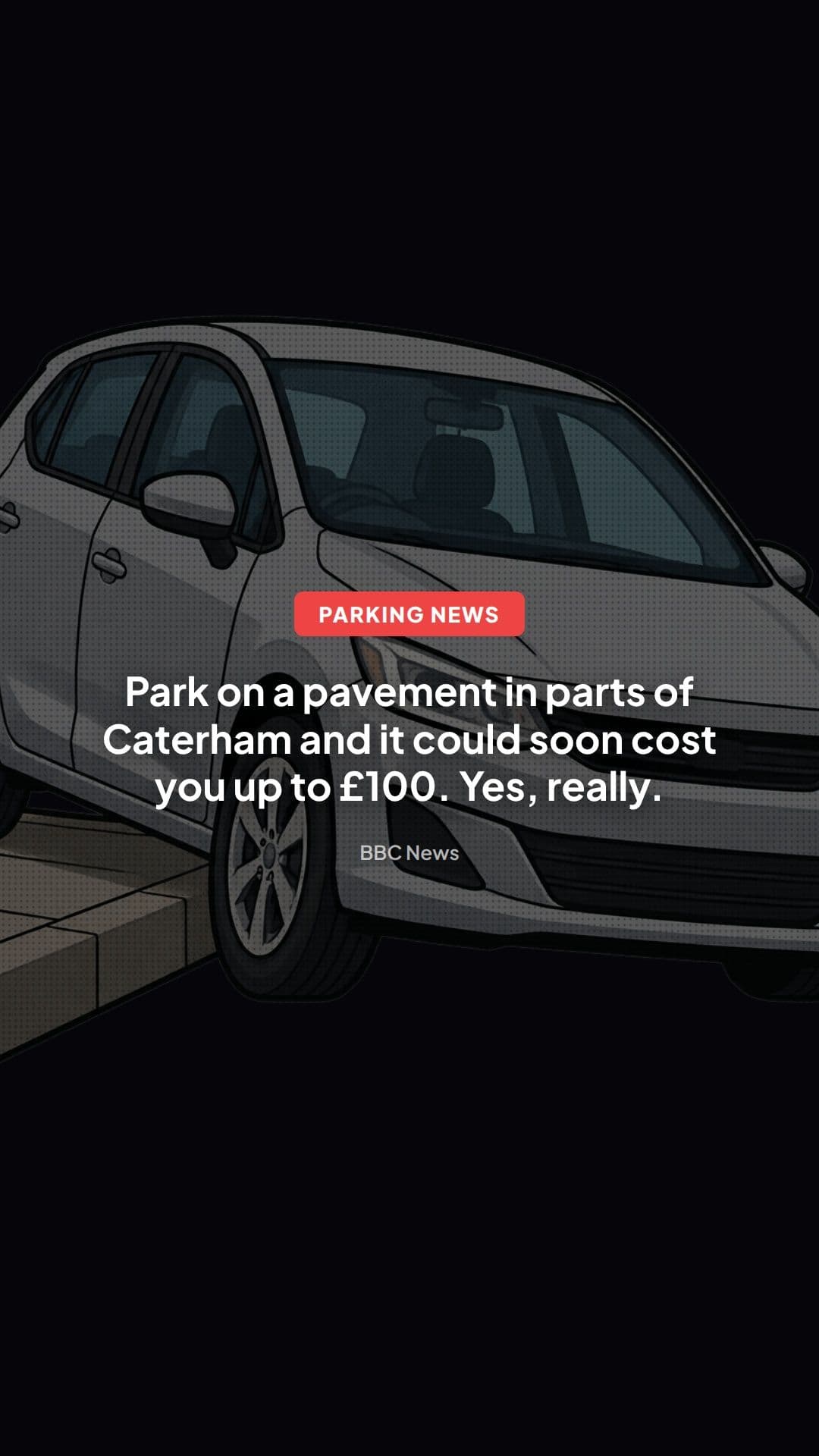
According to the BBC report, Surrey is consulting on a traffic order that would restrict driving, riding and parking on pavements in parts of Caterham. The stated aim is to improve safety for pedestrians, and the penalty could be a fine of up to £100.
Three details are worth noticing.
It is not only about parking. The proposal covers driving and riding on the pavement as well. That wording matters because it can bring in cyclists, motorcyclists and potentially e-scooter users, not just parked cars.
It is local and targeted. The order applies to parts of Caterham, not the whole county. This is how pavement restrictions usually arrive outside London, street by street or area by area.
It is still a consultation. Nothing is fixed. Residents, businesses and drivers can comment, and councils must consider objections before making a final decision.
I am not going to speculate here about which roads are included or how the final order might be worded, because those details sit in the consultation documents. If you live or drive in the area, read the council's own papers rather than relying on a summary.
Why this matters beyond Caterham
The rules are different in London and elsewhere
London has had a general ban on pavement parking since the 1970s, under the Greater London Council (General Powers) Act 1974. Outside the capital, the picture is patchier. The Highway Code (rule 244) says you should not park on the pavement unless signs permit it. In London you must not. Notice the word "should". Outside London, that rule on its own is not a blanket ban that councils can enforce with a penalty charge notice (PCN).
So how do councils outside London tackle it? Mainly by creating local Traffic Regulation Orders (TROs) for particular streets or zones. That is what a consultation like Caterham's is the first step towards. For the wider national picture, see our earlier explainer on what England's 2026 pavement parking crackdown means, which covers the national direction of travel, so I will not repeat it here.
Why pavements are a flashpoint
Parked cars on pavements force pedestrians into the road. The people most affected are those with the fewest options: wheelchair and mobility scooter users, blind and partially sighted people with guide dogs or canes, and parents with buggies. Councils and campaigners often argue that a pavement cluttered with vehicles is a pavement that effectively excludes them.
The counter-argument is equally real. On many older streets, particularly terraced roads built long before widespread car ownership, there is barely room for two cars to pass if both sides are lined with parked vehicles. Drivers sometimes mount the kerb deliberately to leave the carriageway clear for bin lorries, buses or emergency vehicles. Neither side is being unreasonable, which is why these schemes tend to be contentious.
The legal angle
Driving on the pavement
Driving on a footway is already an offence under section 72 of the Highway Act 1835, which is still in force. Separately, the Road Traffic Act 1988 deals with driving on or parking on certain cycle tracks and bridleways. There are practical exceptions, such as crossing the footway to reach a driveway via a dropped kerb. Cycling on the pavement is also generally prohibited and can attract a fixed penalty notice. The Caterham proposal, as reported, would add a local, civilly enforceable layer on top.
How a local order becomes enforceable
A pavement restriction outside London generally relies on a TRO made under the Road Traffic Regulation Act 1984. In England, councils must follow statutory procedures for advertising and consulting on proposed orders, which include a period during which objections can be made. Enforcement of parking contraventions is then typically civil, under the Traffic Management Act 2004, meaning a PCN rather than a criminal prosecution.
Two points follow from that, and both matter if you ever receive a PCN:
- Signs and markings matter. For a restriction to be enforceable, the order needs to be properly made and the restriction needs to be properly signed in line with the Traffic Signs Regulations and General Directions 2016. Areas covered by a pavement ban are often identified by prescribed signs, and a poorly signed or missing restriction can become the basis of an appeal. Our guide on using unclear signs as a defence covers how that argument works in general terms.
- Penalty levels are set by the framework. The BBC reports fines of up to £100 for Caterham. Civil penalties for on-street parking outside London are normally set within national bands, often with a reduction for early payment. How the final figure works in practice will depend on the order and the council's enforcement arrangements, so check the notice itself if you are ever issued one.
Exemptions you should not assume
Most pavement restrictions come with exemptions, but they are narrow, and they vary by order. Common ones include:
- Emergency services and some utility or refuse vehicles carrying out their work
- Crossing the footway to reach a property via a dropped kerb
- Loading and unloading in some circumstances, if the order allows it
A Blue Badge generally does not give you the right to park on a pavement. Blue Badge concessions relate to things like yellow lines, not footway restrictions. Read the actual order rather than assuming you are covered.
What drivers should know
This is general information rather than advice on any individual situation, but here are some sensible takeaways.
1. Have your say while it counts. If you live, work or regularly park in the affected part of Caterham, respond to the consultation. Councils must consider objections and suggestions, and the most useful responses are specific. Which street? What would you do instead? Is there a safety problem, such as emergency access, that the order might create or solve? A vague objection is easier to dismiss than a practical one.
2. Check what is actually on the ground once an order is in force. Do not rely on what a street looked like last year. Look for signs at the entry to the zone and repeater signs along the road. Take photographs of signs and of your vehicle's position if you park nearby. If you ever need to challenge a PCN, that evidence is far more useful than memory.
3. Think about the footway even when you are only popping in. A "quick stop" does not have special status. If the restriction applies, a short stop can still attract a PCN unless the order provides an exemption. Equally, driving across a pavement where there is no dropped kerb or driveway access could fall foul of the rules.
4. Know your driveway rights and limits. Crossing a pavement to reach your own driveway is typically permitted where a proper vehicle crossover exists. Parking across someone else's dropped kerb is a separate problem entirely, covered in our explainers on dropped kerb rules and PCN code 27.
5. Cyclists and riders are in scope too. If the final order covers riding on pavements, it is not just a motorist issue. Households with e-bikes or motorbikes should check the final wording.
6. If you receive a PCN, follow the process. Councils outside London generally handle challenges in stages: an informal challenge, then formal representations after a Notice to Owner, and finally an appeal to an independent tribunal such as the Traffic Penalty Tribunal. Deadlines matter, and the early payment discount usually disappears once you move past the first stage. For the mechanics, see our guides to formal representations and the Traffic Penalty Tribunal process. For higher-stakes disputes, official guidance or independent advice is worth seeking.
Practical alternatives if you currently park on the kerb
If a ban comes in and your street is narrow, it is worth thinking ahead rather than waiting for the first PCN:
- Check for nearby off-street options, such as car parks, driveways you can rent, or spaces offered through community schemes.
- Ask the council about alternatives. Some authorities consider partial solutions on narrow roads, such as marked bays or one-way arrangements, if residents raise the issue during consultation.
- Talk to neighbours. Staggered parking, where cars sit on alternate sides, can sometimes keep the carriageway clear without using the pavement. It is not always practical, but it can be worth raising.
Looking ahead
The Caterham proposal is a small piece of a bigger pattern. Councils across England outside London are increasingly looking at pavement restrictions, and the idea that pavements belong to pedestrians first is gaining ground, particularly in discussions around accessibility. Local orders like this are one of the main tools councils currently have, which is why they tend to be rolled out one area at a time.
For drivers, the direction of travel is clear enough. Where restrictions exist, signage and enforcement are likely to be taken seriously, and "everyone does it" is not a defence. Equally, councils must follow due process, and drivers who understand the consultation and appeal routes are in a much stronger position than those who find out about a restriction when a PCN lands on the doormat.
Whatever the outcome in Caterham, the consultation stage is the moment to speak up. Once an order is made and signed, the debate shifts from "should this happen?" to "did you comply?" If you are affected, read the council's documents, respond with specifics, and keep an eye on the final decision.
This article is general information about UK parking and motoring rules and is not legal advice. For the specifics of any proposed order, consult the council's published consultation documents, and seek independent advice if you are disputing a penalty.
Written by
The Parking Ticket Pal Editorial Team
Source-checked parking guidance
Ready to Challenge Your Ticket?
Let our AI analyse your PCN and generate a professional appeal letter in minutes.
Start Free Appeal