
Airport Parking Fine for 18-Second Wasp Stop: Your Rights
A £100 airport parking fine for an 18-second wasp stop raises questions over private PCNs, grace periods and motorists' rights to appeal at UK airports.

The Parking Ticket Pal Editorial Team
26 October 2026
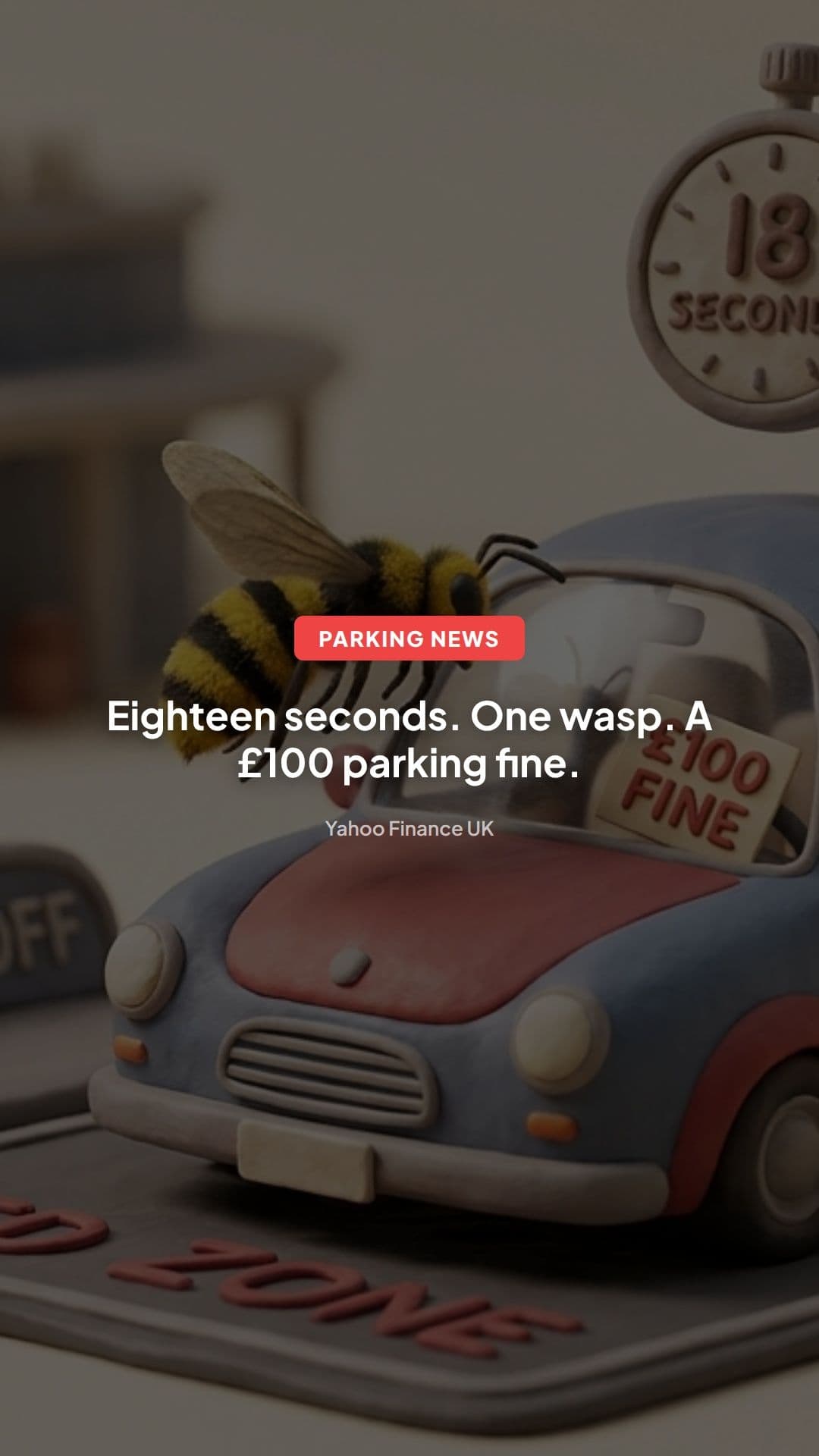
18 Seconds, One Wasp, £100: When Does a Brief Stop Become "Parking"?
Picture the scene. You are pulling up to an airport terminal, bags in the boot, and a wasp appears inside the car. Your instinct is to stop somewhere safe and get it out before it causes a crash. Eighteen seconds later, you are moving again. A few days after that, a £100 charge lands on your doormat.
That is what a driver reported at Leeds Bradford Airport, according to Yahoo Finance UK's coverage. The private parking charge was issued for stopping in a red zone for just 18 seconds. The airport later arranged a goodwill refund, and the story arrived as the government weighs protections for brief stops caused by emergencies.
The refund is welcome, but the interesting question is the one underneath it: at what point does a stop become "parking", and who decides?
What happened, and what we know
The facts as reported are simple. The driver stopped briefly in a red zone at the airport to deal with a wasp. A private parking charge of £100 followed. After the case drew attention, the airport arranged a refund as a gesture of goodwill.
Two details matter. First, the stop lasted 18 seconds, which is hardly a leisurely pause. Second, the refund was goodwill. That is not the same as the operator accepting the charge was invalid. A goodwill refund means the charge was cancelled as a courtesy, not necessarily because anyone found it unenforceable. We do not have the full paperwork, so it would be wrong to speculate about the operator's exact reasoning or the signage on site.
What the case does show is how a rigid, camera-driven system can collide with ordinary human situations.
Why a few seconds can trigger a charge
Many airports use automatic number plate recognition (ANPR) cameras on forecourts and approach roads. A camera records a plate at one point and again at another, or records a vehicle in a restricted zone. Software then calculates the time between those images. If the vehicle appears to have lingered somewhere it should not, a charge can be generated.
The system cannot tell the difference between:
- a driver idling for ten minutes to meet a friend,
- a driver stopped in traffic, and
- a driver who pulled over because of a wasp, a medical problem or a child being unwell.
Someone is meant to review the evidence before a charge goes out, but in practice the volume involved means human judgement often arrives late, usually at the appeal stage.
Airports are also a particular pressure point. Many have introduced tight controls on forecourts and drop-off areas to manage congestion, and these are often backed by charges. If you want the wider picture on how airports police their approach roads, our guide to airport parking rule changes and how to avoid £100 fines covers the ground.
The legal angle: how can a private firm charge you at all?
This is where many drivers get confused, so it is worth setting out the basics.
Contract, not criminal law
A private parking charge is not a fine in the legal sense. Fines are imposed by courts or public bodies using statutory powers. A private charge is an invoice based on contract law. The operator's argument is that signs at the site set out terms, and by stopping or parking you accepted them. If you breach the terms, the contract says you pay.
The key precedent is ParkingEye v Beavis [2015] UKSC 67. The Supreme Court held that a £85 charge for overstaying in a retail car park was enforceable and was not an unlawful penalty, because the operator had a legitimate interest in managing the car park and the charge was not extravagant. That case is often cited by operators, but it is not a blank cheque. It dealt with a specific set of facts, clear signage and a stay which really did exceed the permitted time. It did not decide that every charge for every kind of stop is enforceable.
"Parking" versus "stopping"
Charges stand or fall on the exact terms. Many private sites prohibit "parking" outside bays. Others prohibit "stopping", "waiting" or "dropping off" in particular zones. Which word the sign uses can matter a great deal. If the contract says "no parking" and a driver stops for 18 seconds because of an insect in the cabin, there is at least an argument about whether that is parking at all. If the sign says "no stopping", the argument is different, and the focus shifts to whether the stop was reasonable and whether the sign was clear.
Keeper liability
If the operator does not know who was driving, it can pursue the registered keeper under Schedule 4 of the Protection of Freedoms Act 2012, provided it follows a strict procedure and wording requirements. Those rules include a notice to the keeper containing specified information, and they apply to "parking" on relevant land. Where operators fail on procedure, charges can be challenged on that ground alone.
Airport byelaws
One caution. Some airports are subject to byelaws made under the Airports Act 1986, which can be enforced differently from private contractual charges. Which regime applies depends on the site and the type of notice you receive, so read the paperwork carefully to see what it claims to be.
The proposed emergency protections
Government has been working towards a statutory Private Parking Code of Practice under the Parking (Code of Practice) Act 2019. The proposals under discussion have included a lower cap on charges and a grace period for certain situations. Our explainer on new private parking rules with a £100 cap and 10-minute grace walks through the headline measures.
As reported in this case, the proposals also look at protecting brief stops caused by genuine emergencies. The detail matters here. Until a final code is in force and enforced, drivers cannot assume any such protection applies. Proposals change, and implementation dates slip. It is worth checking the current position on GOV.UK before relying on any rule you have read about.
Even in its strongest form, a rule like this would raise practical questions:
- What counts as an emergency? A wasp can be a real hazard, particularly for someone allergic or who is startled while driving. But where is the line between a hazard and an inconvenience?
- How long is "brief"? Eighteen seconds clearly qualifies. What about three minutes?
- Who judges? If the operator decides at first instance, the same inconsistency drivers face now will continue.
These are not reasons to oppose protections. They are reasons to expect early disputes over the margins.
Why this story resonates
Most drivers have faced some version of this: a child being sick, a dropped phone, a warning light, a pedestrian stepping out, a pet in distress. It would be difficult to defend a system which penalises a driver for acting safely. The Highway Code expects drivers to stay in proper control of their vehicle and to avoid distractions. Pulling over to deal with an insect is arguably the responsible choice compared with swatting at it at speed.
It is also a reminder of scale. Private parking enforcement now issues enormous numbers of charges, and a cancelled charge in a high-profile case does not tell us what happens to people who quietly pay. For wider context, see our piece on private parking tickets hitting record levels.
What drivers should know: practical takeaways
This is general information, not legal advice for your own situation. If a significant sum is at stake, consider speaking to a qualified adviser, and use official guidance from GOV.UK or the relevant appeals service.
1. Do not ignore the notice
Ignoring letters rarely makes them go away. Operators can pursue unpaid charges through the county court, and deadlines for responding are real. Read the notice carefully and note the dates on it.
2. Gather evidence immediately
If you stop for a genuine reason, consider what you can capture while it is fresh:
- the exact time and location,
- photographs of the signage, or the absence of any,
- dashcam footage, if you have it,
- receipts or messages showing what you were doing, and
- medical or other records where a health issue was involved.
3. Check what the sign actually says
Does it say "no parking" or "no stopping"? Is it clear, prominent and visible from where you stopped? Are the charge amount and the terms stated? Weak or confusing signage is a recognised ground for challenge. Our guide to using unclear parking signs as a defence explains how.
4. Appeal to the operator first, then escalate
Most operators have an internal appeals process. If the appeal is rejected, the operator should tell you how to escalate. Depending on which trade body the operator belongs to, that may be POPLA or the Independent Appeals Service. Strict time limits apply, so check the rejection letter. Our step-by-step guide to the POPLA appeals process is a good starting point.
5. Be factual, not emotional
Appeals work best when they state what happened, how long it lasted, why it was necessary, and what part of the operator's own case is weak. Anger is understandable but rarely persuasive.
6. Ask for goodwill, but do not rely on it
Goodwill refunds do happen, particularly after publicity, but they are discretionary. Treat them as a possible bonus and not as a plan. If you have a valid legal argument, make it.
7. Choose safety first
If an emergency happens while you are driving, the safe option is to stop where you can do so safely. A charge can be contested after the event. A crash cannot be undone.
Looking ahead
The Leeds Bradford case sits within a bigger shift. Policymakers have been tightening the rules for private parking operators, and public pressure is growing for enforcement that distinguishes between abuse of a car park and an ordinary human moment. A final code with clear protections for emergencies and short stops would be a sensible step, provided it is written clearly enough to be applied consistently.
Several things are worth watching:
- The final wording. Terms such as "emergency" and "brief" will need definition, or disputes will simply move to a new battleground.
- Enforcement of the code. A rule is only as good as the body that polices it, and drivers will want to see operators held to account when they ignore it.
- Technology. As ANPR becomes more sophisticated, the temptation to automate more charges will grow. Meaningful human review before a charge is issued would do a great deal to prevent cases like this one.
- Airport practice. Airports are commercially motivated to manage their forecourts, and drivers will be watching whether stricter protections translate into fewer disputed charges.
For now, the lesson is a practical one. A charge is not the same thing as a debt, and a short, necessary stop is not automatically a breach. Know the terms, keep your evidence, use the appeals process, and remember that an 18-second wasp stop should never have been a £100 problem in the first place.
This article is general information about UK parking and motoring rules and is not legal advice. For guidance on your own case, consult official sources such as GOV.UK or a qualified professional.
Written by
The Parking Ticket Pal Editorial Team
Source-checked parking guidance
Ready to Challenge Your Ticket?
Let our AI analyse your PCN and generate a professional appeal letter in minutes.
Start Free Appeal