76m private parking PCNs since 2019: what it means
Private parking firms issued 76m PCNs since 2019 despite a government crackdown. We break down charges, appeals, the Code of Practice and your rights.

Amara Okafor
17 March 2026
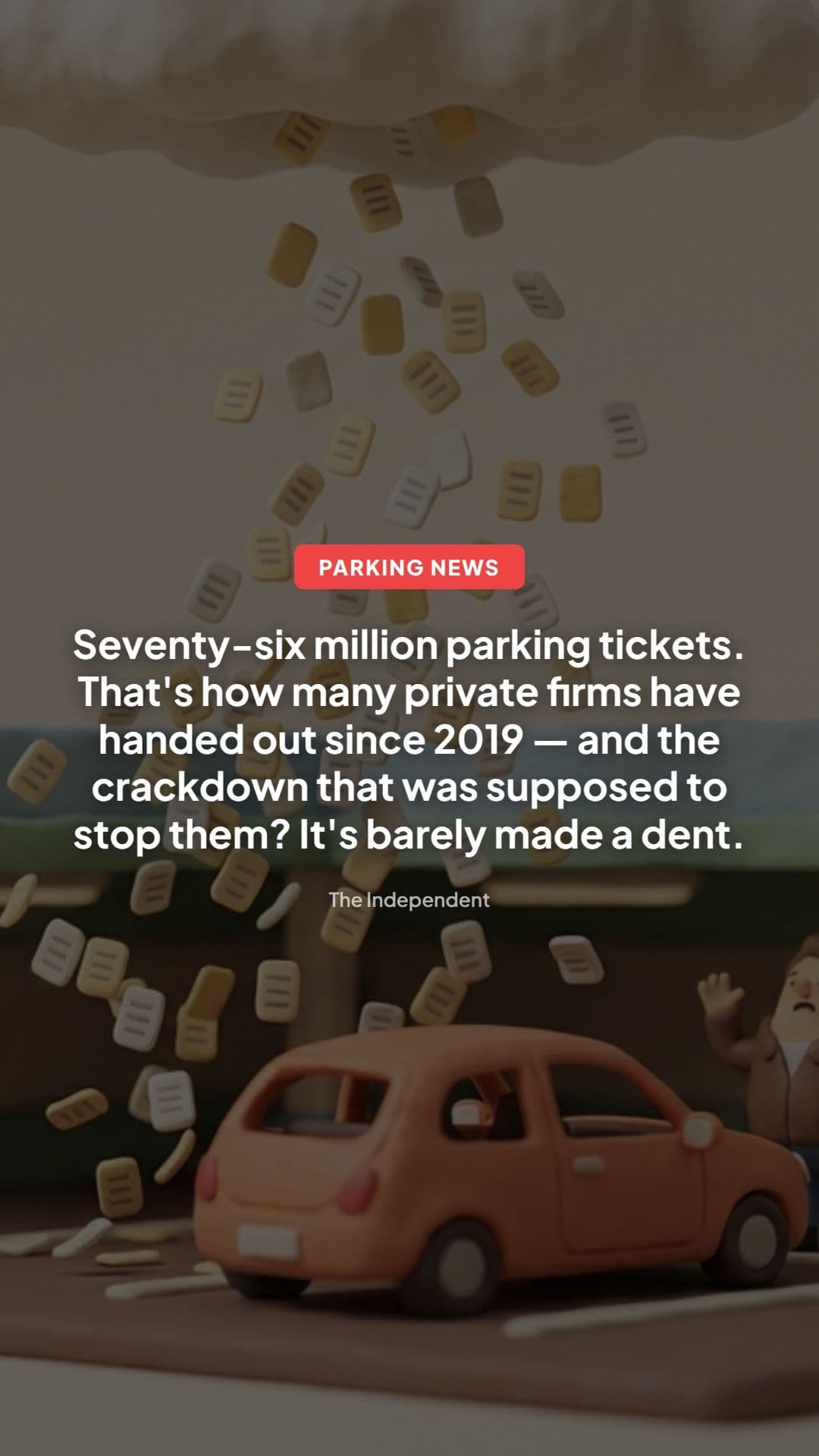
76 Million Parking Tickets and Counting: Why the Private Parking Crackdown Isn't Working
Imagine receiving a letter demanding £100 for overstaying by six minutes in a supermarket car park. You didn't see a sign. You were in the shop spending money. And yet a private company — not the council, not the police — is threatening debt collectors if you don't pay up within 28 days. For millions of British drivers, this isn't a hypothetical. It's Tuesday.
A new report covered by The Independent has laid bare the sheer scale of private parking enforcement in the UK: 76 million parking tickets issued by private operators since 2019. That's roughly 15 million a year, or more than 40,000 every single day. Despite years of government consultations, promised legislation, and public outcry, the numbers suggest that cracking down on aggressive parking firms has proved considerably harder than politicians anticipated. So what's really going on — and what can you do about it?
What the Report Actually Found
The headline figure of 76 million tickets is staggering, but the detail behind it is equally revealing. Private parking operators — companies like ParkingEye, Euro Car Parks, and UKPC — have continued to issue notices at a rate that shows little sign of slowing, even as the government has been promising reform for the better part of a decade.
The data points to a system that is, at its core, financially incentivised to issue as many notices as possible. Unlike council-run enforcement, where penalty charge notices are governed by strict statutory frameworks and any surplus revenue is ring-fenced for transport spending, private operators are essentially running commercial operations. Every ticket that results in payment is revenue. The more tickets issued, the more revenue generated — even if a significant proportion are successfully appealed or simply ignored.
The debate over maximum charge levels has been particularly contentious. Currently, private parking charges can reach £100 in England, Scotland, and Wales (reduced to £60 if paid within 14 days). Critics, including the RAC and motoring groups, have long argued this cap is too high and that a £50 ceiling would be more proportionate. Private operators, predictably, argue that lower caps would undermine their ability to manage car parks effectively.
Why This Matters: A System Built on Confusion
To understand why 76 million tickets is more than just a big number, you need to understand the fundamental difference between public and private parking enforcement — a distinction that many drivers simply don't know exists.
When a council issues a Penalty Charge Notice (PCN), it is acting under statutory authority granted by the Traffic Management Act 2004. The process is regulated, there are defined appeal routes, and independent adjudicators can overturn decisions. The whole system, for all its flaws, has legal teeth on both sides.
Private parking notices — technically called Parking Charge Notices (confusingly also abbreviated to PCN) — operate under an entirely different legal framework. They are, in essence, a contractual claim. When you park on private land, you are (in theory) entering into a contract with the landowner or their managing agent. The charge is presented as a consequence of breaching that contract.
This matters enormously because it means:
- The burden of proof is different. A private firm must demonstrate a valid contract existed, that it was clearly communicated, and that you breached it.
- The charge must be a genuine pre-estimate of loss, not a penalty — though this principle has been tested and stretched considerably in the courts.
- You have the right to appeal, but through the operator's own process first, then through an independent appeals service — either POPLA (Parking on Private Land Appeals) for BPA members, or the IAS (Independent Appeals Service) for IPC members.
The problem is that many drivers either don't know these distinctions exist, or feel so intimidated by the official-looking paperwork that they simply pay without question. Private firms know this. It is, arguably, baked into their business model.
The Legal Landscape: Reform Promised, Reform Delayed
The Parking (Code of Practice) Act 2019 was supposed to be the turning point. It gave the government powers to create a statutory code of practice for private parking, establish a single appeals body, and introduce measures to protect motorists from predatory enforcement. Five years later, the code has still not been fully implemented.
The delay has been attributed to various factors — industry lobbying, government reshuffles, the pandemic — but the effect has been the same: private operators have continued largely as before, with self-regulatory trade bodies (the British Parking Association and the International Parking Community) setting the rules for their own members.
Crucially, the Supreme Court's 2023 ruling in Beavis v ParkingEye remains the defining legal precedent on private parking charges. The court held that a £85 charge for overstaying in a retail car park was not an unenforceable penalty, even though it bore no relation to any actual loss suffered. This was a significant victory for the industry and effectively gave legal legitimacy to high charge levels, provided the signage is adequate and the contract is clear.
However, adequate signage remains a genuine and frequently successful line of appeal. If signs are obscured, ambiguous, or fail to meet the requirements set out in the relevant code of practice, the entire basis for the charge can collapse.
What Drivers Should Know: Your Practical Rights
If you receive a private parking notice, here is what you need to know before you do anything else:
1. Don't automatically pay. Unlike a council PCN, ignoring a private parking notice does not automatically lead to court action. The operator must take you to the county court to enforce payment, and many — particularly for smaller amounts — choose not to.
2. Check who issued it. Is it a council PCN or a private Parking Charge Notice? The issuing body and the reference number format will tell you. Council PCNs have a statutory enforcement route; private notices are contractual claims.
3. Photograph everything. If you believe the signage was unclear, inadequate, or absent, gather evidence immediately. This includes photos of the entrance signs, any pay-and-display machines, and the general layout of the car park.
4. Use the formal appeals process. If you have grounds to appeal — unclear signs, a genuine error, a grace period not observed, or a technical fault with payment machines — submit a formal challenge to the operator first. If rejected, escalate to POPLA or the IAS depending on the operator's trade body membership.
5. Know your grace period rights. Under current BPA and IPC codes of practice, operators must allow a minimum 10-minute grace period after a paid session expires before issuing a notice. If your ticket shows you were issued a notice within this window, that alone may be grounds for cancellation.
6. The registered keeper is not automatically liable. Under the Protection of Freedoms Act 2012, operators can pursue the registered keeper if the driver's identity is not provided — but only if they followed the correct procedural steps, including issuing a valid Notice to Keeper within specified timeframes. Any procedural failure can invalidate the entire claim.
Looking Ahead: Will Reform Ever Actually Arrive?
The government's ongoing consultations on private parking reform have produced more questions than answers. The promised single appeals body remains a work in progress. The statutory code of practice, which would set binding standards for signage, grace periods, and charge levels, has been repeatedly pushed back.
What is clear is that the current system — 76 million tickets and counting — is not working in drivers' favour. The financial incentive to issue notices remains overwhelming, the appeals process is fragmented and inconsistently applied, and public awareness of drivers' rights remains worryingly low.
There are reasons for cautious optimism. Parliamentary pressure has increased. Consumer groups including Which? and the RAC have maintained sustained campaigns for reform. And the sheer volume of the numbers now entering the public domain makes it harder for ministers to argue that the status quo is acceptable.
But until the Parking (Code of Practice) Act 2019 is fully enacted — with a genuinely independent appeals body and binding standards that operators cannot sidestep — drivers will continue to face a system that is structurally tilted against them.
The 76 million figure isn't just a statistic. It's a measure of how far the balance of power has shifted away from the motorist — and how urgently it needs to shift back.
Sources: The Independent; Parking (Code of Practice) Act 2019; Protection of Freedoms Act 2012; ParkingEye Ltd v Beavis [2015] UKSC 67; BPA Code of Practice; IPC Code of Practice.
Written by
Amara Okafor
Council Liaison Officer
Ready to Challenge Your Ticket?
Let our AI analyse your PCN and generate a professional appeal letter in minutes.
Start Free Appeal