Workplace Parking Levy: Which UK Councils Could Charge?
Nearly a dozen councils may introduce workplace parking levies. Find out how the UK tax could affect employers, commuters and parking costs across the country.

Amara Okafor
27 July 2026
Workplace Parking Levies: The Stealth Tax That Could Hit Your Pay Packet Before Your Petrol Tank
Picture this: you drive to work every day, park in the same space in your employer's car park, and think nothing of it. Then one morning your HR department sends round an email explaining that, from next year, a portion of your salary or a new monthly deduction will cover the cost of that same space. No new tarmac, no extra security, nothing has changed except a council decision miles away. That is the reality workplace parking levies could bring to workers across England and Scotland, and reports suggest a growing number of local authorities are now weighing up exactly this move.
What's Happening
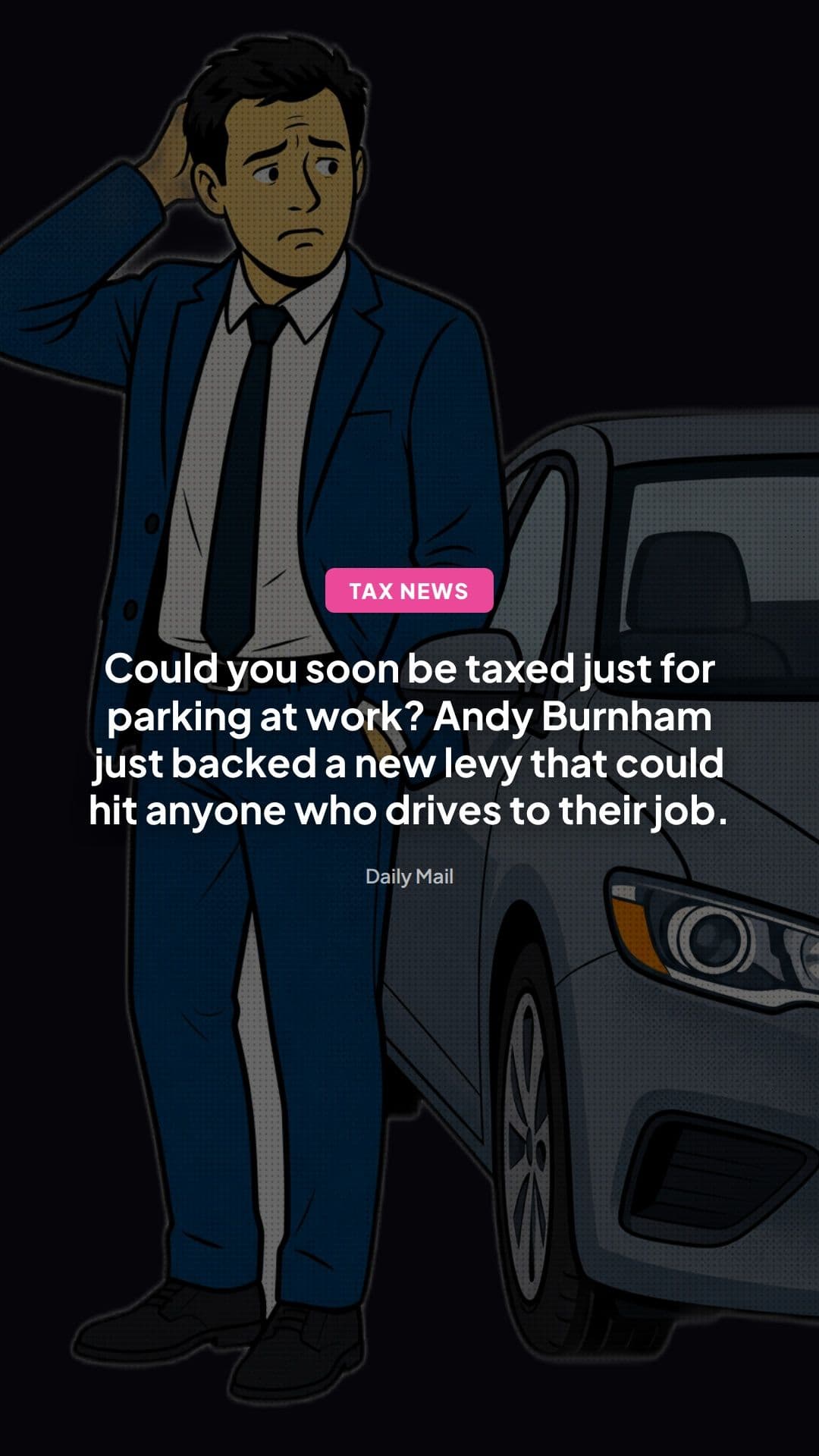
According to reporting picked up by the Daily Mail, close to a dozen councils are reportedly exploring workplace parking levies, schemes that would see local authorities charge employers for the parking spaces their staff use. The mechanism is not new. It already exists in law and has been used, quietly and controversially, in one English city for well over a decade.
A workplace parking levy works by requiring employers above a certain size, typically those with more than ten parking spaces, to buy an annual licence for each space they provide to staff. The council sets the price per space, and it is entirely up to the employer whether they absorb that cost themselves or pass it on to employees through reduced benefits, salary sacrifice arrangements, or direct charges for parking.
The renewed interest reported in the press comes as councils continue to search for new revenue streams amid squeezed budgets, rising demand for public transport investment, and pressure to hit local air quality and net zero targets. With fuel duty income falling as more drivers switch to electric vehicles, and traditional funding pots shrinking, workplace parking levies are being looked at afresh as a way to plug the gap.
Why It Matters
This is not a hypothetical policy dreamed up on a whiteboard. Nottingham City Council has been running a workplace parking levy since 2012, making it the only place in the UK where the scheme is actually in operation. Employers in Nottingham with more than ten liable parking spaces must pay for a licence for each one, and the revenue raised has gone towards funding the city's tram network expansion, the redevelopment of Nottingham railway station, and other public transport improvements.
Supporters argue the Nottingham scheme shows the model works: it discourages unnecessary car commuting, raises meaningful money for buses and trams, and does not directly fine or penalise individual drivers the way a congestion charge does. Critics counter that the costs almost always trickle down to employees eventually, whether through reduced pay rises, new parking charges, or employers simply cutting the number of spaces available and making commuting harder for those without good public transport links.
The reason this matters beyond Nottingham is that the legal framework enabling these levies already applies far more widely. Councils considering the move do not need new primary legislation. They need political will, a business case, and to follow a statutory process. That is a much lower bar than many drivers might assume, which is why the idea of "nearly a dozen councils" quietly weighing it up should not be dismissed as scaremongering.
For anyone who has followed the debate around council parking charges, rising PCN rates, and expanding low emission zones, this fits a broader pattern. Local authorities are increasingly using parking and vehicle-related charges as policy levers, not just revenue raisers, and workplace parking is the next frontier.
The Legal Angle
The power for English and Scottish councils to introduce a workplace parking levy comes from Part 3 of the Transport Act 2000. This is the same piece of legislation that gives local authorities the ability to introduce road user charging schemes, such as congestion charges. Workplace parking levies and congestion charging sit under the same statutory umbrella, though they are distinct schemes with different mechanics.
Crucially, a council cannot simply announce a levy and start billing businesses the following month. The legislation requires councils to demonstrate that a scheme forms part of a wider local transport strategy, typically aimed at reducing congestion or funding alternatives to car travel. There is a formal consultation process, and the resulting revenue is generally ring-fenced for transport-related spending, such as public transport improvements, cycling infrastructure, or road maintenance, rather than being absorbed into general council funds.
Scotland has its own equivalent power under the Transport (Scotland) Act 2019, which similarly allows Scottish local authorities to introduce workplace parking licensing schemes. Glasgow has previously explored the idea publicly, though as with many councils, exploring a policy and actually implementing it are two very different things, and any scheme would still need to go through consultation before becoming reality.
Importantly, the levy is charged to the employer, not the individual driver, and it is not enforced through Penalty Charge Notices in the way parking contraventions or bus lane violations are. This is a licensing regime rather than a fines regime, which means the usual routes drivers might use to challenge a PCN, such as those covered in guides on formal representations for parking fines, simply do not apply here. There is no ticket to appeal because, legally, the charge falls on the business, not the vehicle.
That said, exemptions typically exist for certain categories, such as Blue Badge holders, motorcycles, and emergency service vehicles, mirroring the kind of exemptions drivers already see in other parking and low emission zone schemes.
What Drivers and Employees Should Know
If you drive to work and your employer provides parking, there are a few sensible things worth keeping an eye on, particularly if your local council starts a consultation:
- Watch for council consultations. Under the Transport Act 2000, a formal public consultation is required before any scheme can go ahead. This is your chance, and your employer's chance, to have a say before charges are set in stone.
- Ask your employer how they would respond. Some businesses absorb levy costs entirely, some pass them on through parking charges, and others reduce the number of spaces available, effectively forcing staff to find alternative ways to travel. Knowing your employer's likely approach in advance avoids nasty surprises.
- Check if you would be exempt. Blue Badge holders and other protected groups are typically excluded from liability under existing schemes such as Nottingham's, so it is worth understanding how any proposed scheme in your area would treat disabled employees.
- Think about your commute options now. If a levy looks likely in your area, it may be worth reviewing whether public transport, cycling, or car-sharing could realistically replace some or all of your car journeys, particularly since councils introducing these schemes are usually simultaneously investing in the alternatives.
- Small businesses should check the threshold. Schemes to date have generally exempted employers below a certain number of spaces, often ten, so many small firms may find themselves unaffected even if a levy is introduced locally.
- Don't confuse this with existing charges. A workplace parking levy is separate from congestion charging, ULEZ fees, or standard council parking charges. It is a distinct legal mechanism aimed specifically at employer-provided parking.
Looking Ahead
Workplace parking levies sit in an unusual policy space. They are not new, not untested, and not without a track record, yet they remain rare enough that most drivers have never encountered one. That could be about to change. With councils under sustained financial pressure, public transport investment needs growing, and fuel duty revenues eroding as the vehicle fleet electrifies, the appeal of a scheme that raises ring-fenced money for buses and trams while nudging commuters out of their cars is obvious from a policy perspective.
Whether it proves politically palatable is another matter entirely. Nottingham's scheme has endured plenty of criticism over the years, particularly from businesses who argue it makes the city less competitive for employers weighing up where to locate. Any council following that path is likely to face similar pushback, and given how sensitive drivers already are to rising parking charges and expanding low emission zones, a wave of new levies would almost certainly generate significant public debate.
For now, the sensible approach for drivers and employers alike is simply to stay informed. If your council is named as one of those reportedly considering a levy, keep an eye out for consultation announcements, engage with them if you can, and start thinking early about what your options would be if employer-provided parking suddenly came with a price tag attached. It may not be a change that hits tomorrow, but the legal groundwork for it has been sitting on the statute book for a quarter of a century, waiting for councils to use it.
Written by
Amara Okafor
Council Liaison Officer
Ready to Challenge Your Ticket?
Let our AI analyse your PCN and generate a professional appeal letter in minutes.
Start Free Appeal