Why EV costs are forcing rival car brands to partner
As UK EV investment costs soar, rival carmakers are teaming up to share platforms, batteries and software. What it means for drivers, pricing and choice.

Sarah Mitchell
26 May 2026
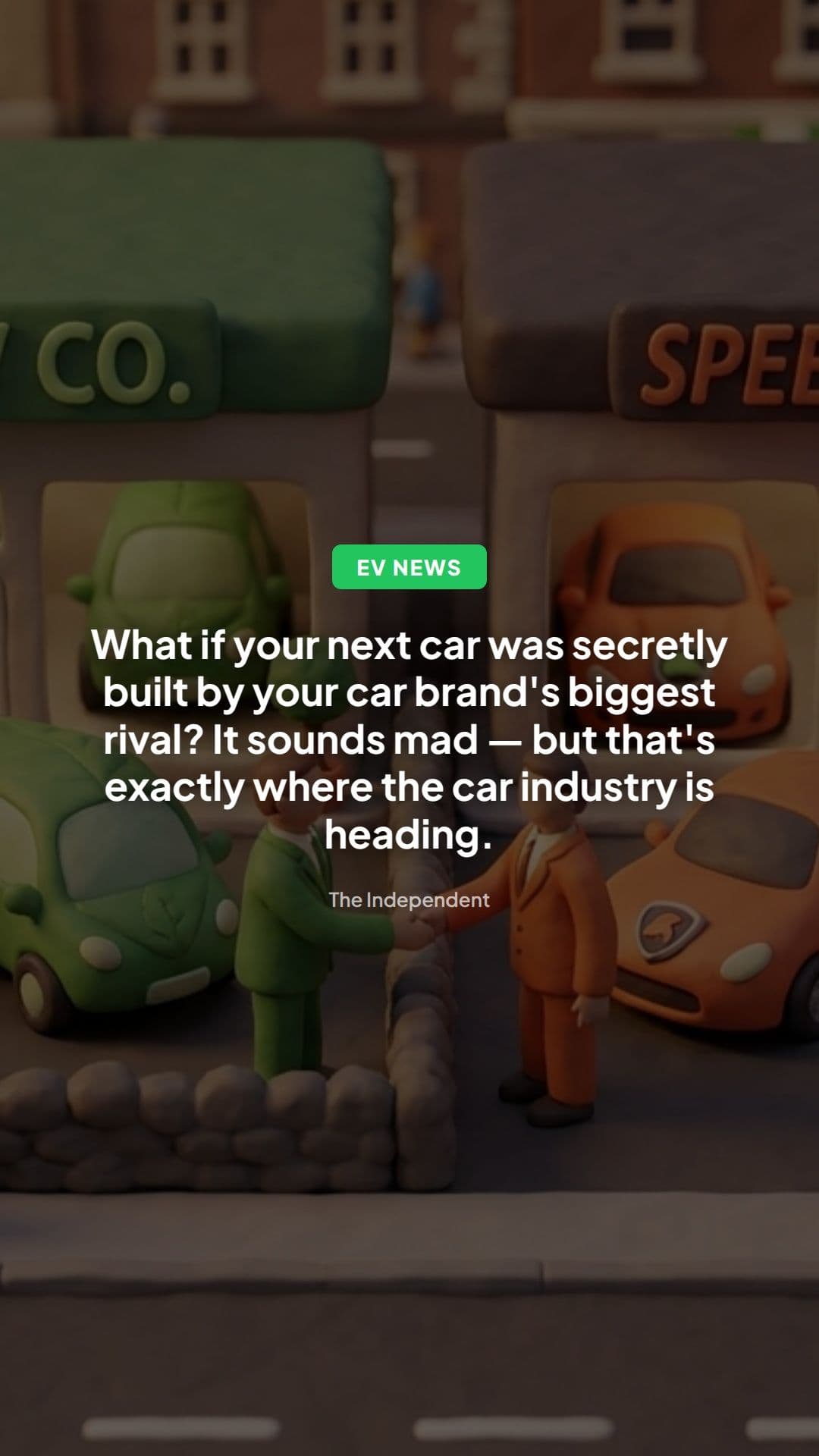
Why Electric Cars Are Forcing Rivals to Become Partners — And What It Means for UK Drivers
The Unlikely Alliances Reshaping the Cars You'll Drive Next
Imagine walking into a dealership in 2028, eyeing up a sleek new electric hatchback bearing a familiar British or European badge — only to discover that underneath the skin, it shares its battery, software platform, and charging architecture with a vehicle from a brand that, just five years earlier, was its fiercest competitor. That scenario isn't science fiction. It's the direction the entire global car industry is heading, and it's happening faster than most drivers realise.
A recent analysis by DriveSmart, reported by The Independent, lays out in clear terms what industry insiders have been whispering about for years: the sheer cost of developing electric vehicles is pushing rival carmakers into each other's arms. The partnerships being formed today will define what cars look like, how they perform, and crucially — what they cost — for the next decade and beyond.
What's Actually Happening: The Great EV Merger of Minds
The core story here isn't simply that car brands are collaborating. Partnerships in the automotive industry are nothing new — badge engineering, shared platforms, and joint ventures have existed for decades. What is new is the scale, the urgency, and the competitive logic driving these deals.
Developing a credible electric vehicle from scratch — including the battery technology, electric drivetrain, software-defined vehicle architecture, and charging infrastructure integration — costs billions of pounds. For context, Volkswagen Group has committed over €180 billion to electrification through to 2028. Ford and General Motors have both burned through tens of billions in their EV transitions, often with underwhelming initial returns.
For smaller or mid-tier manufacturers, those numbers are simply impossible to match independently. The result? A wave of cross-brand alliances:
- Stellantis and Leapmotor — the group behind Peugeot, Vauxhall, Citroën, and Fiat has taken a significant stake in Chinese EV maker Leapmotor, gaining access to its cost-efficient EV architecture
- Renault and Nissan and Mitsubishi — the long-standing Alliance is being restructured, with each partner taking more autonomy but sharing EV platforms more deliberately
- Honda and Nissan — the two Japanese giants announced merger talks in late 2024, driven almost entirely by the need to compete with Tesla and Chinese manufacturers on EV cost and scale
- Toyota and Subaru — deepening their existing relationship to co-develop electric SUV platforms
- BMW and Toyota — collaborating on hydrogen fuel cell technology as a hedge against pure battery dominance
The DriveSmart analysis correctly identifies that this isn't simply cost-cutting. It's survival strategy. The brands that fail to secure a credible EV platform — whether by building it, buying it, or borrowing it — risk being left behind entirely as the market shifts.
Why This Matters More Than You Might Think
For many UK drivers, this might feel like a distant corporate story — interesting, perhaps, but not immediately relevant to everyday motoring. That instinct is wrong, and here's why.
The cars you buy in five years are being designed right now, and the partnerships being struck today will determine their quality, their software reliability, their repairability, and their resale value. When two brands share a platform, they also share vulnerabilities. A software flaw, a battery recall, or a charging compatibility issue can affect hundreds of thousands of vehicles across multiple brands simultaneously.
We've already seen this play out. The Volkswagen Group's MEB electric platform underpins not just the VW ID.3 and ID.4, but also the SEAT/CUPRA Born, the Škoda Enyaq, and the Audi Q4 e-tron. A software issue in any one of those vehicles has knock-on implications for all of them — and for the dealership networks, parts availability, and warranty claims across every brand.
There's also a deeper question about brand identity and consumer trust. UK drivers have historically paid a premium for certain badges — Jaguar, Land Rover, BMW — partly on the basis of perceived engineering distinctiveness. As platforms become shared commodities, that distinctiveness erodes. Whether that's a good or bad thing depends entirely on whether the shared platform is excellent or merely adequate.
The Legal Angle: What UK Regulations Say About EV Partnerships and Consumer Rights
The consolidation of EV platforms has real implications under UK consumer and competition law that deserve serious attention.
Under the Consumer Rights Act 2015, vehicles sold in the UK must be of satisfactory quality, fit for purpose, and as described. When a manufacturer sells a car under one brand but built on another manufacturer's platform, the legal responsibility for defects remains with the selling manufacturer — not the platform partner. This matters enormously if something goes wrong.
Recall obligations are governed by the Road Vehicles (Construction and Use) Regulations 1986 and enforced through the Driver and Vehicle Standards Agency (DVSA). When a shared-platform fault is identified, manufacturers are legally required to notify the DVSA and affected owners. However, because recalls are issued per brand, not per platform, owners of a Vauxhall might receive a recall notice weeks after Peugeot owners have already had their vehicles fixed — even though the underlying issue is identical.
The Competition and Markets Authority (CMA) is also watching these partnerships carefully. Under the Competition Act 1998, any collaboration between rival manufacturers that amounts to price-fixing, market-sharing, or anti-competitive coordination is unlawful, regardless of how it's dressed up as a technology partnership. The CMA has demonstrated its willingness to act in the automotive space, having investigated and fined parking operators in recent years — it won't shy away from scrutinising carmaker alliances if consumer harm is suspected.
For UK drivers considering an EV purchase, warranty terms deserve particular scrutiny. When a vehicle is built on a shared platform, the battery warranty — typically the most expensive component — may be issued by the platform developer rather than the selling brand. If that platform developer exits the UK market or restructures, enforcing that warranty becomes significantly more complicated.
What Drivers Should Know: Practical Advice for Navigating the EV Partnership Era
Given all of the above, here's what savvy UK drivers should be doing right now:
1. Research the platform, not just the badge Before buying any new EV, find out which platform it uses and which other vehicles share it. Websites like What Car?, Autocar, and Electrifying.com typically publish this information. A platform with a strong track record across multiple models is generally a safer bet than a brand-new, proprietary architecture.
2. Read the warranty small print carefully Ask the dealer specifically: who is the warranty provider for the battery? Is it the manufacturer, the platform developer, or a third party? What happens to that warranty if the brand is acquired, restructured, or exits the UK? Get answers in writing.
3. Check DVSA recall records before buying used The DVSA maintains a public database of vehicle recalls at gov.uk/check-vehicle-recall. For shared-platform EVs, it's worth checking recalls across all sibling models, not just the specific badge you're buying. If a related model has had a software or battery recall, the same issue may emerge in your vehicle.
4. Consider the charging network implications Some EV partnerships include agreements on charging compatibility — notably, several manufacturers have adopted Tesla's NACS connector standard. Before buying, confirm which charging networks your vehicle is compatible with and whether that compatibility is hardware-based (reliable) or software-dependent (potentially subject to future updates or disputes).
5. Factor in parts and servicing availability Shared platforms can be a blessing here — more vehicles using the same components means better parts availability and, potentially, lower servicing costs. But it's worth confirming that your local dealer network can actually service the platform, particularly for software updates that increasingly require manufacturer-specific tools.
Looking Ahead: The Road the Industry Is Travelling
The consolidation we're seeing today is, in all likelihood, just the beginning. Industry analysts at BloombergNEF and JATO Dynamics have both suggested that the global car industry — which currently supports well over 100 distinct brands — may consolidate to fewer than 30 genuinely independent manufacturers by 2035.
For the UK specifically, this has profound implications. The ZEV Mandate, which requires manufacturers to sell an increasing percentage of zero-emission vehicles each year (rising to 80% of new car sales by 2030 and 100% by 2035), is accelerating the pressure on smaller manufacturers to either partner up or exit the market. Brands that cannot afford to develop competitive EV platforms independently will either find a partner, become a badge on someone else's platform, or disappear.
There's a genuine opportunity in this for UK drivers — greater competition at the platform level could drive down EV prices as manufacturers compete to licence their technology. But there's also a risk: if the market consolidates around just two or three dominant platforms (as the smartphone market consolidated around iOS and Android), the diversity of choice that UK drivers currently enjoy could narrow significantly.
The smartest thing any driver can do right now is stay informed, ask harder questions before signing on the dotted line, and recognise that the badge on the bonnet tells you less and less about what's actually powering the car underneath it.
The DriveSmart analysis referenced in this piece was originally reported by The Independent. All regulatory information relates to England and Wales unless otherwise stated.
Written by
Sarah Mitchell
Parking Rights Advocate
Ready to Challenge Your Ticket?
Let our AI analyse your PCN and generate a professional appeal letter in minutes.
Start Free Appeal