
Westminster Zig-Zag PCN: Why This Appeal Was Refused
A Westminster driver lost a zig-zag PCN appeal. Learn why pedestrian crossing restrictions are strict, and what evidence may support a valid challenge.

The Parking Ticket Pal Editorial Team
14 September 2026
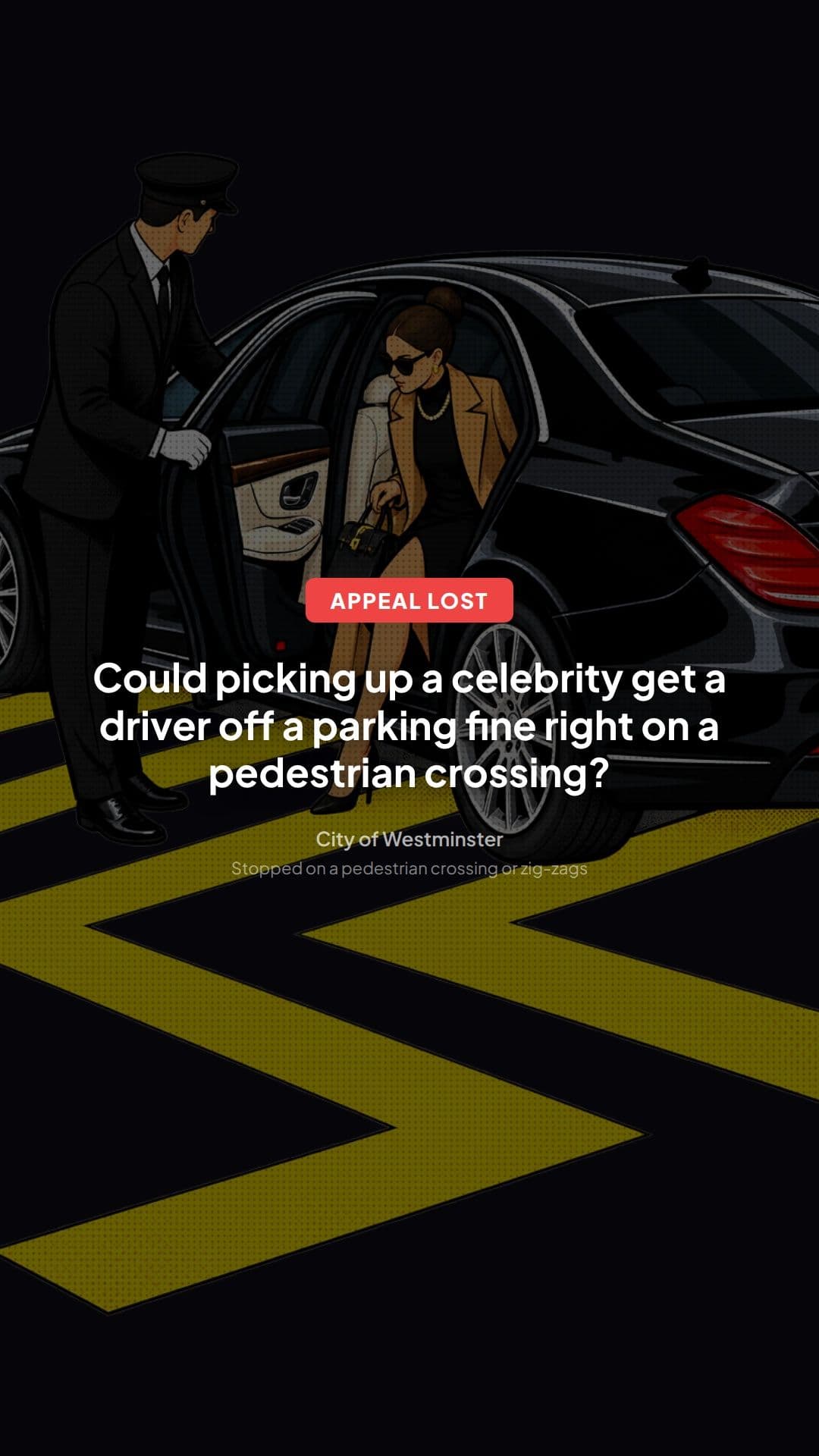
When a Celebrity Client Isn't a Get-Out-of-Jail Card: The Westminster Zig-Zag Case
Why This Case Matters
Picture the scene: a sleek car pulls up outside a glossy London building, hazard lights blinking, engine idling just long enough for a well-known face to duck inside. It looks like something from a film. But for the chauffeuring firm behind the wheel, that thirty-second stop became a parking penalty they couldn't shake off, and worse, one they couldn't even pass on to the client who caused the headache in the first place.
This case, decided by a City of Westminster parking adjudicator, is a masterclass in how UK parking law treats "reasonable excuses" versus legal exemptions. Spoiler: they are not the same thing, and confusing the two can cost you dearly.
The Case: What Happened
A chauffeuring company found itself contesting a Penalty Charge Notice (PCN) after one of its vehicles was caught stopped on a pedestrian crossing area marked by zig-zag lines, the yellow zig-zag markings you see approaching and leaving a zebra crossing.
The zig-zag zones exist for a simple reason: they keep sightlines clear so pedestrians crossing the road can see approaching traffic, and drivers can see pedestrians. Stopping on them, even briefly, undermines that safety function.
According to the firm, their driver had stopped there because he was collecting a celebrity passenger and needed to pull up close to the building the client was exiting, citing security concerns. It's an understandable scenario. Nobody wants a high-profile client standing exposed on a pavement while a driver circles the block looking for a legal parking spot.
The appeal went to a personal hearing, but neither the council nor the appellant turned up. The adjudicator was left to decide the matter "on the papers," meaning based solely on the written evidence and submissions already filed.
The Arguments
The chauffeuring firm's case rested on context and necessity. Their argument, in essence, was:
- Their driver stopped on the zig-zags for a legitimate operational reason
- Security considerations meant getting close to the building was important
- This wasn't reckless or careless parking, but a considered decision based on the passenger's safety
Westminster's position, implicit in issuing the PCN, was more straightforward: the vehicle was on zig-zag markings, full stop. No detailed defence from the council was needed because the facts weren't really in dispute. The car had stopped where stopping isn't allowed.
The Decision
The adjudicator refused the appeal. Crucially, the reasoning wasn't that the driver was lying or that the security concern was invented. The adjudicator explicitly said: "I acknowledge what is said and accept that this vehicle stopped for the reason given."
The problem wasn't credibility. It was law. As the adjudicator put it, "there is no exemption allowing a motorist whether a chauffeur or not to stop on zig-zags for their vehicle to be boarded/alighted whatever the circumstances."
That phrase, "whatever the circumstances," is doing a lot of work here. It's a blunt reminder that zig-zag restrictions don't come with a sliding scale of acceptable excuses. There's no box on the form for "but my passenger is famous" or "but we were worried about security."
The adjudicator also noted, almost as an aside, that the firm couldn't pass the penalty cost on to their client, and that the tribunal had no power to stop Westminster pursuing enforcement regardless of that unfairness. It's a small but telling detail: the adjudicator seemed to have some sympathy for the commercial bind the firm was in, but sympathy doesn't override statute.
The Legal Reasoning, Unpacked
Here's the core distinction this case illustrates, and it's one that trips up far more drivers than just chauffeurs.
A reasonable explanation is not the same as a legal exemption.
UK parking and traffic law works on a system of specific, defined exemptions. For zig-zag markings near pedestrian crossings, these exemptions are narrow and tend to cover things like emergency vehicles responding to an incident, or very specific circumstances set out in the relevant Traffic Signs Regulations and General Directions. General inconvenience, business necessity, or even genuine safety concerns for a passenger don't feature on that list.
This matters because many PCN appeals fail for exactly this reason. Appellants often present a genuinely sympathetic story, being late for a hospital appointment, having a child taken ill, needing to protect a VIP client, and assume that a good enough reason will persuade an adjudicator to cancel the charge. But adjudicators aren't judging whether your excuse is believable or even sympathetic. They're judging whether the law provides a specific exemption that applies to your situation. If it doesn't, the contravention stands, regardless of how compelling the story is.
This is also why the "undisputed" nature of the stop mattered so much here. Because both the fact of stopping and the reason for stopping were accepted, the case became a pure question of law rather than one of evidence. There was nothing left to argue about except whether an exemption existed, and it didn't.
Lessons for Drivers
1. Know the difference between an excuse and an exemption. Before appealing a PCN, ask yourself: is there an actual legal exemption that covers my situation, or do I simply have a good reason? Councils and adjudicators respond to the former, not the latter. If you're unsure what exemptions apply to a specific contravention, the government's official guidance on parking rules and Traffic Signs Regulations is a more reliable starting point than instinct.
2. Zig-zag markings are treated as close to absolute. Unlike some restrictions where a brief stop for boarding or alighting might be tolerated, zig-zag zones near crossings are enforced strictly because they exist purely for pedestrian sightlines and safety. Treat them as a hard no, not a grey area, regardless of who is in the car.
3. Passing on penalty costs to a client isn't guaranteed, or even possible. This case is a useful warning for anyone running a chauffeuring, delivery, or private hire business. If your driver incurs a PCN while accommodating a client's request, you may be the one left holding the bill, with no mechanism to recover it from the person who created the situation. Building this risk into contracts or briefings for drivers is worth considering.
4. Turning up matters, even if the facts aren't disputed. Neither party attended the personal hearing in this case, and it was decided on paperwork alone. While the outcome here likely wouldn't have changed with attendance, given the facts were accepted anyway, personal hearings can sometimes allow for clarification or nuance that written submissions miss. If you've got a hearing scheduled, it's generally worth attending if you can.
5. A sympathetic adjudicator still can't rewrite the law. The adjudicator's evident sympathy for the firm's commercial position didn't translate into a win. This is a useful reality check: tribunals apply the law as it stands, they don't have discretion to cancel a charge simply because the outcome feels harsh.
Key Takeaway
If you're tempted to stop somewhere you shouldn't because the circumstances feel urgent, important, or unavoidable, remember that UK parking adjudicators judge legal exemptions, not the quality of your excuse. Zig-zag markings in particular allow essentially no wriggle room. The safest approach is always to find a legal stopping point, even if it costs you a few extra minutes, because those minutes are far cheaper than a penalty charge with no defence available.
Written by
The Parking Ticket Pal Editorial Team
Source-checked parking guidance
Ready to Challenge Your Ticket?
Let our AI analyse your PCN and generate a professional appeal letter in minutes.
Start Free Appeal