
Wandsworth PCN Refused: Lessons From a Loading Ban
A Wandsworth PCN appeal was refused for parking during a loading ban. Learn what evidence drivers need and how to challenge restriction signs correctly.

The Parking Ticket Pal Editorial Team
17 September 2026
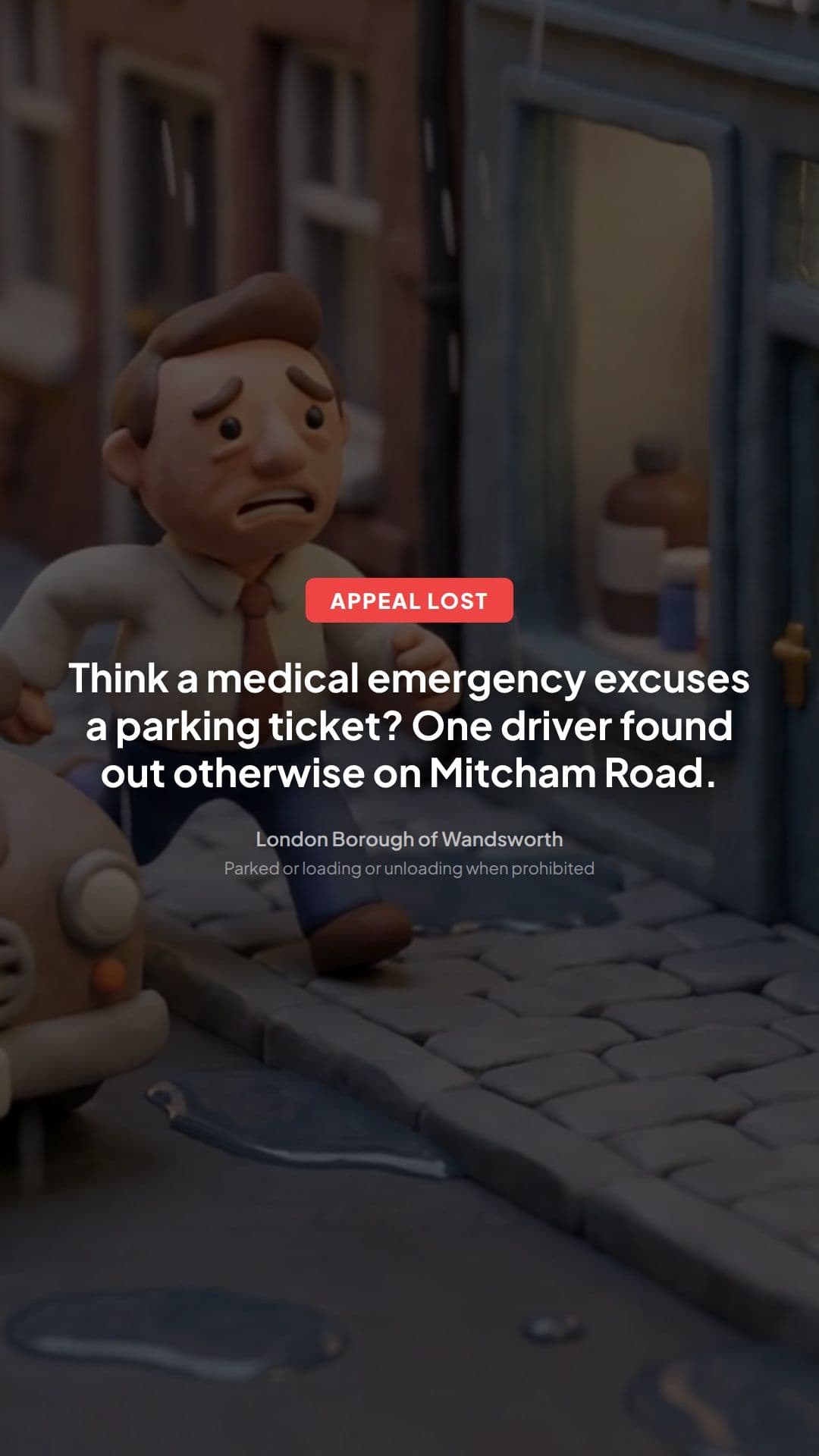
When "Just Two Minutes" Isn't Good Enough: The Wandsworth Prescription Case
Why This Case Matters
Picture the scene: you're nipping into a chemist to collect medicine for someone who needs it urgently. You're not going shopping, you're not popping in for a coffee, you're doing something genuinely necessary. Surely that counts for something if a parking attendant catches you?
According to a recent London Borough of Wandsworth parking tribunal decision, it doesn't. Not even a little bit. This case is a sharp reminder that UK parking law often has no room for sympathy, however reasonable your excuse sounds. If you've ever assumed that a good reason for parking somewhere restricted might save you from a fine, this case will change your mind.
The Case
Mr Vieira parked his car on a single yellow line in Wandsworth to collect an urgent prescription from a chemist, acting on his doctor's instructions. He wasn't gone long. In fact, he was still close enough to his vehicle to spot a parking attendant approaching it while he was inside the shop.
Mr Vieira went out to explain the situation, telling the attendant he only needed a moment to grab an urgent prescription. The attendant wasn't persuaded and told him he had to move the vehicle. Rather than wait around, Mr Vieira drove off. As he did so, the attendant tried to place the Penalty Charge Notice (PCN) under the windscreen wiper, but it fell to the ground instead. The attendant called after him that the ticket would follow in the post, and it duly did.
Mr Vieira appealed, backing up his story with a letter from his doctor, Dr Monteiro, confirming that he had indeed been instructed to collect an urgent prescription that day.
The Arguments
Mr Vieira's case was straightforward and, on a human level, entirely sympathetic. He argued that:
- He only stopped for a genuinely urgent reason, collecting medication on his doctor's instruction
- He had documentary evidence (the doctor's letter) to prove it
- It was a very brief stop, not an attempt to park and disappear for the day
Wandsworth Council's case rested on the parking attendant's contemporaneous notes, which are treated as strong evidence in these tribunals. The attendant had recorded full details of the vehicle parked on a single yellow line while waiting restrictions were in force, and confirmed that the PCN had been handed to the driver (even though it ended up on the ground rather than on the windscreen).
The council's underlying position was simple: the restriction existed, the vehicle was parked in breach of it, and that's a contravention regardless of the driver's reasons.
The Decision
The adjudicator refused the appeal. The PCN stood, and Mr Vieira had to pay.
The reasoning was blunt. The parking attendant's evidence was accepted as reliable, so a contravention had clearly occurred, and the ticket had been correctly served (despite ending up on the pavement rather than the windscreen). The urgency of the errand, however genuine, was described in the ruling as "mitigation" that the adjudicator was "not entitled to take into account."
In other words, this wasn't a case where the adjudicator weighed up the pros and cons and decided against Mr Vieira. It's that the rules governing adjudicators don't allow good intentions to override a clear-cut contravention.
The Legal Reasoning, Explained
This case hinges on one of the most misunderstood aspects of UK parking law: the difference between a legal defence and mitigation.
A legal defence is something that shows no contravention actually happened, or that the penalty notice wasn't properly issued. For example, faded road markings, a missing or obscured sign, or the council following the wrong procedure when serving the ticket. If you can prove one of these, an adjudicator can and will cancel the PCN.
Mitigation, on the other hand, is a reason that makes the contravention understandable or forgivable, but doesn't change the fact that it happened. "I was only there two minutes." "It was an emergency." "I didn't realise it was restricted." These are all mitigation, and adjudicators at parking tribunals are simply not permitted to let mitigation excuse a proven contravention. Their job is to decide whether a contravention occurred, not whether the driver deserves sympathy.
That's why the adjudicator in this case openly acknowledged that Mr Vieira was "only trying to carry out his business" and still refused the appeal. It wasn't a close call. It was a case of applying the law as it stands.
The ruling also confirms a well-established principle: the onus is on the driver to check the signage. Wandsworth's single yellow lines come with accompanying signs (and sometimes kerb markings) that specify when waiting restrictions apply. If you park without checking them, you take on the risk that you might be breaching a restriction you didn't know existed. Not seeing the sign is not the same as there being no sign, and adjudicators consistently draw that distinction.
Lessons for Drivers
1. "I was only going to be two minutes" is not a legal defence. However brief your stop, if a restriction applies at that time, a contravention has occurred the moment you park. There's no informal grace period for urgent errands built into most waiting restrictions.
2. Urgency and good intentions carry no legal weight at tribunal. A doctor's letter, a hospital appointment, an emergency, these might feel like they should count for something, but adjudicators are bound by rules that treat them as mitigation, not defence. If you're relying on your reason for parking rather than on whether a contravention actually happened, you're likely to lose.
3. Always check the sign before you stop, even briefly. Single yellow lines can have complex and specific restriction times. If you're unsure whether waiting is currently prohibited, the responsibility is on you to look, not on the council to make it obvious enough that you can't miss it.
4. Driving away from a parking attendant doesn't stop the PCN. Mr Vieira drove off before the ticket was physically placed on his windscreen, but the attendant's contemporaneous notes were still treated as valid evidence that the PCN had been served. If your details have been recorded and the ticket has been "issued" in the attendant's eyes, leaving the scene generally won't prevent a PCN reaching you by post.
5. If you genuinely believe the signage was unclear or unlawful, that's a different matter entirely. This case was refused because there was no dispute that a valid restriction existed and was breached. If you think the signs were missing, obscured, or contradictory, that's a proper legal defence and worth pursuing. It's a completely different argument to "I had a good reason to be there."
If you're dealing with a PCN and you're not sure whether your circumstances amount to a defence or just mitigation, it's worth reading up on how unclear or missing signage can be used as a defence, since that distinction can make or break an appeal.
Key Takeaway
However urgent or sympathetic your reason for parking somewhere restricted, UK parking adjudicators are not allowed to let good intentions override a proven contravention. If you want to beat a PCN, you need to show the contravention didn't happen or wasn't properly enforced, not simply that you had a good reason for breaking the rules.
Written by
The Parking Ticket Pal Editorial Team
Source-checked parking guidance
Ready to Challenge Your Ticket?
Let our AI analyse your PCN and generate a professional appeal letter in minutes.
Start Free Appeal