Waltham Forest Permit Appeal Refused: Driver Lessons
A Waltham Forest resident permit appeal was refused. Learn what evidence drivers need when challenging a PCN for parking in a shared-use bay at tribunal.

Tariq Khan
24 July 2026
When "Just Moving Out of the Way" Still Gets You a Parking Fine
Picture this: you're working on a building site, you've got permission to park in a couple of suspended bays right outside, and a delivery lorry needs to get past. What do you do? You move your car. Common sense, right?
Not according to a recent Waltham Forest parking tribunal, where a site foreman found himself on the losing end of a penalty charge notice (PCN) despite doing exactly that. His car had barely stopped moving before a parking officer photographed it, and no amount of "but I was only being helpful" could save him from the fine.
This case is a useful reminder that parking law doesn't leave much room for good intentions. Here's what happened, and what every driver can learn from it.
The Case: A Foreman, a Lorry, and a Few Minutes Too Many
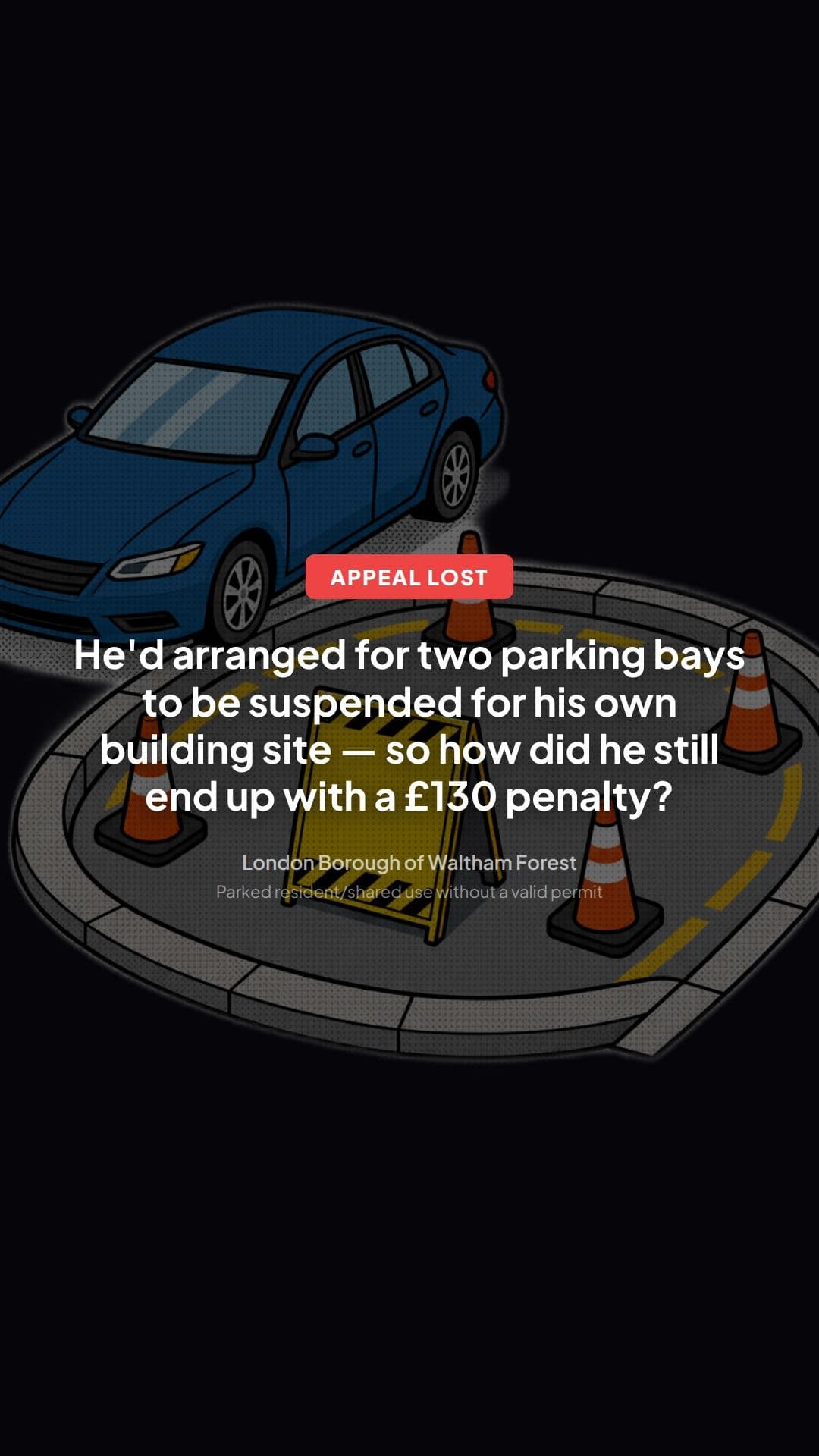
The appellant was working as a foreman on a site in Waltham Forest. He and the site manager had arranged for two parking bays near the site to be suspended, presumably so they could use them for work purposes such as loading or storage.
While a parking officer was on patrol, a delivery truck arrived at the site. To let it through, the foreman moved his car out of the suspended bay and parked it elsewhere, in an area reserved for permit-holding residents.
That's when the trouble started. The officer spotted the car, unoccupied and without a valid permit, and began preparing a PCN. The foreman drove off before the officer finished the process, which meant the council issued the ticket by post instead of handing it over on the spot.
The contravention recorded was "parked resident/shared use without a valid permit", and despite the foreman's explanation, the tribunal ultimately refused his appeal.
The Arguments: Reasonable Behaviour vs the Letter of the Law
The driver's position was straightforward and, frankly, sympathetic. He argued that:
- He'd only moved the car briefly to make way for a delivery.
- The officer had overstated how long the car had actually been sitting there unoccupied.
- The circumstances were understandable given the work being carried out on site.
The council's position was essentially silent, at least in terms of active participation. Waltham Forest didn't take part in the telephone hearing arranged for 21 February. That's not unusual in parking tribunals. Councils frequently rely on their written case and evidence (such as photographs and officer notes) rather than attending every hearing.
Even without a council representative present, the adjudicator still had to weigh the evidence already submitted against the driver's account.
The Decision: Refused, Despite a "Truthful" Explanation
The adjudicator didn't mince words about believing the driver. The written decision states plainly: "The appellant has I believe truthfully explained events."
But sympathy isn't the same as a legal defence. The adjudicator continued: "I have been unable to identify any exemption that can assist with his request for cancellation."
In other words, however reasonable the driver's actions seemed, there was no legal exemption that covered "I moved my car briefly to let a lorry through." The car was parked, unoccupied, in a resident permit bay, without a permit. That's the contravention, and that's what mattered.
The appeal was refused.
The Legal Reasoning, Explained Simply
There are three key legal threads running through this decision, and each one is worth unpacking.
1. Postal service was valid because enforcement had already started
One detail that might surprise drivers: the foreman driving away didn't save him from the ticket. The adjudicator explained that because the officer had already begun preparing the PCN before the car left, the council was entitled to complete the process and post the notice afterwards.
This matters because many drivers assume that if they're not caught "in the act" (i.e., the officer doesn't hand them a ticket physically), the fine won't stick. That's not how it works. Once enforcement action has begun, driving away doesn't cancel it. It just changes how the ticket is delivered.
2. There's no general "emergency" or "necessity" exemption for parking contraventions
The foreman's reasoning, that he needed to move his car to let a delivery through, is the kind of practical, everyday justification that feels like it should count for something. But parking contraventions in the UK operate on a fairly strict, evidence-based system. Unless a specific exemption applies (such as loading, blue badge provisions, or a documented suspension), simply having a good reason to be somewhere doesn't create a legal defence.
The adjudicator was explicit about this: despite believing the driver's account, there was no exemption on the books that covered his situation. If you're navigating a similarly tricky parking rule, our guide on residents parking permit rules and common traps is worth a read to understand how these permit zones typically work.
3. Disputing the exact timing rarely changes the outcome
The foreman also argued that the car wasn't left unoccupied for as long as the officer's notes suggested. The adjudicator acknowledged this might be true, noting the car "may have been parked only briefly where photographed." But ultimately, it didn't matter. The contravention doesn't hinge on how long the car was there unlawfully. It hinges on whether it was there at all without a valid permit. A few minutes is still a contravention.
Lessons for Drivers
This case offers some genuinely useful takeaways, even for drivers who'll never set foot on a building site.
1. "I was only there for a minute" is rarely a valid defence. Parking contraventions are typically about status (permit, payment, signage) rather than duration. If you're not authorised to park somewhere, a short stay usually doesn't change the outcome.
2. Bay suspensions only cover what they're arranged for. The foreman had suspended bays for his work vehicle, but moving into a different zone, even briefly, took him outside that arrangement. If you've arranged a suspension or dispensation, it's worth checking exactly which bay, times, and vehicles it covers.
3. Driving away doesn't stop a PCN if enforcement has already begun. Many drivers assume that if they leave before a ticket is issued in person, they're in the clear. This case shows that once an officer starts the paperwork, the council can still post the notice.
4. A sympathetic story doesn't override the absence of a legal exemption. Adjudicators can and do believe drivers' explanations, as this one clearly did, but tribunals work within a fixed framework of exemptions and contraventions. If your situation doesn't fit a recognised exemption, belief alone won't cancel the charge.
5. Early discounts have a shelf life. The adjudicator noted that the early payment discount had already expired and couldn't be reinstated. If you intend to challenge a PCN, it's worth understanding the discount window and how challenging a ticket can affect it, before that opportunity closes.
Key Takeaway
If you're not covered by a specific, recognised exemption, "I had a good reason" won't cancel a parking ticket, no matter how sensible that reason sounds. When arranging a bay suspension or dispensation, make sure you understand precisely what it covers, and if you ever need to move your vehicle temporarily, be aware that stepping outside that arrangement, even for a few minutes, can still count as a contravention. If you're facing a similar situation, it's worth seeking guidance on the specific exemptions that might apply to your circumstances before assuming common sense will carry the day.
Written by
Tariq Khan
Bailiff Procedures Expert
Ready to Challenge Your Ticket?
Let our AI analyse your PCN and generate a professional appeal letter in minutes.
Start Free Appeal