VW & Cupra EV recall: UK owners’ fire risk warning
Volkswagen Group recalls ~93,000 EVs worldwide, incl. ~2,000 in the UK, over a battery module fault that could overheat and cause fire risk.

Hannah MacLeod
29 March 2026
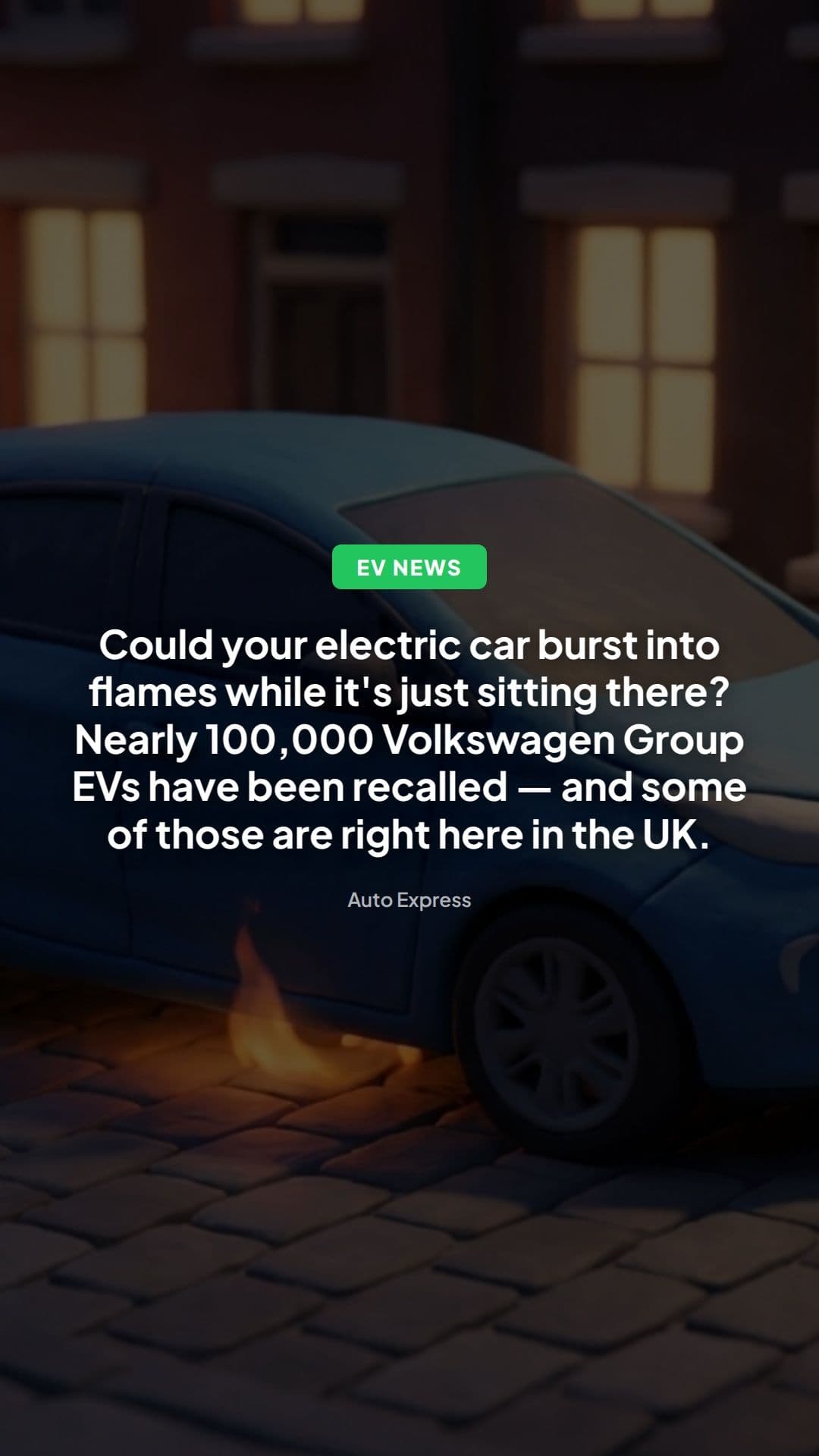
VW and Cupra EV Recall: What 2,000 UK Drivers Need to Know About Battery Fire Risk
Published March 2026 | 7-minute read
Imagine parking your electric car overnight, going to bed, and waking up to find it ablaze on your driveway. It sounds like the stuff of nightmares — but it's precisely the scenario that prompted Volkswagen Group to issue one of the most significant EV recalls of 2026. With roughly 93,000 vehicles affected worldwide and approximately 2,000 of those sitting on British roads, this story deserves far more attention than a fleeting headline.
This isn't just a story about a manufacturing fault. It's a story about what happens when the technology underpinning the EV revolution develops a crack — and what that means for UK drivers in terms of their rights, their safety, and what they should do right now.
What Happened: The Core of the Recall
Volkswagen Group — the umbrella corporation that owns brands including Volkswagen, SEAT, Cupra, Audi, and Škoda — has issued a recall affecting approximately 93,000 electric vehicles globally. In the UK, around 2,000 vehicles are involved, spanning models produced under the Volkswagen and Cupra badges.
The fault centres on a battery module defect that can cause the battery pack to overheat. In the worst-case scenario, that overheating can escalate into a thermal runaway — the technical term for the chain reaction that turns a battery fault into an uncontrolled fire. Thermal runaway in lithium-ion battery packs is notoriously difficult to extinguish and can reignite hours or even days after the initial incident.
As reported by Auto Express, Volkswagen Group has acknowledged the issue and initiated a formal recall process. The manufacturer's response has followed the standard playbook: identify affected vehicles by VIN (Vehicle Identification Number), notify registered owners, and arrange for inspection or replacement of the faulty components.
What the headline doesn't tell you, however, is the broader picture — who is affected, why this kind of fault occurs, and crucially, what your legal rights are if your vehicle is on the list.
Why It Matters: Context and Background
Electric vehicles use lithium-ion battery packs made up of hundreds — sometimes thousands — of individual cells grouped into modules. These modules are engineered to exacting tolerances, but manufacturing variability, software calibration errors, and physical stress over time can all introduce faults.
Thermal runaway is the EV industry's most feared failure mode. Unlike a conventional engine fire, which tends to build gradually and can often be contained, a lithium-ion battery fire can escalate from a minor fault to a full blaze within minutes. The energy density of modern EV batteries means there is an enormous amount of stored energy available to feed a fire once ignition begins.
This isn't the first time a major manufacturer has faced this problem. Hyundai recalled tens of thousands of Kona EVs in 2021 over similar concerns. General Motors paused Chevrolet Bolt sales in the US. BMW, Porsche, and others have issued battery-related recalls in recent years. The difference now is that EV ownership in the UK has reached a critical mass — there are over one million fully electric cars registered in Britain — meaning the scale of any safety issue is correspondingly larger.
The Volkswagen Group's MEB (Modular Electric Drive Matrix) platform, which underpins many of its EVs including the ID.3, ID.4, and the Cupra Born, represents a massive engineering investment. Any systemic fault in that platform carries significant reputational and financial consequences. That context helps explain why the recall has been issued proactively rather than in response to a wave of reported incidents.
The Legal Angle: Your Rights as a UK Driver
This is where things get particularly important for affected owners. In the UK, a formal vehicle recall triggers a clear set of obligations — for the manufacturer, the DVSA (Driver and Vehicle Standards Agency), and the dealer network.
The DVSA's Role
The DVSA maintains the official UK vehicle recalls database, accessible at gov.uk. Any driver can check whether their vehicle is subject to a recall by entering their registration number. When a recall is issued, the DVSA works with the manufacturer to ensure that all registered keepers are contacted directly — typically by letter.
Critically, recall repairs are free of charge. The manufacturer is legally obligated to rectify the fault at no cost to the owner, regardless of whether the vehicle is still under warranty.
Consumer Rights Act 2015
If your vehicle develops a fault — including a battery fault — within 30 days of purchase, you are entitled to a full refund under the Consumer Rights Act 2015. Beyond 30 days but within six months, the burden of proof shifts to the retailer to demonstrate the fault was not present at the time of sale. Beyond six months, the burden moves to the consumer, but the right to a repair or replacement remains.
For EV owners whose battery fault causes consequential damage — for instance, if a fire damages your garage or other property — you may have grounds to pursue a civil claim against the manufacturer under the Consumer Protection Act 1987, which holds producers strictly liable for damage caused by defective products.
What If You're Leasing or Using PCP Finance?
Many EV drivers don't own their vehicles outright — they're on Personal Contract Purchase (PCP) or lease agreements. In these cases, the finance company is the legal owner of the vehicle, and they bear responsibility for ensuring the recall is addressed. If you're on a lease or PCP and your car is subject to a recall, contact your finance provider as well as the dealer. You should not be expected to drive a vehicle that poses a fire risk simply because your contract hasn't expired.
What Drivers Should Know: Practical Advice
If you own a Volkswagen or Cupra electric vehicle, here's what you need to do — and what you need to know.
Step One: Check Whether Your Vehicle Is Affected
- Visit gov.uk/check-vehicle-recalls and enter your registration number.
- Alternatively, contact your nearest Volkswagen or Cupra dealership with your VIN (found on your V5C logbook, typically in section D).
- You can also call the manufacturer's customer service line directly.
Step Two: Don't Panic — But Do Take Precautions
If your vehicle is on the recall list and you haven't yet received a repair appointment, take sensible precautions in the meantime:
- Avoid charging to 100% — most battery management systems allow you to cap charging at 80%, which reduces stress on the cells.
- Don't charge unattended overnight where possible, particularly in an enclosed garage.
- Park away from structures if you have any concerns, until the recall work has been completed.
- Do not ignore the recall letter when it arrives.
Step Three: Book the Recall Repair Promptly
Once contacted, arrange your repair appointment as quickly as possible. Recall repairs are free and mandatory from the manufacturer's perspective — you are not obligated to pay anything, and you should not be pressured into purchasing additional services at the same time.
Step Four: Keep Records
Document everything. Keep copies of all correspondence with the manufacturer and dealer, note the date you were notified, and retain proof that the recall work was carried out. If you subsequently experience any battery-related problems, this paper trail will be invaluable.
Step Five: If You're Refused or Delayed
If a dealer refuses to carry out the recall work, or if you experience unreasonable delays, escalate to the DVSA directly and consider contacting the Motor Ombudsman, which provides an independent dispute resolution service for the automotive sector.
Looking Ahead: What This Means for the EV Industry
The VW and Cupra recall is significant not just for the 2,000 UK drivers directly affected, but for the wider conversation about EV safety and regulation.
Public trust is fragile. The transition to electric vehicles depends on consumers believing that EVs are safe, reliable, and fit for purpose. Every high-profile recall chips away at that confidence, particularly among drivers who were already sceptical. Manufacturers and the government have a shared interest in handling these incidents transparently and swiftly.
Regulation is evolving. The UK's Product Security and Telecommunications Infrastructure Act 2022 and ongoing updates to vehicle type-approval regulations are beginning to address the unique challenges posed by software-defined vehicles and battery technology. But critics argue that the regulatory framework is still catching up with the pace of EV development.
Insurance implications are real. EV battery fires are expensive to deal with — both in terms of the specialist equipment required and the cost of replacement battery packs. Insurers are increasingly scrutinising EV-specific risks, and a spate of high-profile recalls could accelerate premium increases for electric vehicle owners across the board.
For now, the most important thing is straightforward: if your Volkswagen or Cupra EV is on the recall list, act on it. The recall system exists precisely for moments like this, and it is one of the most effective consumer protection mechanisms available to British drivers. Use it.
Check your vehicle's recall status at [gov.uk/check-vehicle-recalls](https://www.gov.uk/check-vehicle-recalls). Original reporting by Auto Express, published 26 March 2026.
Written by
Hannah MacLeod
Traffic Law Specialist
Ready to Challenge Your Ticket?
Let our AI analyse your PCN and generate a professional appeal letter in minutes.
Start Free Appeal