VW and Cupra EV recall: UK owners’ safety and rights
Volkswagen Group recalls ~93,000 EVs (about 2,000 UK) over battery overheating fire risk. Check affected VW/Cupra models and what UK drivers should do.

Isabella Romano
7 April 2026
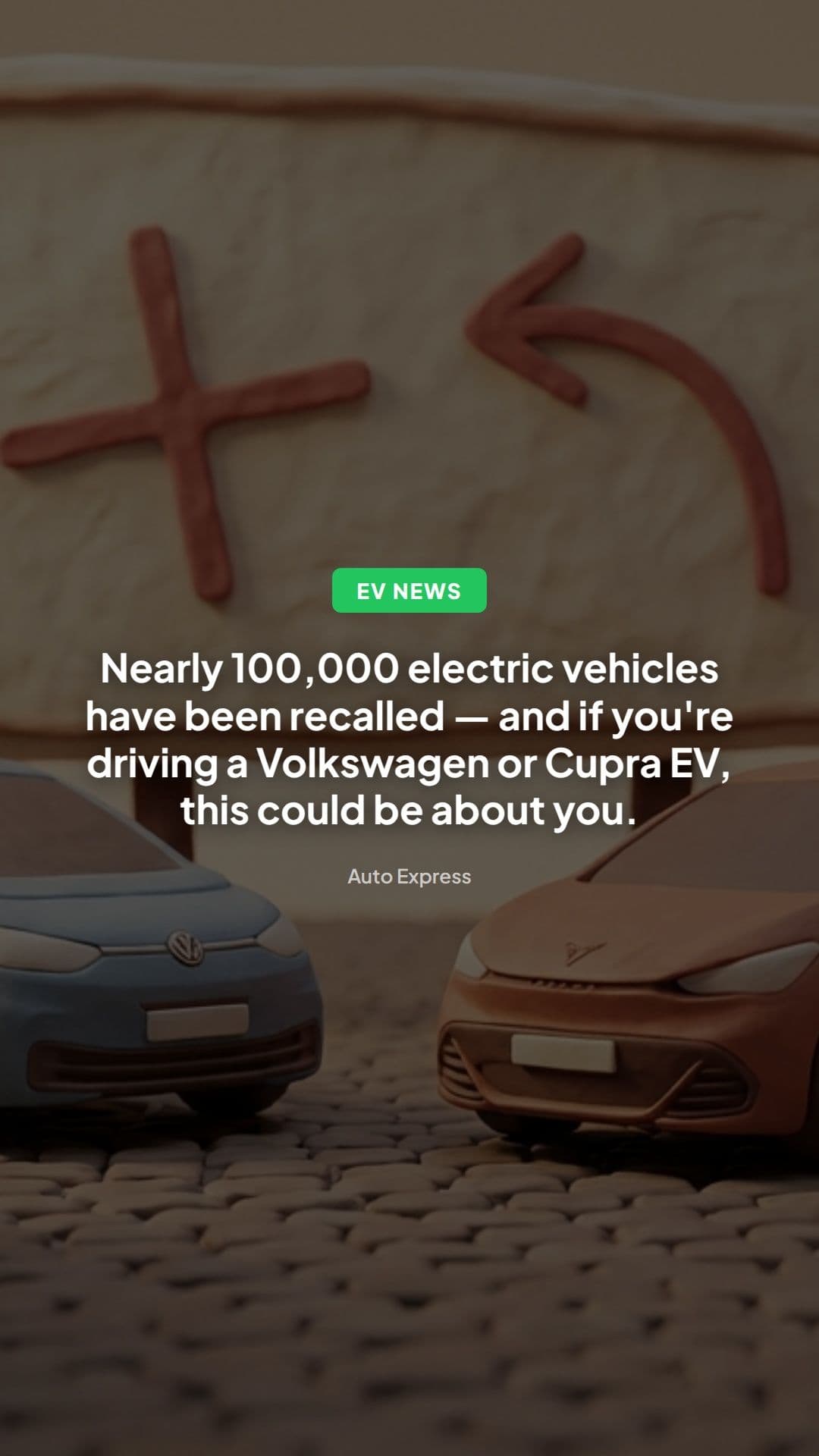
VW and Cupra EV Recall: What UK Owners Need to Know About Battery Fire Risk
An estimated 2,000 British drivers are affected — here's the full picture, your legal rights, and exactly what to do next
Imagine plugging in your electric car overnight, heading to bed, and waking up to find it ablaze on your driveway. It sounds dramatic, but it's precisely the scenario that has prompted Volkswagen Group to issue one of the most significant EV safety recalls in recent British motoring history. With roughly 93,000 vehicles recalled globally — around 2,000 of them registered in the UK — this story touches on far more than a technical fault. It raises urgent questions about EV safety standards, manufacturer accountability, and the rights of British drivers when something goes seriously wrong.
What Actually Happened
According to reporting by Auto Express, Volkswagen Group has initiated a recall affecting approximately 93,000 electric vehicles worldwide, covering models sold under both the Volkswagen and Cupra brands. The specific fault centres on a battery module overheating risk — a defect that, under certain conditions, could escalate to a vehicle fire.
The recall affects around 2,000 UK-registered vehicles, and Volkswagen Group has outlined remedial measures to address the fault, which are expected to involve software updates and, in some cases, physical inspection or replacement of battery components.
Crucially, this isn't a case of a fault being discovered after a fire — it's a proactive recall triggered by the manufacturer's own quality control processes identifying a potential failure mode before widespread incidents occur. That distinction matters, both in terms of public safety and legal responsibility.
The affected vehicles span VW's MEB platform — the same modular electric architecture underpinning models like the ID.3, ID.4, and ID.5 — as well as Cupra's Born, which shares the same underlying platform. Owners should check the DVSA (Driver and Vehicle Standards Agency) recall database or contact their dealership directly to confirm whether their specific vehicle is included.
Why This Matters Beyond the Headlines
Battery fires in electric vehicles are a topic that generates enormous public anxiety, often disproportionate to the actual statistical risk. Studies consistently show that EVs are no more likely to catch fire than petrol or diesel vehicles, and in many analyses, considerably less so. However, when EV fires do occur, they burn differently — hotter, faster, and with a phenomenon known as thermal runaway, where individual battery cells cascade into catastrophic failure. That makes prevention, not just response, absolutely critical.
This recall is significant for several reasons:
- Scale: 93,000 vehicles is a substantial number, and with the MEB platform deployed across multiple brands — including Audi, Skoda, and SEAT beyond VW and Cupra — there are questions about whether the recall scope could widen.
- Trust: The EV transition depends heavily on public confidence. A high-profile safety recall, even a responsibly managed one, feeds existing scepticism among drivers who are already uncertain about making the switch from internal combustion.
- Infrastructure risk: Unlike a petrol fire, an EV battery fire in an enclosed space — an underground car park, a home garage, or a ferry deck — poses extreme risks to surrounding structures and people. Several high-profile incidents in enclosed spaces overseas have already prompted changes to parking policies at some UK facilities.
- Timing: This recall comes at a moment when the UK government is pushing hard for EV adoption ahead of the 2035 ban on new petrol and diesel car sales. Any erosion of consumer confidence in battery safety could slow that transition.
The Legal Angle: What UK Law Says
This is where things get genuinely interesting for affected drivers. UK consumer law provides robust protections in situations like this — arguably stronger than many owners realise.
The Consumer Rights Act 2015
Under the Consumer Rights Act 2015, goods sold must be of satisfactory quality, fit for purpose, and as described. A vehicle with a battery module capable of overheating to the point of fire clearly fails the satisfactory quality test. If the defect existed at the point of sale — even if it wasn't discovered until later — the buyer has legal recourse.
For vehicles purchased within six months of the defect being identified, there is a presumption in law that the fault existed at the time of sale, placing the burden of proof on the retailer to demonstrate otherwise.
For older purchases, the consumer must show the fault was present at the time of sale — but a manufacturing defect of this nature, built into the battery module itself, is precisely the kind of systemic issue that courts have consistently found to satisfy that test.
The General Product Safety Regulations 2005
Manufacturers and distributors operating in the UK are bound by the General Product Safety Regulations 2005, which require that products placed on the market are safe. Where a product is found to be unsafe, the regulations impose a duty to recall, notify authorities, and cooperate with enforcement bodies. VW Group's proactive recall is consistent with compliance here — but the regulations also give the Office for Product Safety and Standards (OPSS) powers to enforce action if a manufacturer drags its feet.
DVSA Recall Obligations
In the UK, vehicle recalls are overseen by the DVSA. Once a recall is registered, manufacturers are legally obligated to remedy the defect free of charge. Owners cannot be charged for the repair, the parts, or any associated work. If a dealership attempts to levy any cost — however it's framed — that is unlawful.
Importantly, if a recalled vehicle is involved in an accident or causes damage before the recall remedy has been applied, and the owner was not notified in a timely manner, the manufacturer's liability exposure increases significantly.
What Drivers Should Do Right Now
If you own a Volkswagen or Cupra electric vehicle — particularly an ID.3, ID.4, ID.5, or Cupra Born — here is a clear, practical action plan:
1. Check the DVSA recall database immediately Visit gov.uk/check-vehicle-recalls and enter your vehicle registration. This will confirm whether your specific car is subject to this recall.
2. Contact your dealership Don't wait for a letter to arrive. Call your nearest VW or Cupra dealership, give them your VIN (vehicle identification number), and ask them to confirm recall status and book a remedial appointment.
3. Adjust your charging habits in the interim Until the recall remedy has been applied, consider the following precautions:
- Avoid charging your vehicle overnight unattended in an enclosed garage
- Use a smart charger that allows you to set charging windows and monitor sessions remotely
- Avoid charging to 100% unnecessarily — most EV manufacturers recommend keeping battery levels between 20% and 80% for daily use anyway
- If your car has an alert or monitoring app (VW's We Connect or Cupra's equivalent), enable notifications
4. Document everything Keep a record of when you were notified, when you booked the repair, and when the work was completed. If anything goes wrong in the interim, this paper trail matters enormously.
5. Know your rights if you want to reject the vehicle If your vehicle is relatively new and you have serious concerns, you may have the right to reject the vehicle for a full refund under the Consumer Rights Act 2015 — particularly within the first 30 days of purchase (the short-term right to reject). For older purchases, a repair or replacement may be the more realistic outcome, but it's worth seeking independent legal advice if you're unhappy.
Looking Ahead: What This Means for the EV Industry
This recall is unlikely to be the last of its kind. As the global EV fleet grows and vehicles age, battery-related issues will become an increasingly common feature of the motoring landscape. The key question is not whether faults will occur — they will, as they do in every technology — but how quickly, transparently, and fairly manufacturers respond when they do.
VW Group's handling here — a proactive recall before widespread incidents — sets a reasonable standard. But the industry as a whole needs clearer, faster recall notification systems. Too many UK drivers remain unaware that their vehicles are subject to outstanding recalls; the DVSA estimates that millions of UK vehicles have unresolved recall notices at any given time.
There is also a broader policy conversation to be had. As EVs become the default rather than the exception, the UK's regulatory framework for battery safety — currently a patchwork of EU-derived standards, domestic consumer law, and DVSA oversight — may need consolidation into something more coherent and proactive.
For now, though, the message to affected VW and Cupra owners is straightforward: act promptly, know your rights, and don't assume the problem will sort itself out. The recall system exists precisely for moments like this — use it.
Source: Auto Express — "Volkswagen and Cupra recall almost 100,000 EVs due to battery fire risk"
Written by
Isabella Romano
Civil Enforcement Officer
Ready to Challenge Your Ticket?
Let our AI analyse your PCN and generate a professional appeal letter in minutes.
Start Free Appeal