Vespa mascot gets a PCN: what council rules allow
A Weymouth restaurant’s decorative Vespa was slapped with a PCN. We explain how council parking enforcement works, and how to challenge a mistaken ticket.

Priya Sharma
20 June 2026
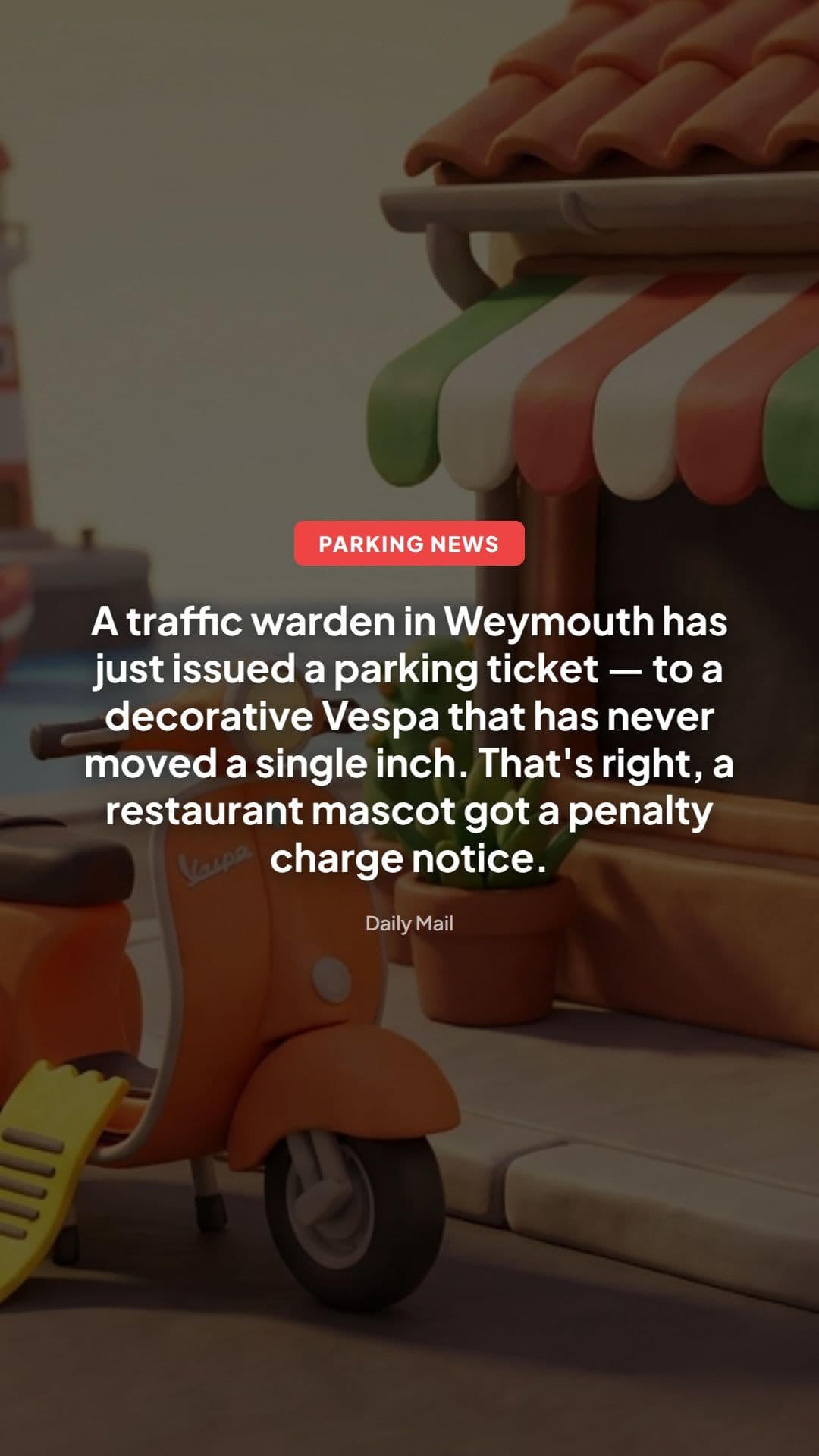
When a Traffic Warden Tickets a Scooter That Can't Move: The Weymouth Vespa Fiasco
There are parking tickets, and then there are parking tickets. Most of us have experienced the sinking feeling of returning to a car to find a yellow envelope tucked under the wiper blade. It's frustrating, occasionally unjust, but usually at least theoretically understandable. What happened outside a family restaurant in Weymouth, however, sits in a category all of its own — and it tells us something genuinely important about how parking enforcement works, where it goes wrong, and what drivers (and, apparently, decorative scooters) can do about it.
What Actually Happened
Staff at a family-run restaurant in Weymouth arrived to find that a traffic warden had issued a parking ticket to their decorative Vespa mascot — a scooter that had been placed outside the premises purely as a display piece. It wasn't parked there in any meaningful sense. It wasn't going anywhere. It was, by all reasonable definitions, a prop.
The incident, reported by the Daily Mail, left staff baffled and prompted an immediate wave of local criticism. The Vespa in question appears to have been positioned outside the restaurant as part of the establishment's character and branding — the kind of charming, independent touch that distinguishes a family-run business from a chain outlet.
And yet, there it was: a Penalty Charge Notice, issued to an object that cannot be driven, cannot be moved under its own power, and arguably doesn't meet the legal definition of a vehicle being "used" on a public road at all.
Why This Matters Beyond the Laughs
It's tempting to treat this story as pure comedy — and admittedly, it is quite funny. But underneath the absurdity lies a serious question about how parking enforcement is conducted in the UK, and whether the system has become so process-driven that basic common sense has been squeezed out entirely.
Parking enforcement in England and Wales was largely decriminalised and handed to local councils under the Road Traffic Act 1991 and later consolidated through the Traffic Management Act 2004. Civil enforcement officers (CEOs) — commonly still called traffic wardens — are employed either directly by councils or through contracted enforcement companies. Their job is to observe contraventions and issue PCNs accordingly.
The problem is that enforcement increasingly operates on a tick-box, observe-and-issue basis. CEOs are often working under pressure, covering large areas, and in some cases operating under performance frameworks that — despite official denials — can create implicit incentives around the volume of tickets issued. When enforcement becomes mechanical rather than considered, you get situations like this one: an officer apparently looking at a two-wheeled vehicle on a public road or pavement, noting that it appears to contravene a restriction, and issuing a notice without pausing to consider whether it could possibly be a vehicle in any legal sense.
The Legal Angle: Can You Actually Ticket a Display Object?
This is where things get genuinely interesting. Under the Road Traffic Regulation Act 1984 and the Traffic Management Act 2004, a PCN can be issued for a "vehicle" that has been left in contravention of a parking restriction. The legal definition of a "vehicle" under UK road traffic law is broadly drawn — the Road Traffic Act 1988 defines it as a "mechanically propelled vehicle intended or adapted for use on roads."
Here's the critical phrase: intended or adapted for use on roads. A decorative Vespa mascot — particularly one that has been stripped of operational function, or simply placed as a display item — could very reasonably be argued to fall outside this definition. If it has no engine, no fuel, no registration, and no road tax, the case that it constitutes a "vehicle" for enforcement purposes becomes extremely thin.
Furthermore, even if it were classified as a vehicle, the owner would have strong grounds to challenge the notice on the basis that:
- No contravention took place — the object was not "parked" in any legal sense; it was placed as a fixture.
- The notice was issued in error — a fundamental requirement of a valid PCN is that it accurately describes a genuine contravention.
- The vehicle (if it is one) was not in use on a road — many restrictions apply specifically to vehicles on the road or in designated areas, not to static displays.
Under the Civil Enforcement of Parking Contraventions (England) Regulations 2007, the recipient of a PCN has the right to make an informal challenge within 14 days, and a formal representation if the informal challenge fails. If the council upholds the notice, the matter can be taken to an independent adjudicator through the Traffic Penalty Tribunal (outside London) or London Tribunals (within the capital). Adjudicators have consistently shown willingness to cancel PCNs where enforcement was clearly disproportionate or procedurally flawed.
It is almost inconceivable that a notice issued to a decorative prop would survive an adjudicator's scrutiny.
What Drivers (and Restaurant Owners) Should Know
Whether you're a motorist who's received a questionable ticket or a business owner who's just found a PCN attached to your ornamental scooter, the practical steps are the same:
1. Don't ignore it. Even the most absurd PCN becomes a debt if left unaddressed. A £70 or £100 fine (depending on the contravention and location) doubles if unpaid within 28 days, and can eventually lead to bailiff action. Ignore it at your peril.
2. Photograph everything immediately. Take time-stamped photos of the vehicle (or object), its position, the surrounding signage, and the PCN itself. In a case like this, photos demonstrating that the Vespa is clearly a display piece — perhaps showing it's non-operational, chained, or positioned with signage — would be invaluable evidence.
3. Challenge at the informal stage first. Write to the issuing council within 14 days of the PCN being issued. At this stage, the council can cancel the notice without formal process. Explain clearly why the notice was issued in error, reference the legal definition of a vehicle, and attach your photographic evidence. Keep the tone factual and firm.
4. If the informal challenge fails, make a formal representation. If the council issues a Notice to Owner and rejects your informal challenge, you have 28 days to make a formal representation. The council must then issue a formal rejection or cancel the notice. If they reject it, you have 28 days to appeal to the independent adjudicator.
5. Know your grounds. The strongest grounds here would be: "No contravention occurred" — because the item ticketed is not a vehicle in any legal sense, and was not parked in contravention of any restriction. Adjudicators take a pragmatic view, and a well-evidenced case with clear photographs will carry significant weight.
6. Businesses displaying objects near the road should be proactive. If you have a decorative vehicle, statue, or prop positioned near a road, it may be worth checking with your local council whether any formal permission is needed (under the Highways Act 1980, placing objects on the highway without consent can itself be an offence). Getting a letter confirming the display is authorised could prevent future enforcement headaches.
Looking Ahead: Enforcement Culture Needs to Catch Up With Reality
The Weymouth Vespa story is funny, but it's also a symptom of a broader problem. As parking enforcement has grown into a significant revenue stream for local authorities — with millions of PCNs issued annually across England — the pressure to process and issue has, in some cases, overtaken the judgment required to enforce fairly.
Civil enforcement officers are not, in most cases, trained lawyers. They're working quickly, often under difficult conditions, and applying rules that were written for clear-cut situations. When something unusual appears — a display scooter, an unusual vehicle type, a complex sign arrangement — the system doesn't always handle it gracefully.
What's needed is better training, clearer escalation procedures for unusual cases, and a genuine culture shift away from volume-based enforcement towards quality-based enforcement. The government's ongoing review of parking enforcement practices, and the introduction of the British Parking Association's updated codes of practice, are steps in the right direction — but incidents like this suggest there's still a long way to go.
In the meantime, if you ever find a parking ticket attached to something that genuinely cannot be parked — a garden ornament, a display piece, a statue — know that you have every right to challenge it, and every reason to expect it cancelled. The law, on this occasion, is very much on your side.
Just perhaps keep the receipt for the Vespa, in case you need to prove it was never roadworthy.
Written by
Priya Sharma
Legal Aid Coordinator
Ready to Challenge Your Ticket?
Let our AI analyse your PCN and generate a professional appeal letter in minutes.
Start Free Appeal