Union urges NHS staff car parking charges to be scrapped
A union says NHS staff car parking charges should end, estimating £79m a year in costs. What could change for permits, staff bays and Trust policies.

Isabella Romano
21 June 2026
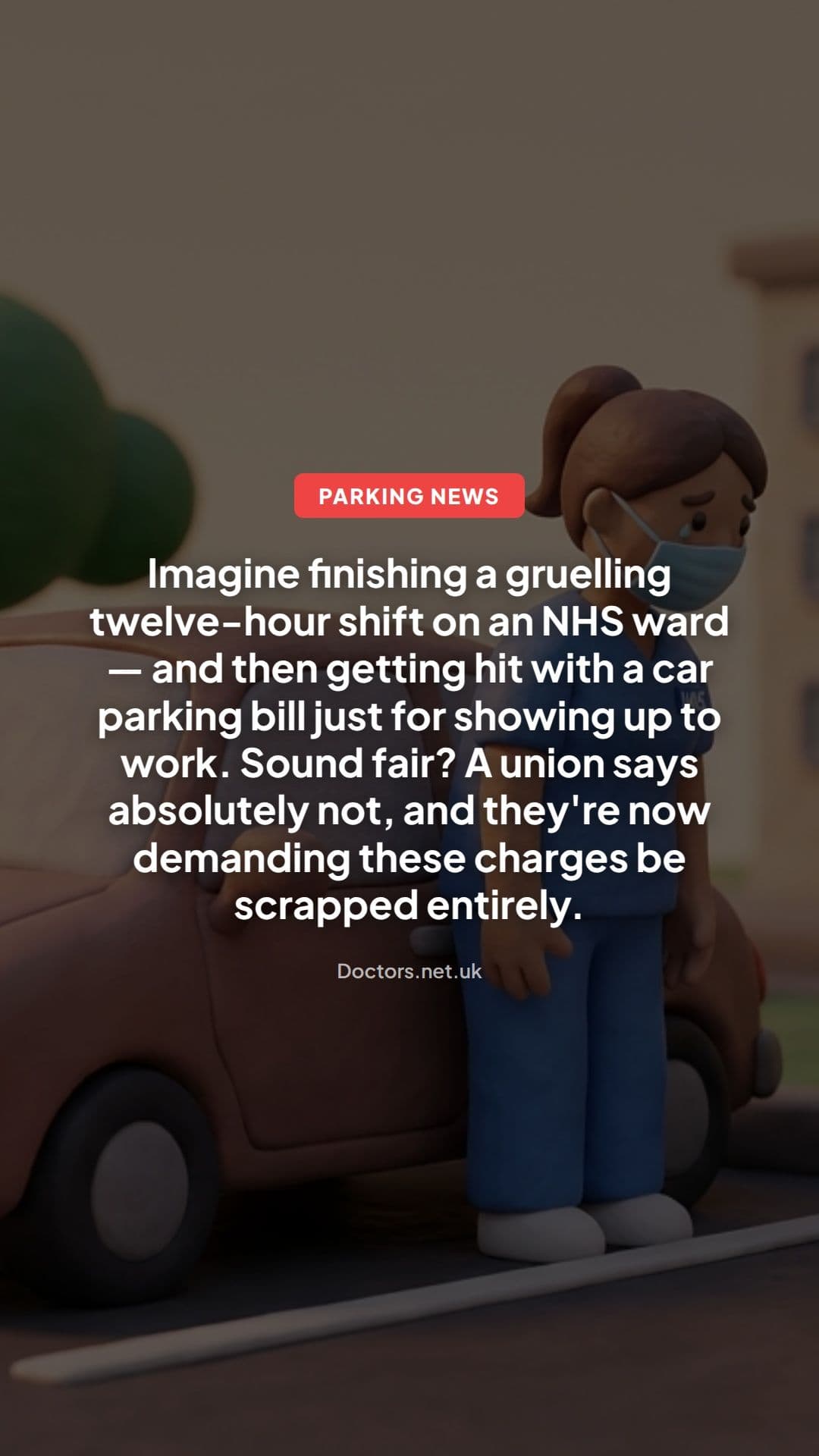
NHS Car Parking Charges Must Go: Why the £79 Million Staff Tax Is a Crisis We Can't Ignore
Every morning, thousands of nurses, doctors, porters, and healthcare assistants arrive at hospitals across Britain and face a choice that no other essential worker should have to make: pay to park at their own workplace, or risk a fine. For many, that daily cost quietly swallows hundreds — sometimes thousands — of pounds each year. Now, a major union is saying enough is enough.
What Happened
A union conference has formally called for the complete abolition of NHS staff car parking charges, shining a fresh spotlight on a practice that costs healthcare workers an estimated £79 million annually. The call, reported by Doctors.net.uk, reflects growing frustration within the NHS workforce at a time when the health service is already struggling with recruitment, retention, and morale.
This isn't a fringe grievance. It's a systemic issue affecting hundreds of thousands of workers who, in many cases, have no practical alternative to driving. Night shift nurses in rural hospitals don't have the luxury of a reliable bus service at 3am. A junior doctor finishing a 12-hour shift isn't cycling home in winter darkness. For these workers, the car isn't a lifestyle choice — it's a necessity. And right now, they're paying for the privilege of going to work.
Why It Matters: The Bigger Picture
The £79 million figure is striking, but it only tells part of the story. NHS car parking charges have been a contentious issue for well over a decade, and the policy landscape around them is genuinely complicated.
In England, the government issued guidance in 2019 — updated during the Covid-19 pandemic — that required NHS trusts to provide free parking for certain categories of NHS staff, including those working night shifts, those with disabilities, and frequent visitors to hospitals with long-term conditions. However, this guidance was never universally applied. Implementation was left largely to individual trusts, and many found workarounds, applied charges inconsistently, or quietly reintroduced fees as pandemic-era exemptions expired.
In Scotland, NHS car parking charges for staff and patients were abolished entirely in 2008. Wales followed suit in 2008 for patients, with staff charges also removed. Northern Ireland has never charged NHS staff for parking. That leaves England as the outlier — the only nation in the UK where NHS workers routinely pay to park at the hospitals and clinics where they work.
This is not a minor administrative quirk. It is a structural inequity baked into the English NHS that directly undermines the government's stated goals of improving workforce morale and reducing staff attrition.
The NHS Long Term Workforce Plan, published in 2023, identified retention as one of the most urgent challenges facing the health service. Losing experienced staff costs the NHS enormously in recruitment and training. When workers cite financial pressures as a reason for leaving — and many do — parking charges are part of that calculation. It may not be the headline reason someone quits, but it is one of many small indignities that accumulate over time.
The Legal Angle: What Rights Do NHS Staff Actually Have?
This is where things get genuinely murky, and it's worth unpacking carefully.
NHS trusts are not legally obligated under primary legislation to provide free parking to staff. The guidance issued by NHS England — including the NHS Car Parking Principles — is exactly that: guidance. It carries significant weight and trusts are expected to follow it, but it does not have the force of law. A trust that charges staff for parking is not, technically, breaking the law.
However, there are several legal and regulatory frameworks that interact with this issue:
- The Health and Social Care Act 2012 gives NHS England the power to issue directions and guidance to trusts. Persistent non-compliance with parking guidance could, in theory, be flagged through regulatory oversight, but enforcement is weak and rarely pursued.
- Employment law is potentially more relevant. Under the Employment Rights Act 1996 and associated case law, deductions from wages — including those made for parking — must be clearly agreed in employment contracts. Workers who have parking charges deducted from their pay without explicit contractual consent may have grounds for a claim.
- The Equality Act 2010 is also worth considering. If parking charges disproportionately affect disabled workers, part-time workers (who are statistically more likely to be women), or those on lower pay grades, there could be grounds for an indirect discrimination argument. This is a complex legal area, but it is not entirely without merit.
- The National Minimum Wage Act 1998 is perhaps the most powerful lever. If parking charges, when deducted, bring a worker's effective hourly rate below the National Living Wage, the employer is in breach of the law. For the lowest-paid NHS workers — healthcare assistants, porters, catering staff — this is a real possibility that has been raised by unions before.
The union's conference call for abolition is therefore not just a political demand. It has genuine legal underpinnings that could be pursued through employment tribunals if trusts continue to impose charges on their most financially vulnerable workers.
What Drivers and NHS Workers Should Know
If you work for the NHS and are currently paying for parking, here is what you should be aware of:
1. Check your trust's parking policy Every NHS trust should have a published car parking policy. Under NHS England guidance, certain staff — including night shift workers, those with disabilities, and those on low incomes — should be eligible for free or heavily subsidised parking. If you fall into one of these categories and are being charged, raise it formally with your HR department.
2. Check your payslip carefully If parking charges are deducted directly from your salary, confirm that this is covered in your employment contract. Unauthorised deductions from wages are unlawful under the Employment Rights Act 1996. If you're unsure, your union rep or Citizens Advice can help you review this.
3. Calculate your effective hourly rate If you're on a lower pay band, add up your annual parking costs and calculate whether they bring your effective hourly rate below the National Living Wage (currently £12.21 per hour as of April 2025). If they do, you may have a legal claim.
4. Use your union This is exactly what unions are for. If your trust is not complying with NHS England's parking guidance, your union can raise a formal grievance on your behalf, escalate to NHS England, or pursue legal action. The conference call reported by Doctors.net.uk is a sign that unions are mobilising on this issue — get involved.
5. Keep records If you're appealing a parking charge or building a case for reimbursement, keep receipts, payslips showing deductions, and any correspondence with your employer about parking. Evidence matters.
Looking Ahead: Can This Change?
The political will to abolish NHS staff parking charges in England has historically been limited. Car parking generates significant revenue for trusts — some hospitals take in millions of pounds annually — and the Treasury has shown little appetite to replace that income with direct funding.
However, the pressure is building. The union conference call adds to a growing chorus of voices, and with NHS workforce pressures showing no sign of easing, the argument that parking charges are a false economy is becoming harder to dismiss. Every nurse who leaves the profession partly because of financial strain costs the NHS far more in recruitment and agency costs than a year's worth of parking revenue.
There is also a political dimension. With the next general election cycle approaching and NHS staffing a defining issue for voters, the £79 million figure is a potent one. It is specific, it is verifiable, and it is the kind of number that cuts through. Abolishing staff charges would cost the government money — but it would also be a visible, tangible gesture of respect to a workforce that has been stretched beyond reasonable limits.
Scotland, Wales, and Northern Ireland have already shown it can be done. The question for England is no longer whether abolition is possible, but whether there is the political courage to make it happen.
For the hundreds of thousands of NHS workers paying to park at their own workplace every single day, that question cannot come soon enough.
Written by
Isabella Romano
Civil Enforcement Officer
Ready to Challenge Your Ticket?
Let our AI analyse your PCN and generate a professional appeal letter in minutes.
Start Free Appeal