UK parking fees and charges: Minister’s March 2026 reply
Analysis of the 4 March 2026 ministerial answer on UK parking fees and charges, covering council enforcement, PCNs, and wider policy changes.

Sarah Mitchell
8 March 2026
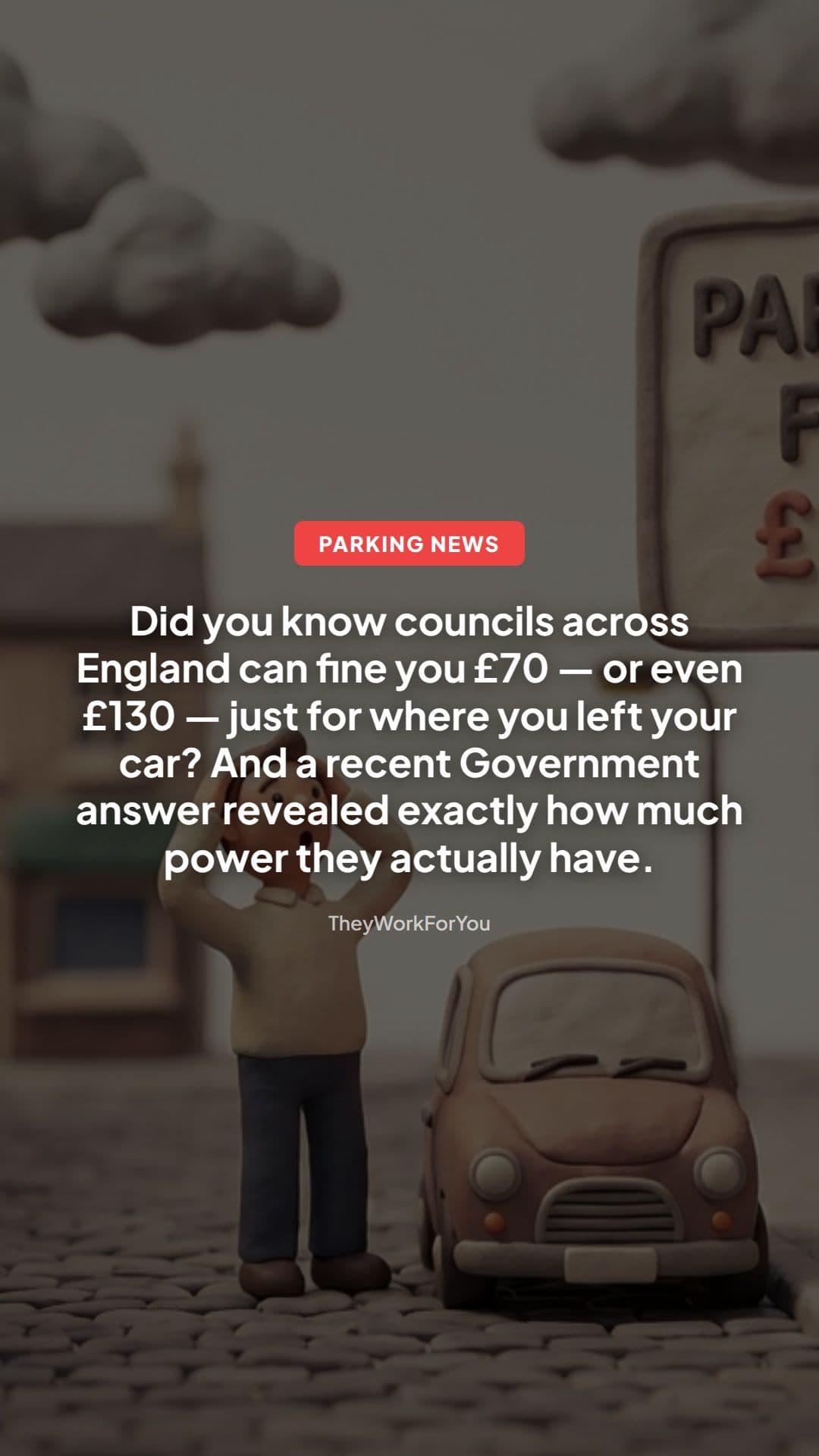
Parking Fees and Charges Under the Microscope: What Parliament's Latest Answer Really Means for Drivers
A written parliamentary answer recorded in March 2026 has shone a fresh light on how councils manage parking enforcement — and the questions it raises go far deeper than a simple policy statement.
The Moment That Catches Your Eye
Picture this: you've just returned to your car, ticket in hand, only to find a Penalty Charge Notice (PCN) tucked under your wiper. You're certain you paid correctly. You're equally certain the signage was confusing. And yet, somewhere in a local authority back office, a decision has already been made — and the burden of proof, at least initially, feels like it's entirely on you.
That frustration is shared by millions of British drivers every year. So when a Member of Parliament tables a formal question about parking fees and charges, and the Ministry of Housing, Communities and Local Government (MHCLG) is compelled to respond on the record, it's worth paying close attention. The written answer recorded on 4 March 2026, published via TheyWorkForYou, touches on council enforcement powers, Penalty Charge Notices, and related policy — and what it reveals, between the lines, is a system that is simultaneously well-regulated on paper and deeply inconsistent in practice.
What the Parliamentary Answer Actually Said
The written question, tabled on 26 February 2026 and answered by the Ministry on 4 March, sought clarity on parking fees and charges — specifically how councils enforce them, how PCNs are issued, and what policy framework governs the whole process.
The Ministry's response covered the broad architecture of civil parking enforcement (CPE): the framework under which local authorities, rather than the police, have taken over responsibility for most on-street and off-street parking contraventions. It acknowledged the role of PCNs as the primary enforcement tool, the right of motorists to challenge those notices, and the policy principles that are supposed to underpin how councils exercise their powers.
What the answer did not do — and this is telling — is acknowledge the significant variation in how those powers are applied across different local authorities. It did not address the growing body of evidence suggesting that some councils treat parking enforcement as a revenue stream rather than a genuine traffic management tool. And it offered no new commitments on reform, transparency, or accountability.
For drivers, that silence is as significant as anything that was said.
Why This Matters: A System Built on Complexity
Civil parking enforcement has been the dominant model in England and Wales since the Road Traffic Act 1991 began the process of decriminalising parking offences, with the Traffic Management Act 2004 completing the transition and setting out the current framework. Under CPE, councils have the authority to issue PCNs, pursue debt through the Traffic Enforcement Centre (TEC) at Northampton County Court, and ultimately instruct enforcement agents (bailiffs) to recover unpaid charges.
On the surface, this seems straightforward. In practice, it has created a patchwork of enforcement cultures, fee structures, and appeals processes that vary enormously from one local authority to the next.
Consider the basics: a Band A PCN in London currently carries a charge of £110, reduced to £55 if paid within 14 days. In other parts of England, Band B PCNs start at £70, reduced to £35. But the reason for a PCN — the contravention code — can be the same in both cases. A driver parking in a suspended bay in Camden faces a very different financial consequence to a driver committing the identical contravention in, say, Stoke-on-Trent.
This disparity has never been satisfactorily explained by central government, and the March 2026 parliamentary answer did nothing to address it.
The Legal Angle: Rights You May Not Know You Have
The legal framework governing council parking enforcement is more protective of drivers than many people realise — but only if you know how to use it.
The Traffic Management Act 2004 is the cornerstone. It requires councils to follow a strict statutory process when issuing and pursuing PCNs. This includes:
- Serving a Notice to Owner (NTO) within six months of the contravention if the PCN was not paid or challenged within 28 days
- Allowing a formal representation at the NTO stage, with the council obliged to consider it properly and provide a reasoned rejection if they refuse it
- Providing an independent appeal route via the Traffic Penalty Tribunal (outside London) or London Tribunals (within the capital)
Crucially, the independent adjudicators at these tribunals are not council employees. They are genuinely independent, and their decisions are binding on local authorities. Councils cannot simply ignore an adjudicator's ruling in their favour.
The London Local Authorities Act 1996 and various statutory instruments add further layers, particularly around the proper display and positioning of Traffic Regulation Orders (TROs) — the legal instruments that create parking restrictions. If a restriction is not properly made, signed, and lined, it may be legally unenforceable, regardless of what a parking attendant observed.
The key principle: a PCN is not a fine in the criminal sense. It is a civil charge. You have rights. You have a process. And the council has obligations it must meet.
What Drivers Should Know: Practical Takeaways
Given the backdrop of this parliamentary exchange, here is what every driver in England and Wales should keep firmly in mind:
1. Always Challenge If You Have Grounds
The informal challenge (made within 14 days of the PCN, before any payment) preserves your right to the 50% discount if the challenge fails. Many drivers don't realise that making an informal challenge does not mean you've lost that discount — councils are required to restart the discount period if they reject your challenge.
2. Photograph Everything
The moment you return to your car and find a PCN, take photographs. Capture the signage, the road markings, the position of your vehicle, the PCN itself, and any pay-and-display machine or meter in the vicinity. This evidence is invaluable at appeal.
3. Request the Evidence Pack
When making a formal representation, you are entitled to request the council's evidence — including the Civil Enforcement Officer's notes, photographs, and a copy of the relevant Traffic Regulation Order. Many successful appeals hinge on discrepancies in this documentation.
4. Know Your Deadlines
- 14 days: Pay the reduced amount, or submit an informal challenge
- 28 days: If no challenge made, pay the full amount or risk escalation
- 28 days from NTO: Submit a formal representation
- 28 days from Notice of Rejection: Appeal to the independent tribunal
Missing these windows can be costly — but even late statutory declarations have their place in certain circumstances.
5. Council Surpluses Are Not Your Problem
Some councils generate significant surpluses from parking enforcement. Under the Road Traffic Regulation Act 1984, these surpluses are supposed to be ringfenced for transport-related expenditure. If you suspect a council is enforcing aggressively for revenue purposes rather than traffic management, that context can be relevant in an appeal — particularly if you can demonstrate disproportionate or targeted enforcement.
Looking Ahead: What This Parliamentary Exchange Signals
The fact that a parliamentarian felt it necessary to table a formal question about parking fees and charges in early 2026 is itself instructive. It suggests that the issue remains politically live — that drivers, constituents, and their representatives are not satisfied that the current system is working fairly.
There are several pressure points that are likely to define the parking enforcement landscape in the months and years ahead.
Transparency of TROs: There is growing political pressure to make Traffic Regulation Orders more easily accessible to the public. Currently, a driver wishing to inspect the TRO underpinning a restriction may need to submit a formal request to the council — a process that is opaque and time-consuming. Digital publication of all TROs, in a standardised and searchable format, would be transformative for driver rights.
Consistency of charges: The disparity in PCN charges between different local authorities — and between London and the rest of England — has no principled justification. A future government review could standardise Band A and Band B charges nationally, removing the postcode lottery element of enforcement.
Council accountability: The requirement for councils to publish annual parking accounts is already enshrined in law, but compliance and transparency vary. Stronger reporting requirements, with clearer breakdowns of enforcement activity, appeals outcomes, and surplus expenditure, would go some way towards rebuilding public trust.
Technology and fairness: As cashless parking systems, ANPR cameras, and automated enforcement become more prevalent, the margin for technical error — and the potential for injustice — increases. Parliamentary scrutiny of how these technologies are governed, audited, and challenged is not just welcome; it is essential.
The March 2026 parliamentary answer may not have broken new ground. But the question itself — and the political attention it represents — is a reminder that parking enforcement in the UK remains a contested, consequential, and often misunderstood area of public life. For drivers navigating this system, knowledge remains the most powerful tool available.
Source: TheyWorkForYou — Written Answer, 4 March 2026 (Question reference 2026-02-26.116230.h)
Written by
Sarah Mitchell
Parking Rights Advocate
Ready to Challenge Your Ticket?
Let our AI analyse your PCN and generate a professional appeal letter in minutes.
Start Free Appeal