UK EV tariff cliff edge could push up prices in 2026
A looming tariff cliff edge could raise UK EV prices and disrupt supply. What it means for motorists, leases, and running costs if trade rules aren’t fixed.

James Wilson
10 July 2026
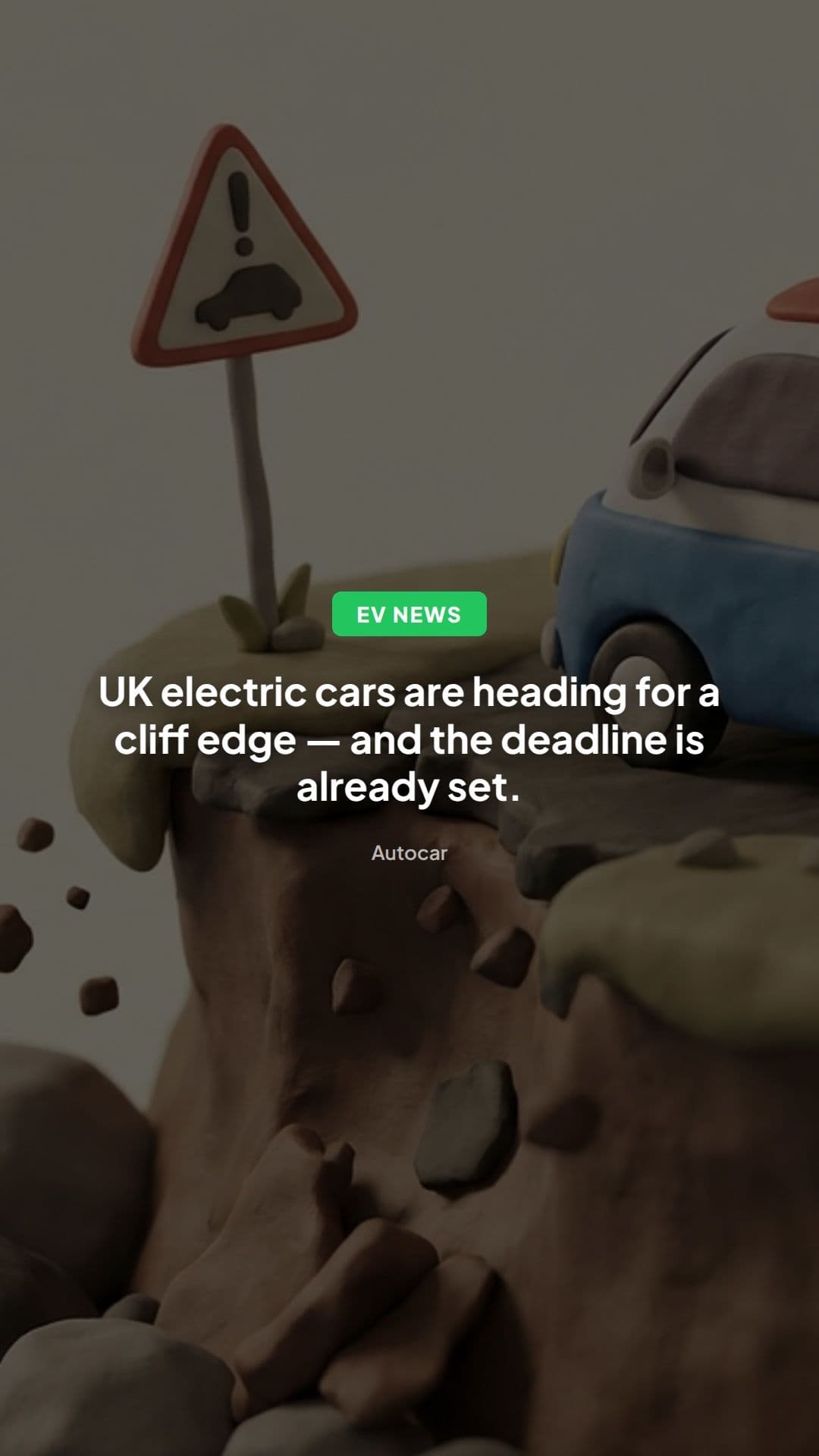
The EV Tariff Cliff Edge: Why Britain's Electric Car Future Hangs in the Balance
Imagine finally taking the plunge on an electric vehicle — doing your research, weighing up the running costs, perhaps even booking a test drive — only to find that by the time you get to the dealership, the price has jumped by thousands of pounds overnight. Not because of inflation, not because of supply shortages, but because of a trade policy deadline that quietly crept up on an industry still finding its feet.
That is the very real scenario facing UK drivers and the broader automotive sector right now, as warnings grow louder about a looming tariff cliff edge that could fundamentally reshape the electric vehicle market in Britain. This isn't scaremongering — it's a structural problem years in the making, and its consequences will be felt by anyone who owns, drives, or is thinking about buying an EV.
What's Actually Happening
Autocar has reported that both industry figures and government sources are sounding the alarm over a critical threat to the UK's EV market: the potential expiry of trade arrangements that have, until now, kept tariffs on electric vehicles manageable.
At the heart of the issue are rules of origin requirements embedded in the UK-EU Trade and Cooperation Agreement (TCA), signed in December 2020. These rules determine whether a vehicle qualifies as sufficiently "British" or "European" to benefit from zero-tariff trade between the UK and EU. For EVs, the critical component is the battery — and the thresholds for how much of that battery must be sourced domestically or from within the trading bloc have been a source of ongoing tension.
Under the TCA, a transitional arrangement was put in place to give manufacturers time to build up domestic battery supply chains. The rules of origin threshold for EV batteries was set to tighten incrementally. From 2024 onwards, the requirement increased — and further tightening remains on the horizon. Car manufacturers that cannot demonstrate compliance face a 10% tariff on vehicles exported between the UK and EU. In practice, that means higher costs which will ultimately be passed on to consumers.
The UK government and industry bodies, including the Society of Motor Manufacturers and Traders (SMMT), have been lobbying hard for flexibility. But with global trade already unsettled — not least by ongoing uncertainty around US tariff policy — the pressure on the UK's EV supply chain has never been more acute.
Why This Matters More Than You Might Think
To understand why this is such a significant problem, you need to appreciate just how globally distributed EV manufacturing actually is. Unlike a conventional petrol engine, which might be assembled predominantly in one country, an electric vehicle's value is concentrated in its battery pack — and those battery cells are overwhelmingly produced in China, South Korea, and Japan.
Britain does not yet have the gigafactory capacity to manufacture batteries at scale domestically. The Envision AESC plant in Sunderland, attached to the Nissan operation, is one of the few meaningful examples of UK battery production, but it remains a fraction of what would be needed to satisfy rules of origin requirements across the industry.
This creates a painful paradox: the UK government wants more people to drive EVs, has set ambitious targets under the Zero Emission Vehicle (ZEV) Mandate requiring manufacturers to hit specific EV sales percentages each year, and yet the trade architecture surrounding those vehicles could make them substantially more expensive to produce and sell.
If tariffs bite, manufacturers face a stark choice: absorb the cost (reducing margins on vehicles already sold at thin profit), pass it to consumers (making EVs less competitive against petrol and diesel alternatives), or redirect vehicles away from the UK market altogether in favour of markets where they face lower trade friction.
None of those outcomes is good for drivers.
The Legal and Regulatory Framework
The ZEV Mandate, introduced under the Zero Emission Vehicles, Infrastructure and Charge Points (ZEV) Act 2023 and associated regulations, places a legal obligation on manufacturers to ensure a rising percentage of their new car sales are zero-emission. In 2024, the target was 22% of sales; it rises annually towards 80% by 2030 and 100% by 2035.
Manufacturers that fail to meet their ZEV targets face financial penalties — currently set at £15,000 per non-compliant vehicle. This creates a regulatory bind: manufacturers must sell EVs to avoid fines, but if tariffs make those EVs more expensive to produce and import, the economics become increasingly difficult.
There is also the question of international trade law. The UK-EU TCA is a binding international agreement. Unilaterally waiving rules of origin requirements would require renegotiation with Brussels — a politically sensitive exercise given the broader state of UK-EU relations. Meanwhile, any changes to tariff schedules affecting imports from outside the EU (for example, on Chinese-made EVs or battery components) are governed by UK Global Tariff schedules and World Trade Organisation (WTO) commitments.
The UK has so far resisted following the EU and US in imposing punitive tariffs on Chinese EVs — the EU levied additional duties of up to 35.3% on Chinese-made electric cars in late 2024 — but that restraint itself creates complications, as it may affect the UK's negotiating position in future trade talks.
What Drivers Should Know Right Now
If you're in the market for an EV, or thinking about making the switch, here's what this situation means in practical terms:
- Buy sooner rather than later if you've already decided. If tariff pressures increase, manufacturers are likely to raise prices. The current window — while trade arrangements remain in relative flux — may represent better value than what comes next.
- Check whether your chosen vehicle qualifies for the UK EV grant. The plug-in car grant currently offers up to £3,750 off eligible new EVs priced under £35,000. Not all vehicles qualify, and the eligibility criteria include requirements around where the vehicle is manufactured. Changes to trade policy could affect which models remain on the market at grant-eligible price points.
- Be aware of the ZEV Mandate's effect on manufacturer behaviour. Because manufacturers must hit EV sales targets or face fines, some are offering significant discounts and incentives to move electric vehicles. This is partly why new EV prices have been falling. That dynamic may shift if tariff costs rise.
- Consider the total cost of ownership, not just the sticker price. Even if upfront costs rise, EVs typically offer lower running costs — cheaper to fuel, lower servicing costs, and (until 2025 at least) favourable Vehicle Excise Duty treatment. From April 2025, EVs became subject to standard VED rates, so factor that into your calculations.
- If you're a fleet operator, the tariff situation is particularly important. Fleet procurement decisions are made months or years in advance. Building in contingency for potential price increases on specific models — particularly those manufactured outside the UK and EU — is prudent risk management.
Looking Ahead: What Happens Next
The UK government is in an uncomfortable position. It needs EV adoption to accelerate to meet its climate commitments and ZEV Mandate obligations. It needs the automotive sector — still a significant employer, particularly in the Midlands and North East — to remain viable. And it needs to navigate trade relationships with the EU, the US, and China simultaneously, each of which pulls in a different direction.
The most likely near-term outcome is continued lobbying for a further extension or relaxation of rules of origin thresholds under the TCA, combined with efforts to accelerate domestic battery manufacturing investment. The government has committed funding to support gigafactory development, but building industrial capacity takes years, not months.
There is also growing pressure for a UK-EU automotive reset as part of broader diplomatic normalisation. The automotive industry on both sides of the Channel has a shared interest in avoiding tariff disruption, and that alignment may ultimately provide the political leverage needed to reach a workable arrangement.
For drivers, the honest message is this: the EV transition remains the direction of travel, and the long-term trajectory of costs is still downward as technology matures and supply chains develop. But the road between here and there is bumpier than the government's optimistic projections suggest. The tariff cliff edge is real, the timeline is tight, and the consequences of getting this wrong will be measured in higher prices, reduced choice, and a slower transition away from fossil fuels than anyone wants.
Keeping a close eye on trade negotiations over the coming months isn't just for policy wonks — it's increasingly relevant to anyone standing on a forecourt deciding whether to go electric.
Written by
James Wilson
Legal Counsel
Ready to Challenge Your Ticket?
Let our AI analyse your PCN and generate a professional appeal letter in minutes.
Start Free Appeal