UK EV sales target may be cut: what it means for drivers
UK ministers reportedly plan to weaken the 2030 EV sales target to 50–70%. We explain the ZEV mandate, fines, and what changes could mean for UK drivers.

David Chen
1 July 2026
UK Electric Car Sales Target Set to Be Weakened: What It Really Means for Drivers
The government is reportedly preparing to water down one of the most significant motoring policies of the decade. If the reports are accurate, Britain's electric vehicle revolution is about to hit a speed bump — and the ripple effects will be felt by every driver on UK roads, whether they're already behind the wheel of an EV or still weighing up the switch from petrol.
What's Actually Happening?
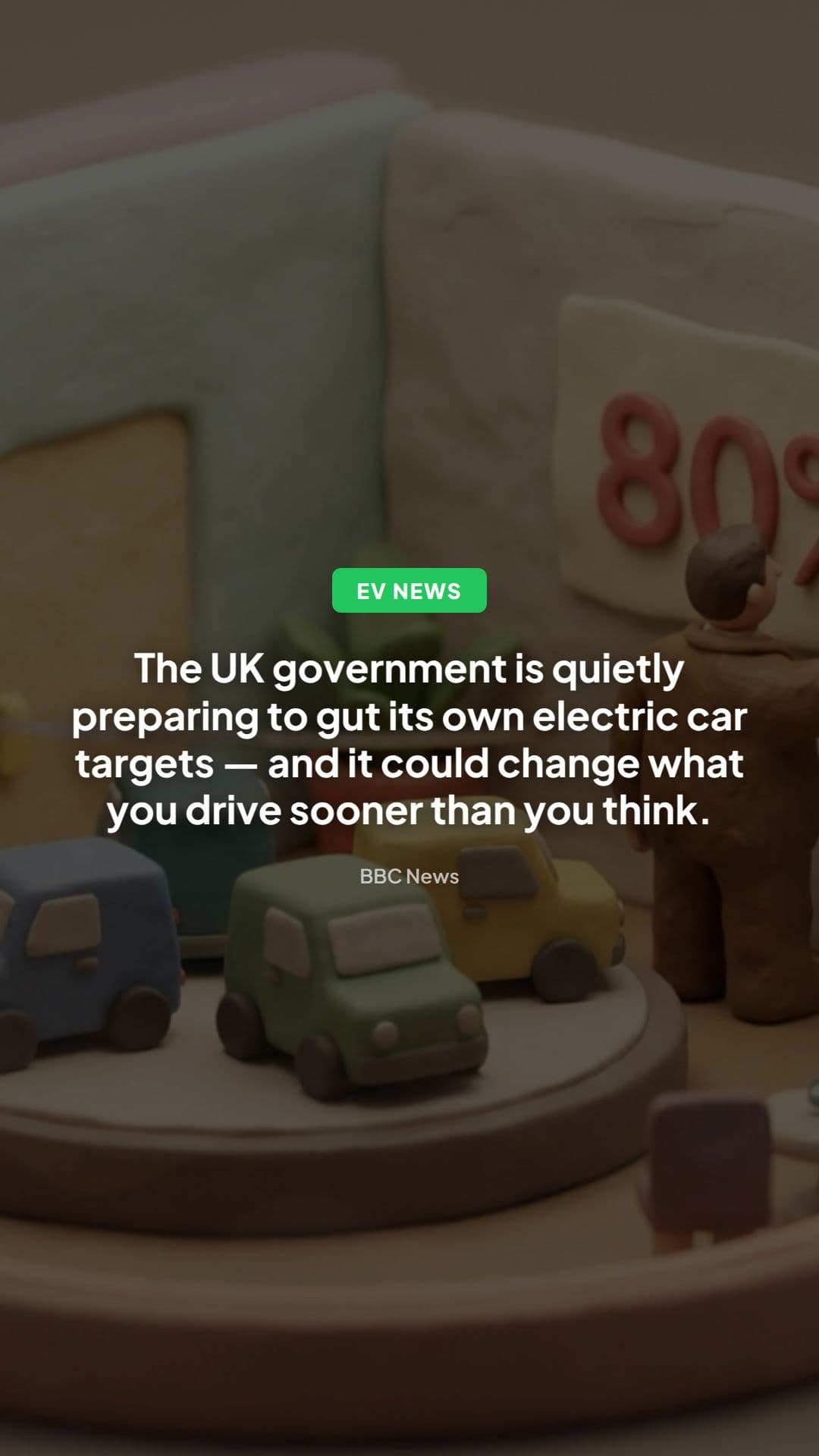
According to reporting by BBC News, the UK government is preparing to lower its 2030 electric vehicle sales target from the current 80% threshold down to somewhere between 50% and 70%. That's a meaningful retreat from what was already considered an ambitious — some would say aggressive — commitment.
The target in question sits within the Zero Emission Vehicle (ZEV) mandate, a regulatory framework that requires car manufacturers to hit escalating percentages of electric vehicle sales each year. Under the current rules, 80% of new cars sold in the UK must be zero-emission by 2030, rising to 100% by 2035.
Crucially, the structure of the mandate — including its annual percentage increases and the financial penalties for manufacturers who fail to comply — is reportedly set to remain in place. What's changing is the headline ambition: that 80% figure looks set to be revised downward.
This isn't a complete U-turn. It's more of a recalibration. But the distinction matters enormously, both for the industry and for the millions of drivers trying to plan their next vehicle purchase.
Why Is This Happening Now?
To understand the significance of this move, it helps to know how we got here.
The ZEV mandate was introduced under the Automated and Electric Vehicles Act 2018 and subsequently strengthened through secondary legislation. It was designed to give manufacturers a clear, legally binding roadmap for the transition away from internal combustion engines. The theory was sound: give industry certainty, and investment in EV infrastructure and production would follow.
The reality has been messier. Several major manufacturers — including Ford, Stellantis, and Volkswagen — have publicly warned that the 80% target is unachievable given current consumer demand. UK EV sales have been growing, but not at the pace the mandate demands. In 2024, electric vehicles accounted for around 18% of new car registrations. Closing the gap to 80% in just six years was always going to require extraordinary market conditions.
Industry lobbying has been intense. The Society of Motor Manufacturers and Traders (SMMT) has repeatedly called for the target to be reviewed, arguing that without changes, manufacturers face a stark choice: sell EVs at a loss to hit quotas, or pay significant penalties. Those penalties — currently set at £15,000 per non-compliant vehicle — are not trivial.
There's also a consumer dimension. Charging infrastructure, particularly outside major cities, remains patchy. Range anxiety persists. And upfront purchase costs, despite falling, still put many EVs beyond the reach of average buyers. The government appears to have concluded that the policy was running ahead of the market.
The Legal Framework: What the ZEV Mandate Actually Requires
It's worth being precise about what the ZEV mandate is and isn't.
The mandate operates through The Zero Emission Vehicles (ZEV) Mandate Regulations, which set binding annual targets for manufacturers. These targets apply at the manufacturer level, not the dealership or consumer level. So the legal obligation falls on Ford, Toyota, BMW, and so on — not on you as a driver.
Manufacturers can trade credits between themselves. If Tesla, for example, sells a higher proportion of EVs than required, it can sell surplus credits to manufacturers who are falling short. This trading mechanism was modelled partly on similar systems in California and the EU, and it provides some flexibility within the overall framework.
The penalties for non-compliance are set out in the regulations and enforced by the Driver and Vehicle Licensing Agency (DVLA) and the Department for Transport (DfT). A manufacturer that misses its annual target faces a fine per vehicle it falls short by. With tens of thousands of vehicles at stake, the cumulative exposure runs into hundreds of millions of pounds — which is precisely why manufacturers have been lobbying so hard.
What the reported change would do is reduce the 2030 target percentage, which would in turn reduce the number of EVs manufacturers need to sell to avoid penalties. The annual escalation structure reportedly stays in place, meaning the trajectory towards 100% by 2035 remains the destination — just with a slightly less steep climb in the near term.
What Drivers Should Know: Practical Takeaways
If you're a driver trying to make sense of all this, here's what actually matters to you:
1. The 2035 petrol and diesel ban isn't changing (yet) The headline commitment — that new petrol and diesel cars will not be sold after 2035 — has not been reported as part of this revision. If you're planning to buy a new petrol car in the next few years, that remains your legal right. But the clock is ticking, and resale values for petrol cars are likely to shift as the deadline approaches.
2. EV prices may not fall as fast as hoped One argument for keeping the 80% target was that it would force manufacturers to produce more affordable EVs to hit volume. With a softer target, that competitive pressure eases slightly. Drivers hoping for a rapid drop in EV purchase prices may need to be patient.
3. The used EV market remains your friend Regardless of what happens to new car targets, the used EV market continues to grow. Prices for second-hand electric vehicles have fallen significantly, and for many drivers, a used EV now represents a genuinely competitive option against an equivalent petrol or diesel car.
4. Charging infrastructure investment shouldn't slow The government has separate commitments around public charging infrastructure under the Electric Vehicle (Smart Charge Points) Regulations 2021 and the broader EV infrastructure strategy. These are not directly tied to the ZEV mandate targets, so the rollout of rapid chargers should continue regardless of the target revision.
5. Company car drivers should pay attention If you drive a company car, your employer's fleet decisions are influenced by Benefit in Kind (BIK) tax rates, which currently make EVs significantly cheaper than petrol equivalents. Those rates are set independently of the ZEV mandate and remain highly favourable for EVs through to 2028. The tax incentive to go electric hasn't changed.
Looking Ahead: What This Really Signals
The reported weakening of the 2030 target is, in many ways, an acknowledgement of reality. Policy ambition has to be grounded in what the market can actually deliver — and right now, the gap between the mandate's demands and consumer behaviour is significant.
But there's a risk in reading this purely as good news for drivers who want to stick with petrol. The underlying direction of travel is unchanged. The 2035 ban on new petrol and diesel sales remains on the statute book. Manufacturers are still investing heavily in EV platforms. And the financial case for electric motoring — particularly for higher-mileage drivers — continues to strengthen as energy costs shift.
What the revision does do is buy time. Time for infrastructure to catch up. Time for prices to fall further. Time for consumers to build confidence in the technology. Whether that time is used wisely — by government, industry, and drivers alike — will determine whether Britain's EV transition is remembered as a smooth evolution or a chaotic lurch.
For now, the message to drivers is simple: the direction is set, even if the pace has been adjusted. Plan accordingly.
Source: BBC News — "UK electric car sales target set to be weakened"
Written by
David Chen
Consumer Rights Expert
Ready to Challenge Your Ticket?
Let our AI analyse your PCN and generate a professional appeal letter in minutes.
Start Free Appeal