UK EV sales surge: could inflation and energy bills stall?
UK battery-electric car sales rose nearly 60% in April 2026, passing 2m EVs on the road. But Iran war-linked inflation and energy prices may slow growth.

Oliver Johansson
6 May 2026
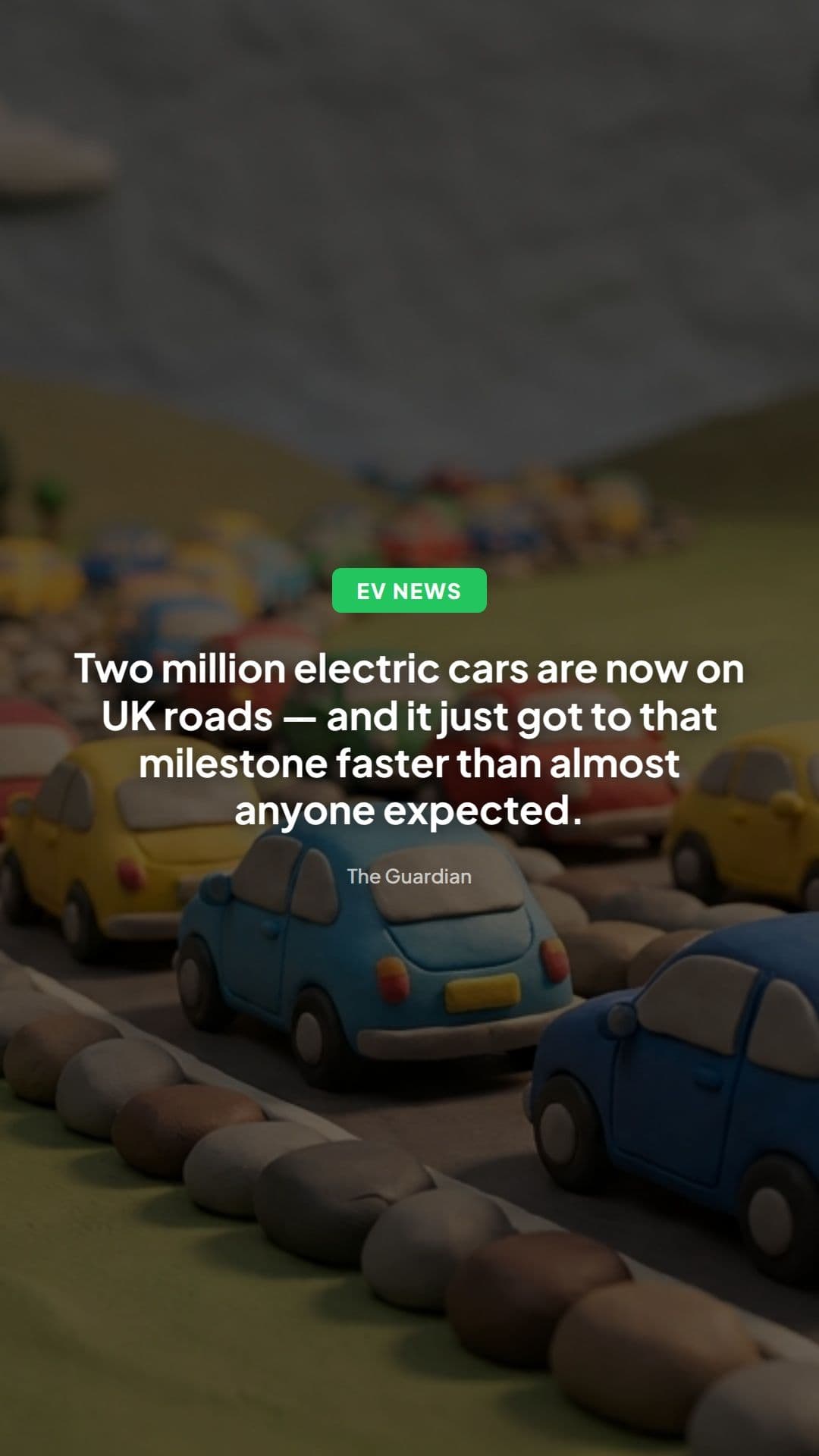
UK Electric Car Sales Hit Two Million — But Can the Momentum Last?
Battery-electric registrations surged nearly 60% in a single month. That's the good news. The bad news is arriving from the Middle East.
There is a particular kind of optimism that surrounds electric vehicle adoption in Britain — the sense that, after years of false dawns and range anxiety, the tipping point has finally, irreversibly arrived. April 2026 appeared to confirm it. Battery-electric vehicle (BEV) registrations jumped by almost 60% compared with the same month the previous year, pushing total UK EV registrations past the symbolic two-million mark for the first time, according to figures from the Society of Motor Manufacturers and Traders (SMMT).
Two million electric cars on British roads. It sounds like a triumph. And in many ways, it genuinely is.
But the same week those figures landed, oil markets were rattling, energy bills were creeping upward again, and the spectre of wider conflict in the Middle East was casting a long shadow over the global economy. The question is no longer simply whether Britain can go electric. It is whether the financial conditions that make it attractive to do so will survive long enough for the transition to become irreversible.
What Happened: A Record Month With a Warning Attached
The SMMT data, reported by The Guardian, shows BEV registrations leaping by nearly 60% in April 2026 — a striking acceleration that pushed cumulative UK EV registrations beyond two million vehicles. To put that in context, it took the UK roughly a decade to register its first million electric cars. The second million arrived considerably faster, reflecting falling purchase prices, an expanding charging network, and growing consumer confidence.
Yet the SMMT and industry analysts were quick to attach a significant caveat. Escalating geopolitical tensions — particularly the conflict involving Iran — are feeding inflationary pressures across global energy markets. Wholesale gas prices have spiked. Oil markets remain volatile. And for a country that still generates a meaningful proportion of its electricity from gas-fired power stations, that volatility does not stay neatly contained in the petrol forecourt. It bleeds into electricity bills too.
The concern, in plain terms, is this: if the cost of charging an EV at home rises sharply, and if the purchase price of new electric vehicles climbs because of supply-chain inflation affecting battery components and raw materials, then the economic case that has been driving adoption could weaken — potentially significantly.
Why It Matters: The Fragile Economics of Going Electric
Understanding why this moment is so consequential requires stepping back from the headline figures and looking at what has actually been driving EV uptake in Britain over the past 18 months.
A combination of factors has been at work. The Zero Emission Vehicle (ZEV) mandate — introduced under the Automotive Sector Deal and given statutory force through the Zero Emission Vehicles, Infrastructure and Charging Act 2023 — requires manufacturers to ensure that a rising percentage of their new car sales are zero-emission. By 2024, the target was 22%, climbing to 28% in 2025 and beyond. Manufacturers facing potential fines for missing these targets have responded by cutting EV prices aggressively, offering substantial discounts and finance deals that have made electric cars genuinely competitive with their petrol equivalents for the first time.
At the same time, the UK EV Grant scheme — administered through Innovate UK and currently offering up to £3,750 off qualifying vehicles — has kept entry-level electric cars within reach of buyers who would otherwise be priced out. Models such as the Renault Scenic E-Tech and the Fiat 600e have benefited directly.
Add to that the growing disparity between petrol prices and home electricity tariffs — particularly for drivers on overnight EV-specific tariffs such as Octopus Energy's Intelligent Octopus Go — and the financial argument for switching has become increasingly compelling for many households.
The risk now is that several of these pillars could weaken simultaneously. Energy price rises driven by Middle East instability would increase the cost of home charging, eroding one of the EV's primary selling points over petrol. Supply-chain inflation — particularly affecting lithium, cobalt, and nickel, all of which are sensitive to geopolitical disruption — could push battery costs back up, forcing manufacturers to raise prices or withdraw discount programmes. And if broader inflation rises, the Bank of England may hold interest rates higher for longer, making finance deals more expensive precisely when buyers need them most.
The Legal Angle: What the ZEV Mandate Means for Drivers
It is worth understanding how the regulatory framework shapes the market, because it directly affects what choices are available to you as a buyer — and at what price.
The Zero Emission Vehicles, Infrastructure and Charging Act 2023 is the cornerstone piece of legislation here. It enshrines in law the government's commitment to phasing out new petrol and diesel car sales by 2035, and it creates binding annual targets for manufacturers. Crucially, it also contains provisions to support public charging infrastructure, placing duties on local authorities and highway authorities to consider EV charging needs in planning decisions.
Under the Energy Act 2023, large fuel retailers are required to provide public EV charging at motorway service areas and certain A-road locations — a measure designed to address the so-called "charging desert" problem that has deterred many potential buyers.
For consumers, the Consumer Rights Act 2015 remains relevant: if you purchase an EV and it fails to perform as described — whether in terms of range, charging capability, or software functionality — you have the same statutory rights as with any other significant purchase. The rise of over-the-air software updates and subscription-based features in modern EVs has created new grey areas here that consumer law has not yet fully addressed.
One area to watch is the VAT differential on public charging. Currently, electricity supplied through public charge points attracts 20% VAT, while domestic electricity — used for home charging — attracts just 5%. HMRC has faced legal pressure to equalise this rate, and the disparity has been widely criticised as penalising drivers without off-street parking, who disproportionately rely on public infrastructure. If energy prices rise further, this inequality becomes even more acute.
What Drivers Should Know: Practical Steps in an Uncertain Market
If you are considering buying an electric vehicle in 2026, the current uncertainty does not mean you should wait indefinitely — but it does mean you should go in with clear eyes. Here is what to consider:
- Lock in a tariff now. If you already own an EV or are about to purchase one, investigate overnight charging tariffs immediately. Rates such as Octopus Intelligent Go (currently around 7–9p per kWh overnight) represent exceptional value. These tariffs can be fixed or variable — understand which you are signing up for.
- Check ZEV mandate pricing. Because manufacturers must hit their EV sales targets or face fines of £15,000 per vehicle, many are still offering significant discounts and cashback deals. This pressure does not disappear overnight, even if inflation rises — use it to your advantage while negotiating.
- Understand your grant eligibility. The UK EV Grant currently applies to vehicles costing under £35,000. Check the Innovate UK eligibility list before you buy, and confirm with the dealer that the grant will be applied at point of sale, not retrospectively.
- Consider a used EV. The used EV market has expanded substantially, with prices having softened considerably from their 2022 peaks. A two- or three-year-old BEV can represent excellent value, though always check the battery health report before purchasing.
- Factor in charging infrastructure at home. If you have off-street parking, investigate the EV chargepoint grant (up to £350 towards a home charger installation), available through the Office for Zero Emission Vehicles (OZEV). Without a home charger, your running costs will be significantly higher.
- Read the finance small print. With interest rates still elevated, PCP and HP deals on EVs can look attractive in headline terms but carry significant total cost. Use the FCA-regulated APR figure, not the monthly payment, as your comparison point.
Looking Ahead: Two Million Cars, and a Crossroads
Two million electric vehicles on British roads is not a footnote — it is a genuine milestone in one of the most significant infrastructure transitions this country has undertaken since the electrification of the railway network. The momentum is real, and the structural forces driving it — legislation, manufacturer targets, falling battery costs — have not disappeared.
But the Guardian's caution is well-founded. History shows that EV adoption is not immune to macroeconomic shocks. The 2022 energy crisis temporarily dampened enthusiasm in several European markets. A sustained period of high energy prices, combined with supply-chain inflation and tightening household budgets, could slow the trajectory meaningfully — even if it is unlikely to reverse it entirely.
The government faces a genuine policy challenge: maintaining the conditions that make EV adoption economically rational for ordinary drivers, even as external pressures bear down on energy markets. That means defending the ZEV mandate against any backsliding, equalising VAT on public charging, and ensuring that grant support reaches the buyers who need it most.
For drivers, the message is straightforward: the window of exceptional EV value may not stay open indefinitely. If the numbers work for you now — and for many drivers, they do — the time to act is before the geopolitical weather worsens further.
Two million down. The next two million will be the real test of whether Britain's electric revolution can survive the storms ahead.
Written by
Oliver Johansson
Traffic Management Consultant
Ready to Challenge Your Ticket?
Let our AI analyse your PCN and generate a professional appeal letter in minutes.
Start Free Appeal