UK EV interest surges as petrol prices rise: what next?
Petrol price spikes are driving a surge in UK electric car searches and enquiries. We unpack the data, costs and key buying factors for motorists.

Isabella Romano
2 May 2026
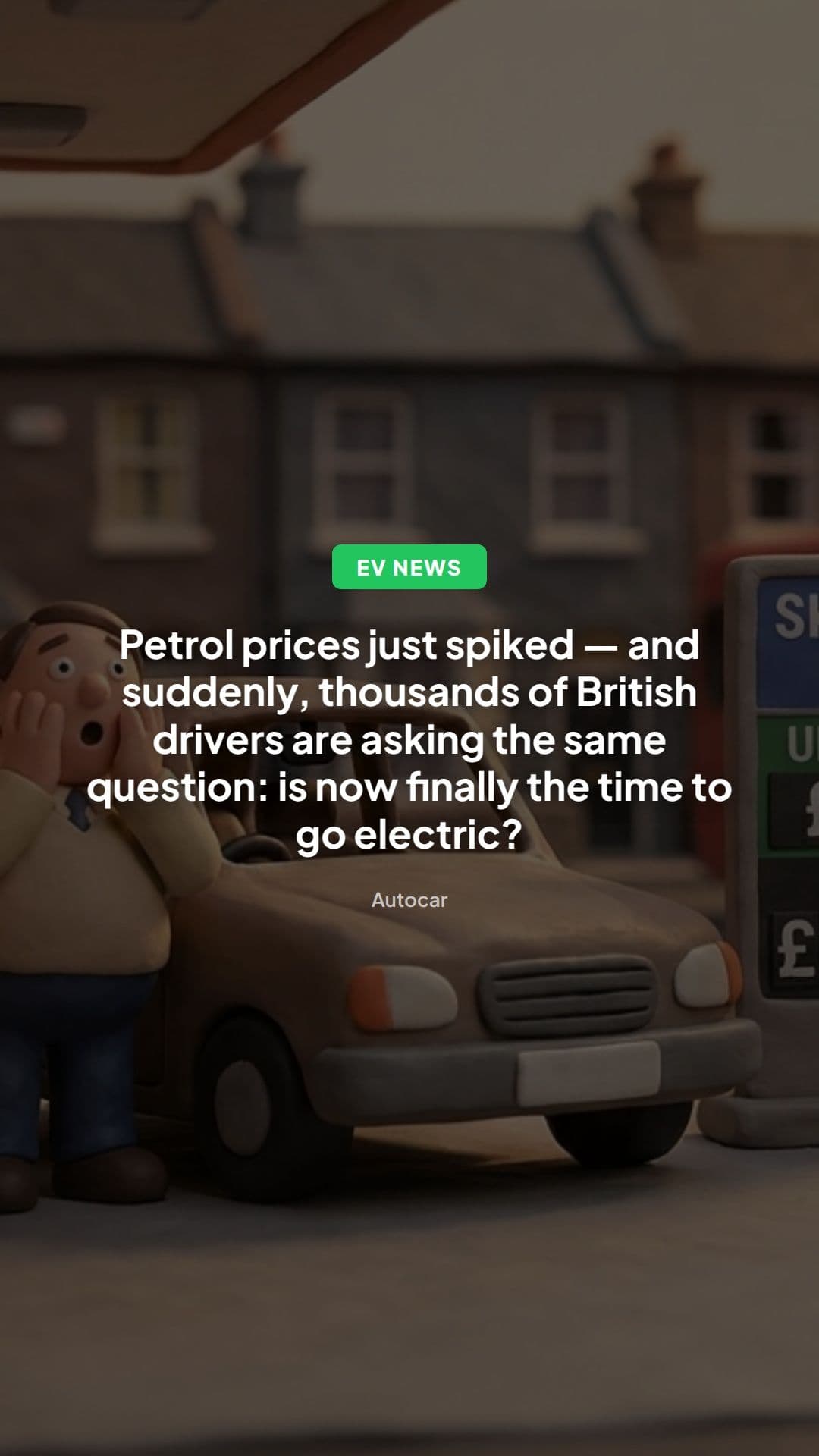
Fuel Price Surge Sparks EV Revolution: What UK Drivers Need to Know Before Making the Switch
Reading time: approximately 7 minutes
Imagine standing at a petrol station forecourt, watching the numbers on the pump spin faster than your patience allows, and quietly wondering whether you've filled up for the last time. For thousands of British drivers, that moment is becoming less hypothetical and more of a genuine turning point.
According to a recent report from Autocar, interest in electric vehicles has surged sharply in the wake of the latest spike in UK petrol and diesel prices. Search volumes are up, dealership enquiries are climbing, and the conversation around EVs has shifted — almost overnight — from "eventually, maybe" to "actually, let's look into this properly." The question is: what does this surge really mean, and what do drivers need to understand before they act on it?
What Happened: The Fuel Price Spike That Changed the Conversation
The UK has experienced a notable and uncomfortable rise in pump prices over recent months. Petrol and diesel costs have climbed sharply, driven by a combination of global oil market volatility, geopolitical tensions, and the ongoing ripple effects of post-pandemic supply chain disruption. For many households already stretched by the cost of living, the forecourt has become one of the most visible and painful pressure points in the weekly budget.
The Autocar report documents a clear and measurable response: online searches for electric cars have spiked, dealerships are fielding more enquiries, and comparison tools and EV-focused websites are reporting record traffic. Drivers who had previously filed EVs under "something to think about in a few years" are now actively researching models, charging infrastructure, and running costs.
This is not the first time fuel price rises have nudged drivers towards EVs — similar patterns emerged following the 2022 energy crisis — but the current surge appears more sustained, and crucially, the EV market is now in a far stronger position to meet that demand than it was even two years ago.
Why It Matters: The Bigger Picture Behind the Enquiries
The connection between pump prices and EV interest is not simply emotional. The economics are genuinely compelling, and they are becoming more so.
The average UK driver covers roughly 7,400 miles per year, according to the Department for Transport. At current petrol prices hovering around 135-140p per litre, a typical petrol car achieving 40 miles per gallon costs in the region of £1,200–£1,400 annually just in fuel. A comparable EV, charged primarily at home on a standard overnight tariff, can cover the same distance for as little as £300–£400 per year — and potentially less for drivers on smart energy tariffs who charge during off-peak hours.
That is a saving of roughly £800–£1,000 every year, before you factor in the elimination of road tax (though this changed in April 2026 — more on that shortly), reduced servicing costs thanks to fewer moving parts, and the growing availability of cheaper used EVs on the market.
There is also a broader societal shift underway. The UK's Zero Emission Vehicle (ZEV) mandate, introduced under the Automated and Electric Vehicles Act 2018 and strengthened through subsequent regulation, requires that 22% of new car sales by manufacturers must be zero-emission in 2024, rising to 80% by 2030 and 100% by 2035. This means manufacturers are legally obligated to push EVs into the market, which in turn is driving competition, reducing prices, and expanding choice. The timing of this fuel price spike coincides with a market that is, for the first time, genuinely ready for mainstream adoption.
The Legal Angle: Rights, Regulations, and What Drivers Should Understand
The surge in EV interest brings with it a set of legal and regulatory considerations that many prospective buyers overlook entirely.
Vehicle Excise Duty (VED) changes in April 2026 represent one of the most significant shifts for EV owners. Until recently, pure battery electric vehicles were exempt from road tax — a meaningful financial incentive. From April 2026, however, newly registered EVs are subject to the standard annual VED rate, and those with a list price exceeding £40,000 attract the additional luxury car supplement of £620 per year for five years. This is not a reason to avoid EVs, but it is a cost that prospective buyers must now factor into their calculations honestly.
Consumer protection law is also worth understanding when purchasing an EV. Under the Consumer Rights Act 2015, any vehicle sold must be of satisfactory quality, fit for purpose, and as described. This applies whether you are buying new from a franchised dealer or used from a private seller. Battery health is a particular concern with used EVs — a battery degraded to 70% of its original capacity could reasonably be argued to fall below satisfactory quality if it was not disclosed at the point of sale.
The Automated and Electric Vehicles Act 2018 also established a framework for EV charging infrastructure, placing duties on charge point operators and setting minimum standards. The government's Public Charge Point Regulations 2023 went further, mandating that rapid charge points on motorways and A-roads must have a 99% reliability rate and must offer contactless payment — no more being forced to download yet another app just to charge your car. Drivers who encounter non-compliant charge points have grounds to complain formally to the Office for Zero Emission Vehicles (OZEV) and the charge point operator.
On the subject of grants, the UK EV grant scheme has been restructured. The plug-in car grant for private buyers has ended, but grants remain available for small vans, motorcycles, taxis, and wheelchair-accessible vehicles. Buyers should check the current OZEV guidance directly, as eligibility criteria and amounts are subject to change.
What Drivers Should Know: Practical Advice Before You Take the Plunge
If rising fuel costs have pushed you from curious to genuinely interested, here is what you should know before committing.
Do your real-world range homework. Manufacturer range figures are based on standardised WLTP testing conditions. In practice, cold weather, motorway driving, and use of heating or air conditioning can reduce range by 20–30%. If your daily commute is 60 miles and the EV you're considering claims 200 miles of range, you're probably fine — but don't assume the headline figure reflects your actual driving pattern.
Home charging is where the economics really work. Public rapid charging, while improving, remains significantly more expensive than home charging. If you have access to off-street parking and can install a 7kW home wallbox (installation typically costs £800–£1,200, with some employer and local authority schemes partially subsidising this), you will recoup that cost within a year or two through fuel savings.
Check your lease or finance agreement carefully. Many drivers are now considering EVs through PCP or lease arrangements. Be aware of mileage caps, battery health clauses, and early termination penalties. The Financial Conduct Authority (FCA) regulates motor finance, and you have rights under the Consumer Credit Act 1974 if your agreement contains unfair terms or if the vehicle does not perform as represented.
Consider the used EV market. The combination of rising new EV supply and consumer hesitancy has created a genuine buyer's market in used EVs. Models that cost £35,000 new two years ago are now available for £18,000–£22,000. Request a battery health report from the dealer — reputable sellers will provide this — and check the vehicle's service history and any outstanding recalls via the DVLA.
Be realistic about your charging infrastructure. Before buying, map out the charge points near your home, workplace, and regular routes using tools like Zap-Map. Check whether your local authority has any planned street charging installations if you park on-road — the government's EV Infrastructure Strategy commits to 300,000 public charge points by 2030.
Looking Ahead: A Tipping Point, Not Just a Trend
What Autocar's report captures is something more significant than a temporary spike in web searches. It reflects a genuine and accelerating shift in driver psychology — the moment when the financial argument for EVs becomes impossible to ignore, even for those who had previously been sceptical.
The UK's EV infrastructure, while still imperfect, has improved dramatically. There are now over 70,000 public charge points across the country, with rapid and ultra-rapid charging becoming increasingly common on major routes. The choice of models available — from affordable city cars to family SUVs and commercial vans — is broader than it has ever been.
The ZEV mandate ensures that manufacturers will continue to prioritise and expand their electric ranges, and competitive pressure is already driving prices down. For drivers currently wincing at the pump, the question is no longer really whether to go electric — it is when, and how to do it sensibly.
The fuel price spike has not created the EV revolution. But it may well have accelerated it by several years. And for drivers who do their homework, understand their rights, and approach the transition with clear eyes, the timing might just be perfect.
Sources: Autocar, Department for Transport, OZEV, Consumer Rights Act 2015, Automated and Electric Vehicles Act 2018, Public Charge Point Regulations 2023, Vehicle Excise Duty (Amendment) Regulations 2025.
Written by
Isabella Romano
Civil Enforcement Officer
Ready to Challenge Your Ticket?
Let our AI analyse your PCN and generate a professional appeal letter in minutes.
Start Free Appeal