UK car sales surge in May as Chinese EV brands rise
UK new-car registrations hit a post-Covid high in May, led by rapid EV growth. Chinese makers and Tesla gained share as the market shifts in 2026.

Lisa Rodriguez
6 June 2026
UK Car Sales Hit Post-Covid High: What the EV Surge Really Means for British Drivers
The showroom floors are buzzing again. May 2026 has delivered the strongest new-car registration figures the UK has seen since before the pandemic ground everything to a halt — and the headline numbers alone tell only half the story. Beneath the glossy sales data lies a fundamental reshaping of Britain's automotive landscape, one that touches everything from how you charge your car to which brands you'll see dominating the roads in five years' time. And yes, there's a very real chance that the next car parked next to you at the supermarket will have been designed and built in China.
So what's actually happening, why does it matter, and what should you — the British driver — know before your next trip to a dealership?
What Happened: Britain's Biggest Month for New Cars Since Before Covid
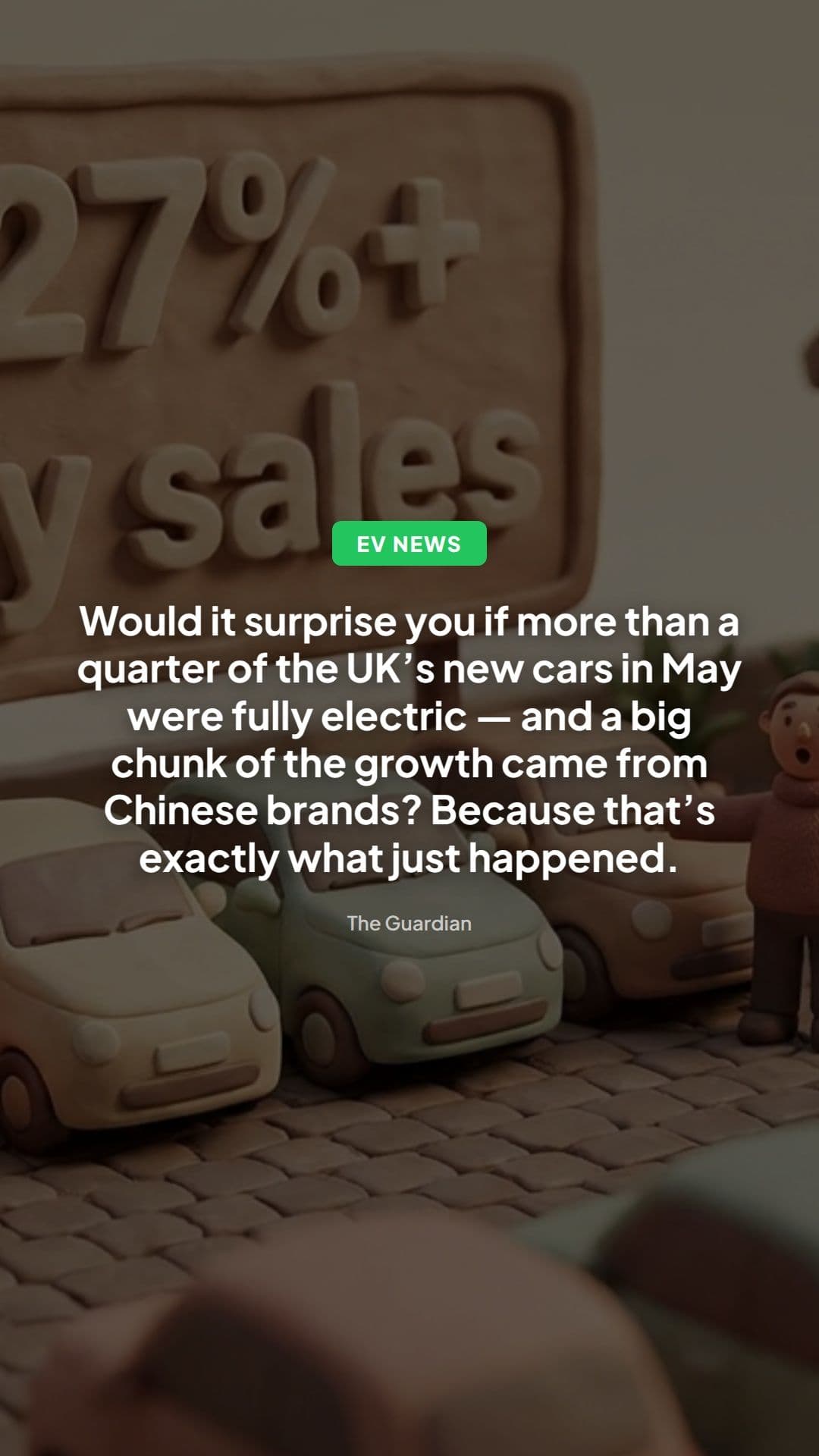
According to reporting by The Guardian, UK new-car registrations for May 2026 reached their strongest level since before the pandemic. The recovery has been building for some time, but May's figures represent something of a watershed moment — confirmation that the market has not merely recovered, but is actively transforming.
Two forces are driving this surge simultaneously. First, battery-electric vehicle (BEV) registrations jumped sharply, continuing a trend that has been accelerating throughout 2025 and into 2026. Second — and this is where it gets genuinely fascinating — Chinese EV manufacturers are no longer a curiosity or a footnote. They are gaining meaningful ground in the British market, alongside a resurgent Tesla.
Brands such as BYD, MG (now Chinese-owned under SAIC), and newer entrants like Chery and Omoda are registering real sales numbers, not just concept-show appearances. For context, BYD sold more EVs globally in 2025 than Tesla — and that competitive pressure is now arriving on British shores in earnest.
Why It Matters: The Bigger Picture Behind the Numbers
To understand why this moment is significant, it helps to zoom out a little.
The UK government's Zero Emission Vehicle (ZEV) Mandate, which came into force in 2024, legally requires manufacturers to ensure that a rising percentage of their new car sales are zero-emission. In 2026, that target sits at 22% of total sales. Manufacturers who miss the target face fines of £15,000 per non-compliant vehicle — a penalty serious enough to reshape entire product strategies.
This regulatory pressure is one reason why BEV registrations are climbing so steeply. Manufacturers are actively incentivising electric purchases — through discounts, enhanced finance deals, and fleet-focused promotions — because the alternative is a crippling fine.
Chinese manufacturers, crucially, arrive in this market with a structural advantage. Because they have built their entire domestic industry around EVs from the ground up, they don't carry the legacy costs of converting petrol and diesel production lines. Their cost base is lower, their battery supply chains are more mature, and they can often price aggressively while still turning a profit.
For British consumers, this translates into something rather welcome: more affordable electric cars. A BYD Dolphin, for instance, competes directly with a Volkswagen ID.3 or a Vauxhall Astra Electric — but frequently undercuts them on price. When a brand-new EV can be had for under £25,000, the calculus for buyers changes significantly.
The Legal Angle: Regulations Shaping Every Purchase Decision
The legal framework surrounding this EV surge is more complex than most buyers realise, and it has direct implications for what you can and can't do once you've driven off the forecourt.
The ZEV Mandate and Consumer Knock-On Effects
Under the Automated and Electric Vehicles Act 2018 and subsequent ZEV Mandate regulations, the government has created a compliance ecosystem that shapes manufacturer behaviour. When a manufacturer over-achieves on EV sales, they can bank or trade those credits — effectively creating a carbon-credit market within the automotive sector. This is why you'll sometimes see surprising discount offers: a manufacturer may be buying compliance headroom for a weaker quarter.
Import Tariffs and Chinese EVs
Here's a legal wrinkle that doesn't get enough attention. The European Union introduced substantial tariffs on Chinese-made EVs in late 2024 — up to 35.3% on top of existing 10% duties for some manufacturers — after concluding that Chinese state subsidies were distorting competition. The UK, post-Brexit, operates its own tariff schedule independently.
Currently, the UK's standard import duty on cars is 6.5%, and the government has not matched the EU's punitive tariff regime on Chinese EVs. This means British consumers are, right now, accessing Chinese EVs at meaningfully lower prices than their European counterparts. Whether this remains the case is a live political and trade question — and one that could change the affordability picture dramatically if UK-China trade relations shift.
Type Approval and Safety Standards
All vehicles sold in the UK must hold valid GB Type Approval (or recognition of equivalent approval) under the Road Vehicles (Approval) Regulations 2020. Chinese manufacturers selling here must meet the same crash-test, emissions, and electrical safety standards as any European or Japanese brand. The DVSA enforces compliance, and vehicles that don't meet standards cannot legally be registered. So while the "are Chinese cars safe?" question is understandable, the regulatory answer is clear: if it's on sale here, it has passed the same tests as everything else.
What Drivers Should Know: Practical Advice for Navigating the New Market
If you're in the market for a new car — or simply trying to make sense of what's happening — here's what actually matters:
1. Check ZEV Grant Eligibility Before You Buy The UK's EV grant scheme (administered by Ozev) provides up to £3,750 off qualifying vehicles priced under £35,000. Not every EV qualifies — the vehicle must be on the approved list, and the discount is applied at point of sale by the dealer. Chinese brands including BYD and MG have models on the approved list, making the grant accessible across a wider range of buyers than ever before.
2. Verify Charging Infrastructure Compatibility Most new EVs sold in the UK now use the CCS (Combined Charging System) standard or, increasingly, Tesla's NACS connector. Before purchasing, confirm what connector your prospective vehicle uses and whether your home charger and preferred public networks are compatible. This is especially relevant with newer Chinese entrants, where after-sales support networks are still maturing in the UK.
3. Understand Your Consumer Rights on New EVs Under the Consumer Rights Act 2015, any new vehicle must be of satisfactory quality, fit for purpose, and as described. If an EV develops a fault — including battery degradation beyond what was represented at sale — within the first six months, the burden of proof lies with the retailer to show the fault wasn't present at purchase. After six months, it shifts to you. Keep all documentation, including any range or battery health representations made during the sale process.
4. Don't Assume Warranty Parity Established brands typically offer five to eight-year battery warranties. Newer Chinese entrants vary — some are competitive, others less so. Read the small print on battery capacity guarantees: a warranty that covers "defects" is not the same as one that guarantees the battery will retain at least 70% capacity over eight years.
5. Factor in VED Changes From April 2025, electric vehicles are no longer exempt from Vehicle Excise Duty. New EVs registered from that date pay a first-year rate of £10, then move to the standard rate (currently £195 per year). This is a modest sum compared to the running cost savings of an EV, but it's worth factoring into your total cost of ownership calculation — particularly if you're comparing against a hybrid.
Looking Ahead: What This Surge Tells Us About Britain's Automotive Future
May 2026's record figures are not a blip. They reflect structural forces that are only going to intensify.
The ZEV Mandate ratchets upward annually — reaching 80% by 2030 and 100% by 2035, when the sale of new petrol and diesel cars effectively ends in the UK. That trajectory makes the current Chinese EV surge look like an opening act. As legacy manufacturers scramble to hit compliance targets, and as Chinese brands invest in UK-specific marketing, dealer networks, and after-sales infrastructure, the competitive landscape will look radically different by the end of the decade.
There's also a geopolitical dimension worth watching. If the UK government comes under pressure — from domestic manufacturers, trade unions, or diplomatic channels — to introduce protective tariffs on Chinese EVs, prices could rise quickly. The window of competitive Chinese EV pricing may be narrower than it appears.
For now, though, the British driver finds themselves in an unusually strong position: more choice, more competition, and more affordable electric vehicles than at any point in history. The challenge is navigating that choice wisely — understanding the legal protections available, the regulatory context shaping the market, and the practical realities of EV ownership before signing on the dotted line.
The post-Covid high isn't just a number. It's the starting gun for the most significant transformation British motoring has seen in a century.
Written by
Lisa Rodriguez
Automotive Journalist
Ready to Challenge Your Ticket?
Let our AI analyse your PCN and generate a professional appeal letter in minutes.
Start Free Appeal