TfL Stopped Where Prohibited Appeal: Key Lessons for Drivers
A TfL appeal for stopping where prohibited was refused. Learn why the evidence mattered and what drivers should check before challenging a PCN in London.

The Parking Ticket Pal Editorial Team
9 September 2026
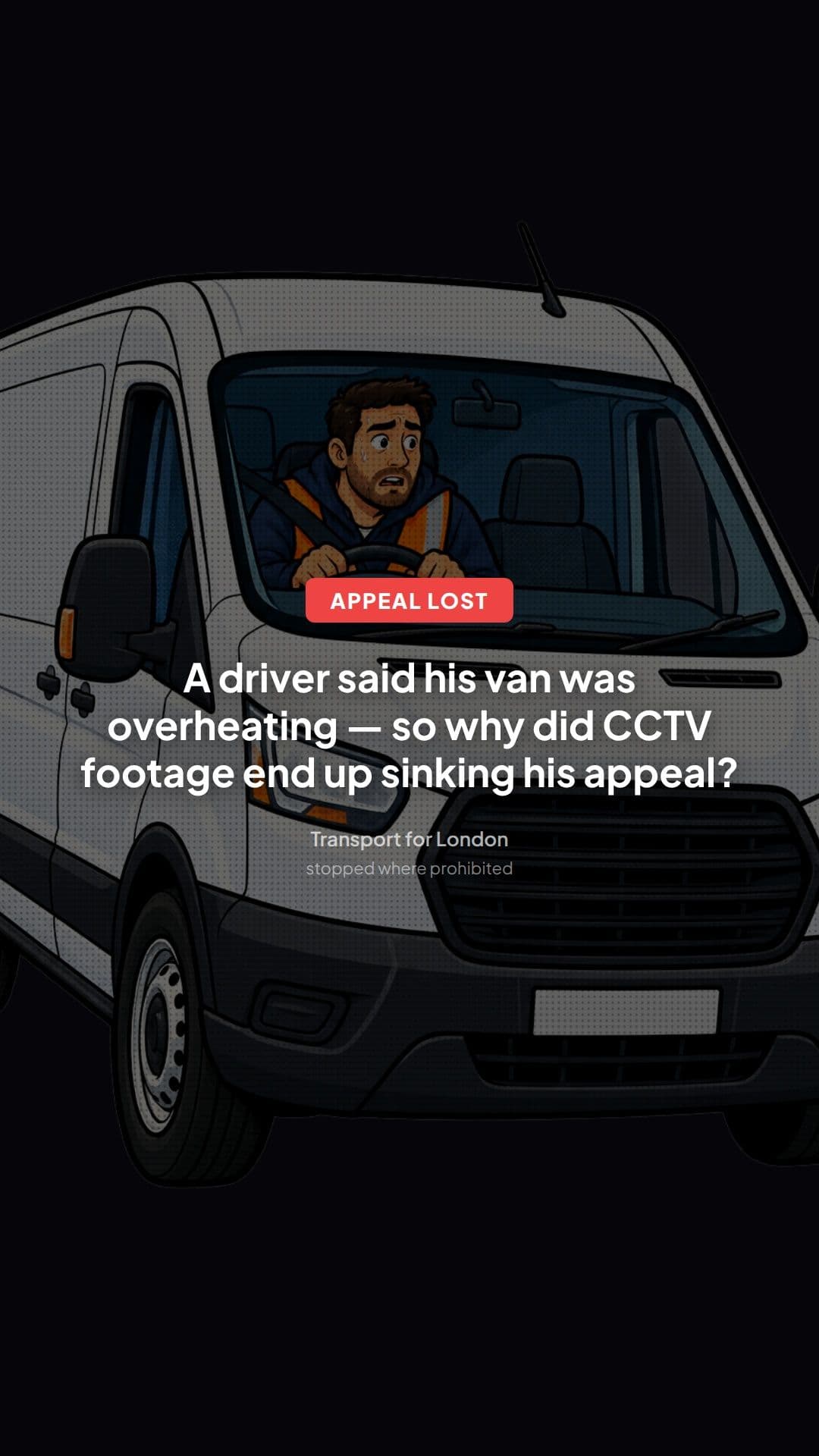
"My Engine Was Overheating": Why This TfL Appeal Broke Down Before It Even Started
Why This Case Matters
Every driver has had that moment of dread: a warning light flashes, the temperature gauge creeps up, or something under the bonnet just doesn't sound right. Common sense says pull over. But what happens when you do exactly that in a spot marked "no stopping", and a camera catches you?
This case, decided by a London tribunal adjudicator against Transport for London, is a useful reminder that having a genuine-sounding excuse isn't the same as proving one. The driver said his van had overheated. The adjudicator didn't believe him, and the appeal was refused. The reasoning behind that refusal tells us a lot about how these cases are actually won and lost.
The Case
The contravention here was "stopped where prohibited", enforced by Transport for London, almost certainly on one of London's red routes. Red routes are among the strictest stretches of road in the country when it comes to stopping. Unlike an ordinary yellow line restriction, many red route rules don't just ban parking, they ban stopping altogether, even briefly, even to drop something off or answer the phone.
The driver appealed his penalty charge notice, explaining that his van had been overheating. He said he pulled over and waited around 15 minutes to let the engine cool down before continuing his journey. On the face of it, that's a reasonably relatable story: vehicles do overheat, and driving on with a dangerously hot engine could cause serious mechanical damage or even become unsafe.
The Arguments
The driver's position was straightforward. He'd stopped not by choice but by necessity. His van was overheating, so he waited a quarter of an hour for it to cool down, then drove off. Implicit in this argument is a defence that tribunals do sometimes accept: that a genuine, unavoidable vehicle fault forced the stop, and that the driver couldn't reasonably have gone elsewhere.
TfL's position, by contrast, rested on the CCTV footage that had captured the stop in the first place. The recording didn't show a driver popping the bonnet to release heat, checking fluid levels, or doing anything else consistent with dealing with an overheating engine. It simply showed a van stationary, bonnet down, for around 15 minutes.
The Decision
The adjudicator refused the appeal. In their own words, they found it "curious" that a driver claiming his engine needed to cool down had kept the bonnet firmly shut throughout. There was no supporting evidence of any mechanical fault, and nothing to show any repair had taken place afterwards. Put simply: the adjudicator didn't accept that the breakdown had happened at all, and so found that the contravention had occurred as recorded.
The Legal Reasoning, Unpacked
This case isn't really about red routes or overheating engines. It's about something much more fundamental in parking law: the burden of proof.
When you appeal a penalty charge notice, you're not just telling a story, you're asking an adjudicator to accept your version of events over what the evidence shows. In most tribunal appeals, the driver carries at least some responsibility for backing up their account with evidence, particularly once the authority has produced something like CCTV footage that appears to contradict it.
Here's the key point: an adjudicator doesn't have to disprove your excuse. They just have to not be convinced by it. The driver didn't need to produce a mechanic's report or a smoking radiator to lose this case. He simply needed to fail to persuade the adjudicator that his account was more likely true than not. The CCTV evidence did the heavy lifting for TfL: it directly contradicted the practical detail of the driver's story (that the engine needed to cool, yet the bonnet stayed shut), and once that inconsistency was spotted, the whole account unravelled.
This connects to a well-established principle in vehicle breakdown defences: mechanical failure can be a valid reason for an otherwise prohibited stop, but only where there's credible evidence to support it. Tribunals have accepted breakdown defences before, but usually where there's some combination of a witness account, a garage receipt, a recovery service callout, photos of hazard warning triangles or bonnet-up positioning, or other corroboration. A bare assertion, unsupported and seemingly contradicted by the very evidence meant to help enforce the rule, rarely survives scrutiny.
Lessons for Drivers
1. If your vehicle genuinely breaks down, act like it. Put your hazard lights on, raise the bonnet if it's safe to do so, and if possible, take photos or a short video showing the problem. These small actions do double duty: they signal distress to other road users, and they create the evidence trail you'll need if you're later challenged.
2. Keep any paperwork. A garage receipt, breakdown recovery confirmation, or even a dated text to a colleague or family member saying "my van's overheated, I've had to pull over" can transform a flimsy account into a credible one.
3. CCTV cuts both ways. Councils and TfL rely heavily on camera evidence to catch contraventions, but that same footage can also undermine a driver's account if it doesn't match what's being claimed. Before appealing, think carefully about whether the footage might actually contradict your version of events rather than support it.
4. Genuine emergencies are still a recognised defence, but they need proof. The tribunal system isn't automatically hostile to breakdown claims. Adjudicators regularly allow appeals where there's a credible account of an unavoidable stop. The issue here wasn't the type of defence, it was the total absence of anything beyond the driver's word.
5. Understand what you're up against on red routes. TfL's red route network has some of the tightest stopping restrictions in the country, often with no grace periods and enforcement by camera rather than a warden's discretion. If you're unfamiliar with how these restrictions work, it's worth reading up on the differences between red routes and ordinary parking restrictions before you find yourself needing to make a snap decision.
Key Takeaway
A good excuse without evidence is just a story, and tribunals decide cases on evidence, not sympathy. If you ever have to stop somewhere you shouldn't because of a genuine vehicle problem, your instinct to protect yourself and your vehicle is right, but your very next instinct should be to document what's happening. A photo of a raised bonnet or a hazard warning triangle takes seconds. It could be the difference between a successful appeal and a refused one.
Written by
The Parking Ticket Pal Editorial Team
Source-checked parking guidance
Ready to Challenge Your Ticket?
Let our AI analyse your PCN and generate a professional appeal letter in minutes.
Start Free Appeal