TfL Red Route PCN Appeal Refused: Key Lessons for Drivers
A TfL red route PCN appeal was refused after a driver stopped where restrictions applied. Learn which evidence, signs and exemptions could affect your case.

Priya Sharma
5 August 2026
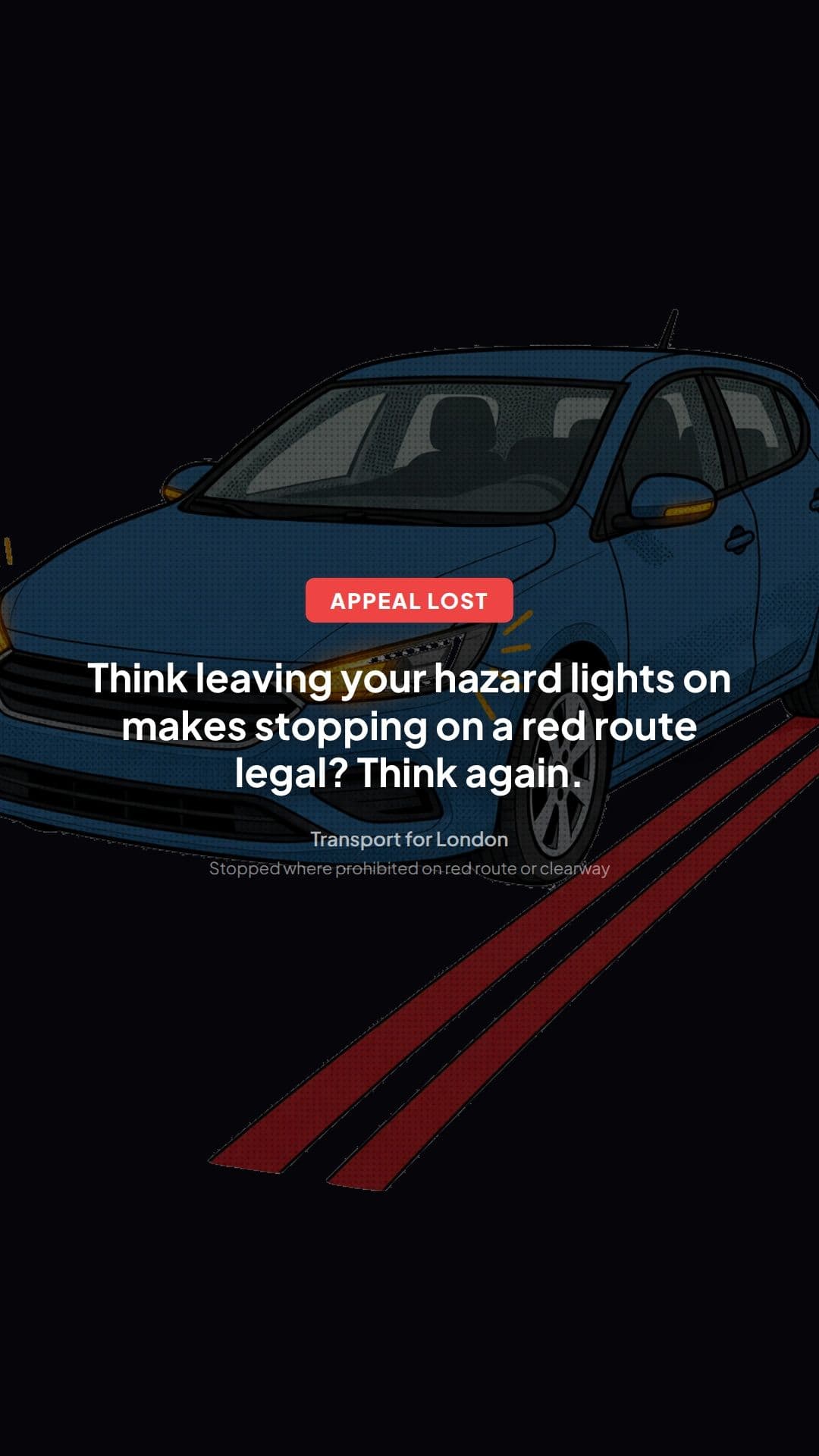
When "I Was Only Popping In" Isn't Enough: The Red Route Case That Cost a Driver Dear
Why This Case Matters
Picture this: you pull up outside a shop you've visited a hundred times before, hazards flashing, planning to dash in and grab something quickly. You've done it before without a problem. Surely that counts for something?
According to a recent Transport for London tribunal decision, it doesn't. Not without proof. This case is a sharp reminder that in the world of parking enforcement, your personal history with a location means nothing if you can't back up your story with evidence on the day. It's a lesson every driver who relies on "quick stops" needs to understand, especially on London's red routes, where the rules are stricter and less forgiving than ordinary parking restrictions.
The Case: A Six-Minute Wait on London Road
The basic facts are straightforward. On 8 June 2022, a driver stopped their vehicle on London Road, a red route where stopping is heavily restricted. Transport for London issued a penalty charge notice (PCN) for "stopped where prohibited on red route or clearway."
TfL's evidence came from CCTV footage, which is the backbone of most red route enforcement cases. The footage showed the vehicle parked with its hazard lights on for around six minutes before the driver returned. Crucially, the driver appeared to be on his phone during this time, and at no point did the footage show any loading or unloading taking place.
This detail matters enormously. At this particular location, loading was permitted between 10am and 4pm, for a maximum of 20 minutes. So there was a legitimate window for a driver to stop briefly to load or unload goods. The problem for this driver was that nothing in the footage suggested that's what was happening.
The Arguments: Habit Versus Hard Evidence
The driver's defence was simple and, frankly, understandable from a human point of view. He explained that he always stopped at this location to collect his shopping and had never had any issues before. In other words: this is routine, this is normal, and nothing was different this time.
TfL's case rested entirely on what the CCTV actually showed, not what the driver said he usually did. Their argument was that the footage was the objective record of what happened on that specific day, and it showed no loading or unloading activity at all. The vehicle sat with hazards on, engine presumably off, driver absent and then apparently distracted on his phone once he returned. Nothing about that sequence pointed to legitimate loading.
The Decision: Appeal Refused
The adjudicator sided firmly with TfL. The appeal was refused, and the reasoning was clear: the authority had established, on the evidence available, that no permitted activity had taken place during the stop.
The adjudicator acknowledged that loading was allowed at that spot within certain hours and time limits. But allowing loading isn't the same as allowing any stop a driver wants to make. The activity has to actually be loading. Since the CCTV showed no goods being moved, no boxes carried, no visible unloading of shopping, there was nothing to support the claim that this fell within the permitted exception.
The Legal Reasoning, Decoded
This case hinges on a distinction that trips up a lot of drivers: the difference between a permitted purpose and a permitted presence.
Red routes exist to keep traffic moving on some of London's busiest roads. Stopping is generally prohibited, but there are carved-out exceptions, most commonly for loading and unloading, often restricted to specific hours and a maximum duration. This case involved exactly that kind of exception: a 10am to 4pm window with a strict 20-minute cap.
However, an exception to a rule only applies if you're actually doing the thing the exception covers. Simply pulling over legally within the time window doesn't automatically make your stop lawful. You need to be genuinely loading or unloading goods for the exception to protect you. The moment you're just sitting in the car, waiting, or nipping off to do something unrelated (like shopping that doesn't involve carrying goods to or from the vehicle), you've stepped outside the exception, even if you're within the permitted hours and under the time limit.
This is where CCTV becomes so powerful in these cases. Adjudicators aren't required to take a driver's word for what was happening. They look at what the footage actually depicts. Here, the footage showed a stationary vehicle, an absent driver, and a return to the car followed by phone use, with no visible movement of goods at any point. That's a pattern far more consistent with a personal stop than a loading stop.
The driver's argument that he'd done this before without issue carries no legal weight in this context. Adjudicators assess the specific contravention on the specific day, based on the specific evidence. A history of getting away with something isn't evidence that the behaviour was compliant. It might just mean it hadn't been caught, or observed closely, before.
Lessons for Drivers
This case offers several practical takeaways for anyone who regularly stops on red routes, clearways, or similar restricted roads:
Understand what "loading" actually means. It's not a general licence to stop for any errand. It specifically means the physical activity of loading or unloading goods into or out of your vehicle. Quickly running into a shop to buy something, without visibly carrying items back to the car, is unlikely to satisfy this test if challenged.
Time limits and hours are only half the story. Even if you stop within the permitted window and stay under the time cap, that alone won't save you if there's no genuine loading activity taking place. Both elements need to be true together.
Assume you're being watched. Red routes are among the most heavily monitored roads in London, precisely because keeping them clear is a priority. CCTV coverage is common, and it's usually the primary evidence used in enforcement decisions. If you wouldn't want an adjudicator watching your stop back, don't make it.
"I've done this before" isn't a defence. Adjudicators judge each case on its own evidence. A track record of stopping somewhere without penalty proves nothing about the legality of any single stop, especially the one that's now being disputed.
If you are genuinely loading, make it obvious and be ready to prove it. If you find yourself contesting a similar PCN, evidence of what you were doing matters far more than an explanation of your usual habits. If you're navigating a challenge like this, it's worth reading up on how to use unclear signage or evidence gaps as part of a formal appeal, and considering official guidance from the Traffic Penalty Tribunal or independent advice if the financial stakes are significant.
The Key Takeaway
On a red route, the burden isn't on the council to guess what you were doing, it's on you to show you were doing something the rules actually permit, and CCTV footage that shows six empty minutes with no goods in sight will almost always beat a claim that "this is just what I always do here."
Written by
Priya Sharma
Legal Aid Coordinator
Ready to Challenge Your Ticket?
Let our AI analyse your PCN and generate a professional appeal letter in minutes.
Start Free Appeal